



Use Wozber and land your dream job
Create Resume
No registration required
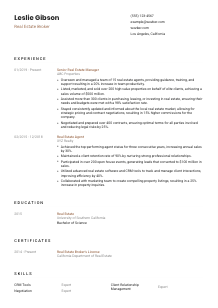
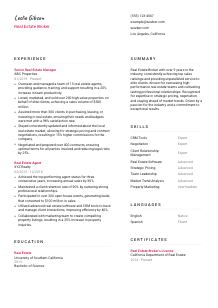
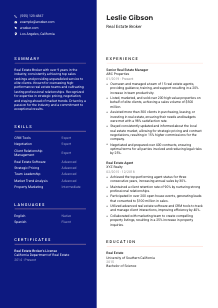
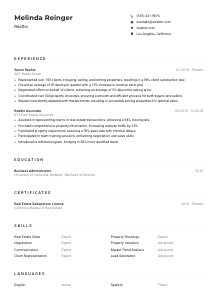
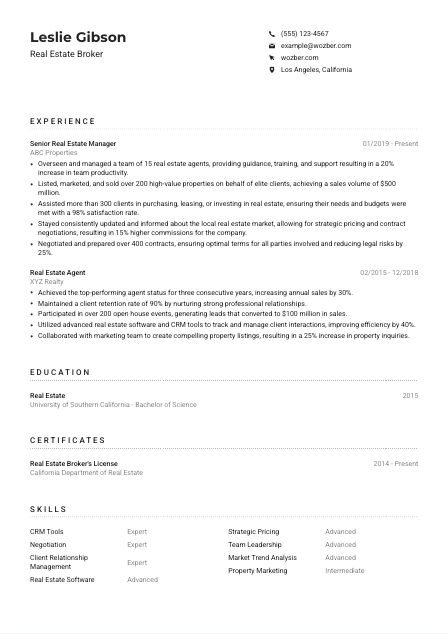
Sealing property deals, but your resume isn't closing the gap? Check out this Real Estate Broker resume example, created with Wozber free resume builder. It shows how to highlight your charismatic salesmanship and market expertise to match job requirements, making sure your career trajectory is as prime as the listings you represent!
Real estate brokers are trusted with revenue, risk, and reputation all at once. Hiring teams look for more than sales ability. They want proof that you can lead agents, price property accurately, negotiate clean contracts, and guide clients through purchases, leases, or investment decisions without losing momentum or compliance.
The fastest way to show that range is to tailor your resume around brokerage work, transaction volume, team oversight, and local market knowledge. Wozber's free resume builder helps you shape that experience into an ATS-compliant resume that uses the right real estate terminology, so hiring teams can quickly see whether you can run deals, support agents, and perform in the market they serve.
In real estate, basic contact information does more than identify you. It tells an employer whether you are easy to reach, active in the market, and already positioned for the territory and license requirements attached to the role. Keep this section clean, accurate, and immediately relevant.
Use your full name as the most visible line at the top of the page. Brokers often work through referrals, listings, and reputation, so your resume should present your name clearly and professionally without extra labels or clutter.
Place "Real Estate Broker" directly beneath your name when that matches your active credential and target role. This instantly aligns your profile with the position and avoids confusion with adjacent titles such as agent, realtor, or sales manager.
Include a reliable phone number and a professional email address, ideally in a simple format such as firstname.lastname. If a hiring manager wants to discuss listing production, contract oversight, or team leadership, there should be no friction in reaching you.
Broker roles are often tied to state licensing and local market knowledge, so location can carry real weight. For this opening, listing "Los Angeles, California" immediately supports the employer's stated requirement and signals that you are already operating in the market.
Add a website or professional profile if it supports your candidacy with useful business context, such as transaction history, brokerage branding, client testimonials, or market-facing content. Skip links that do not strengthen your case as a broker who can win listings or manage client relationships.
This section should answer three questions at a glance: who you are, what role you do, and how to contact you in the right market. If those details are accurate and easy to scan, the rest of the resume can do the selling.




For a broker, experience is where hiring teams look for operating range. They want to see whether you have led agents, moved inventory, advised buyers or investors, negotiated terms, and handled the pace and detail that come with active transactions. Write this section around business results and brokerage responsibilities, not generic job summaries.
Start by marking the responsibilities that define the role. In this case, the employer wants team management, property listing and sales activity, client guidance across buying, leasing, and investing, local market awareness, and contract negotiation. Those themes should show up clearly in your bullet points using language that matches your actual work.
List your positions in reverse chronological order with title, company name, and dates. That structure helps a hiring manager quickly trace your path from agent-level production into brokerage leadership or broader transaction responsibility.
Each role should show what changed because of your work. Instead of saying you managed agents or sold homes, show scope and results. The sample resume does this well with details like leading 15 agents, lifting team productivity by 20%, and serving more than 300 clients across purchase, lease, and investment activity.
Transaction count, sales volume, commission growth, client satisfaction, contract volume, lead conversion, and team performance all give useful context in real estate. A bullet such as selling 200 properties for $500 million or negotiating 400 contracts says far more than a vague claim about being results-driven.
Prioritize achievements tied to listings, negotiations, CRM usage, pricing strategy, agent support, compliance, and client relationship management. The example's mention of improved efficiency through CRM tools is relevant because the job specifically asks for real estate software and CRM proficiency. Keep the section focused on evidence that translates directly to brokerage performance.
A broker resume should read like a record of deals handled, teams supported, and business produced. When your experience section shows volume, leadership, and transaction judgment, employers can picture you stepping into active brokerage work with minimal ramp-up.
Education will not outweigh brokerage production, but it still matters, especially when a posting names a degree requirement. Present it clearly so the hiring team can confirm the academic background without having to search for it.
If the job asks for a bachelor's degree in Real Estate, Business, or a related field, make that information unmistakable. A degree such as a Bachelor of Science in Real Estate, like the one in the example, fits the requirement immediately and should be written in full.
List the degree, field of study, school, and graduation year. This keeps the section easy to scan and works well in an ATS-friendly resume format, especially when recruiters are checking minimum qualifications first.
If your field of study connects to property, finance, business, or market analysis, keep that connection visible. For brokerage roles, coursework is less important than the degree itself, but a directly related major can still strengthen the overall picture.
Early-career candidates may benefit from including honors, relevant coursework, or real-estate-related extracurriculars. For a broker with several years of sales and transaction history, those extras usually matter less than closed deals, client outcomes, and licensing.
The more established you are in brokerage, the leaner this section can be. Experienced brokers usually need only the essentials because hiring decisions will lean more heavily on production history, market knowledge, and license status.
This section should confirm that you meet the academic requirement and support the rest of your profile without taking space away from transaction experience. Simple, accurate formatting does the job well.
Real estate is a licensed profession, so certifications are not a decorative add-on. They tell an employer whether you can legally operate, represent clients, and supervise work where required. Put the credentials that matter most front and center.
For a Real Estate Broker role, your active broker's license is essential and should appear clearly in this section. Include the official name of the credential and issuing authority. In the example, "Real Estate Broker's License" from the California Department of Real Estate does exactly that.
Keep the section focused on certifications tied to brokerage, compliance, property transactions, negotiation, or specialized segments such as investment or leasing. Avoid padding this area with unrelated training that does not support your day-to-day authority or expertise.
Add the issue date or validity range when relevant so employers can see that your credentials are current. That matters in a regulated field where expired licensing can stop a hire immediately.
If you have recent continuing education or advanced real estate training, include it when it strengthens your profile. Ongoing learning signals that you stay current on legal changes, disclosure standards, market practices, and brokerage operations.
When your credentials are clearly listed, employers do not have to guess whether you are qualified to practice. In brokerage hiring, that clarity removes a major barrier right away.
A broker's skills section should read like a short operating summary of how you win business and manage transactions. Focus on the mix of relationship skills, market judgment, negotiation ability, and software fluency that drives listing activity and client service.
Start with the skills the employer explicitly names, then add closely related strengths you can support elsewhere on the resume. Here, that includes real estate software, CRM tools, communication, and interpersonal ability, along with broker-level capabilities such as strategic pricing and team leadership.
Lead with skills that affect deals directly, such as negotiation, client relationship management, contract handling, market trend analysis, property marketing, and agent coaching. The sample list works because it balances platform knowledge with brokerage judgment and revenue-driving abilities.
Do not turn this into a long inventory. Organize the strongest, most job-relevant skills first so a hiring manager can quickly connect them to your experience bullets. If you use proficiency labels, keep them credible and consistent.
Every skill listed here should connect to how you attract clients, move transactions forward, price intelligently, or support a sales team. If a skill does not help explain broker performance, leave it out.
Real estate runs on trust, clarity, and constant communication. If a posting asks for English proficiency or your market includes multilingual clients, the languages section can strengthen your profile by showing how you build rapport and handle conversations across communities.
When the role calls for strong or highly proficient English, state your level plainly. If English is your native language, say so. That checks an explicit requirement and supports the communication demands of contracts, negotiations, and client advising.
Additional languages can be valuable when working with buyers, sellers, tenants, or investors from different communities. In the example, Spanish is a useful addition because it can broaden client communication in many markets, including Los Angeles.
Describe language ability with terms such as Native, Fluent, Intermediate, or Basic. Clear labels set the right expectation for client meetings, phone calls, and written communication.
If you work in an area with diverse buyer or renter populations, language ability can support lead generation, client service, and referral growth. Mention it when it is relevant to the market, not as a filler detail.
For brokers, language skills can support smoother negotiations, stronger client comfort, and access to more communities. Include them when they contribute to how you generate business or deliver better service.
This section works best when it shows how you communicate with the clients and communities your target market includes. Keep it honest, specific, and tied to real brokerage value.
Your summary should quickly establish your level, market value, and operating strengths. For a Real Estate Broker, that usually means years in the field, transaction or team scope, and the few capabilities that define how you produce results.
Before writing the summary, identify the few priorities the employer cares about most. For this role, that includes brokerage experience, team oversight, client-facing communication, real estate software fluency, and contract negotiation. Your summary should touch the ones you genuinely bring.
Start with a direct statement of your professional standing, such as years in real estate sales or brokerage. The sample summary uses over 9 years in the industry, which immediately gives context for the scale of the candidate's background.
Use the next lines to highlight strengths that are backed up later in the resume, such as leading high-performing agent teams, maintaining strong client satisfaction, managing luxury or high-volume listings, or staying ahead of market trends to price strategically.
Aim for a short paragraph that a hiring manager can absorb in seconds. Three to five lines is enough to frame your value. Focus on production, leadership, negotiation, and market knowledge rather than generic passion statements.
A broker summary should make it clear, quickly, that you know how to lead transactions and support business growth. If the opening lines already sound like someone who can manage clients, contracts, and agents, the rest of the resume has a strong foundation.
A Real Estate Broker resume should make three things easy to understand fast: your license status, your ability to produce and negotiate deals, and your capacity to lead clients or agents through active transactions. When each section points back to those strengths, the document reads like a broker's record, not a generic sales resume.
Use Wozber to build and refine an ATS-compliant resume with language that matches the role, then review it for local relevance, transaction scope, and clean formatting. The finished resume should make an employer confident that you can step into brokerage work, manage risk, and move business forward.




