



Use Wozber and land your dream job
Create Resume
No registration required
Overseeing projects, but your resume feels like an unruly workflow? Check out this Technical Project Manager resume example, created with Wozber free resume builder. Learn how to align your managerial prowess with technology imperatives, propelling your career as smoothly as bug-free code!
Technical Project Managers sit at the point where delivery plans, engineering constraints, budgets, and stakeholder expectations all collide. A resume for this work needs to show more than coordination. It should make your command of scope, risk, timelines, cross-functional execution, and technical delivery visible from the first few lines.
When that alignment is clear, hiring teams can quickly see whether you've run the kinds of programs they need, from Agile delivery cycles to executive status reporting. Wozber's free resume builder helps shape that story into an ATS-compliant resume, so requirements like project ownership, tools, and delivery outcomes are easy to read in both an ATS and a hiring review.
For a Technical Project Manager, the header should answer practical questions fast: who you are, what role you do, how to reach you, and whether you meet any stated location requirement. Keep it clean, professional, and easy to scan so nothing slows down the first review.
Use your full name in a larger, readable font so it stands apart from the rest of the page. Technical Project Management is a stakeholder-facing function, and a polished header sets the same organized tone you'd bring to a kickoff deck, status report, or steering committee update.
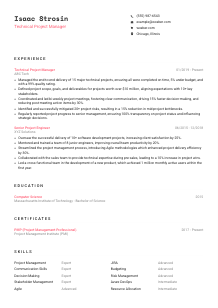
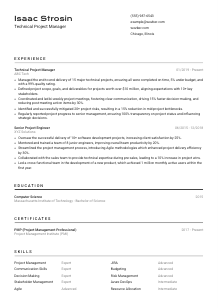
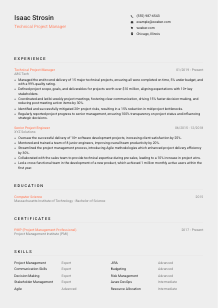
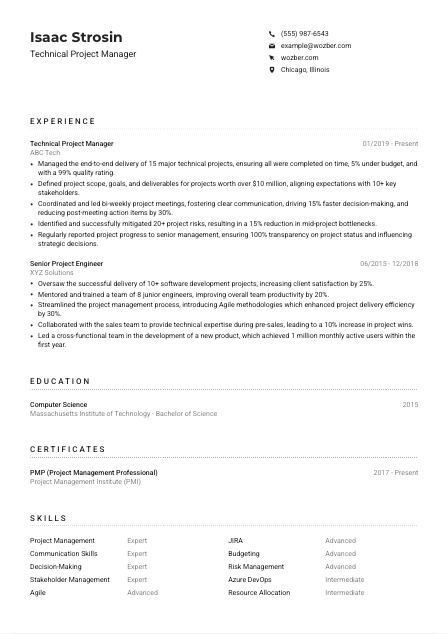
Place "Technical Project Manager" immediately under your name when that is the role you are targeting. This removes any doubt about your direction, especially if your recent titles include adjacent roles such as Project Engineer, Program Manager, or Delivery Lead. In the example, using the exact target title helps connect prior technical delivery work to the opening quickly.
Include a phone number and a professional email address that you check regularly. Avoid cluttering this section with unnecessary labels or personal details. Hiring teams need a fast path to contact you after reviewing project delivery history, certifications, and tool experience, so accuracy matters here.
If a role specifies a location requirement, reflect it clearly in your header. Here, listing "Chicago, Illinois" supports the employer's stated need and helps avoid friction during ATS filtering or recruiter review. If location is not required for another application, keep this detail aligned with that posting rather than treating it as a universal rule.
A LinkedIn profile or personal website can strengthen your header if it reinforces your resume with consistent titles, project scope, certifications, or delivery highlights. For Technical Project Managers, this can be especially useful when your online profile shows cross-functional leadership, Agile practice, or major program outcomes that support the resume narrative.
Your header should confirm the basics without distraction: identity, target role, contact information, and any stated location match. When this section is clean and complete, the reader can move straight to your delivery record.




This is the section that carries the most weight for Technical Project Manager roles. Hiring teams look for delivery scope, project complexity, risk handling, stakeholder management, Agile execution, and results tied to time, budget, quality, or business outcomes.
Start by identifying the operational priorities in the role. For Technical Project Manager openings, that often includes end-to-end delivery, scope definition, cross-functional coordination, risk mitigation, executive reporting, Agile workflows, and tools such as JIRA or Azure DevOps. Use those priorities to decide which parts of your experience deserve the most space and which wording should appear naturally in your bullets.
List your roles starting with the most recent so reviewers see your current delivery scope first. This format works especially well when you've moved from engineering, implementation, or analyst work into formal project ownership. In the example, the move from Senior Project Engineer to Technical Project Manager clearly shows progression from technical execution into broader delivery leadership.
Each bullet should show what you led, what you influenced, and what changed because of your work. For this profession, strong bullets often cover project scope, stakeholder alignment, sprint or release cadence, budgets, issue escalation, and follow-through. The sample does this well by naming concrete responsibilities such as managing end-to-end delivery, defining deliverables, leading recurring project meetings, and reporting progress to senior management.
Metrics matter because Technical Project Managers are often judged by execution quality and predictability. Include numbers tied to budget, delivery volume, project value, quality, risk reduction, timeline improvement, user adoption, or decision speed. Examples from the sample, such as completing 15 major projects on time and 5% under budget or reducing bottlenecks by 15%, show the kind of business-facing proof that makes project leadership credible.
Prioritize experience that proves you can run technical initiatives across teams, tools, and deadlines. Older bullets that focus only on individual contribution, generic coordination, or unrelated technical tasks should be trimmed or reframed unless they support delivery leadership. If the job calls out Agile, JIRA, Azure DevOps, stakeholder communication, or risk management, make sure those themes are easy to find in your most relevant roles.
Your experience section should make it easy to picture you running a technical project from kickoff through delivery, managing tradeoffs, keeping stakeholders aligned, and reporting progress with confidence. If those capabilities are clear in the first few bullets, the rest of the resume works harder for you.
Education usually plays a supporting role in Technical Project Manager hiring, but it still matters when the posting asks for a specific academic background. Present it clearly so reviewers can confirm the degree requirement without digging.
If the job asks for a bachelor's degree in Computer Science, Information Systems, or a related field, make sure that credential is easy to spot. A relevant technical degree helps frame you as someone who can work credibly with engineering teams, technical dependencies, and platform-level discussions.
List degree, field of study, school, and graduation year in a straightforward order. This keeps the section ATS-friendly and easy to review. For Technical Project Manager roles, simplicity is better than over-formatting because the reader usually wants to confirm academic alignment quickly before returning to your delivery history.
Write the full degree name rather than a shortened or vague version. "Bachelor of Science in Computer Science" is stronger than "BS" alone because it directly reflects the technical foundation many employers want. In the example, the MIT computer science degree supports the candidate's credibility in technical delivery environments.
Most experienced Technical Project Managers do not need a long list of classes. Add relevant coursework only if you are earlier in your career or your degree title does not fully show your connection to software delivery, systems work, analytics, or project execution. Courses related to software development, systems analysis, database concepts, or project management can help in those cases.
Honors, capstones, or technical student projects are worth mentioning only when they add something your experience section does not already show. For example, a systems-focused thesis, senior design project, or leadership role in a technical organization can reinforce your foundation if your professional history is still developing.
Education should quickly validate the technical or analytical foundation requested in the posting. Keep it concise, accurate, and easy to verify so attention stays on your project delivery record.
Certifications carry real weight in Technical Project Manager hiring because they signal process discipline, shared terminology, and commitment to professional standards. They are especially useful when the employer names one directly, as with PMP in this posting.
When a posting mentions a certification such as PMP, list it prominently if you hold it. That immediately addresses a preferred or required qualification and strengthens your credibility in governance, scope control, scheduling, stakeholder communication, and delivery oversight.
Focus on credentials that connect to how Technical Project Managers actually run work. PMP, Certified ScrumMaster, SAFe, Agile delivery, or related technical project credentials all help when they match your experience. In the example, PMP and CSM work well together because they support both formal project control and Agile execution.
Show the year earned and, if relevant, the active period or renewal status. This is useful for certifications that require ongoing maintenance and tells the employer your credential is current. Clear dates also help when recruiters need to confirm whether your certification still aligns with compliance or client expectations.
Technical Project Managers often work across shifting delivery models, tooling, and reporting expectations. Continued certification in Agile frameworks, cloud platforms, product delivery, or risk management can strengthen your profile when it aligns with the kinds of systems and teams you manage.
A well-chosen certification section reinforces that you can manage delivery with structure, shared methodology, and current professional standards. When the right credentials are easy to find, they support the credibility of everything else on the page.
A Technical Project Manager skill section should reflect how delivery actually gets done: planning, stakeholder communication, risk control, Agile execution, and the tools used to keep work moving. Generic skill dumping weakens this section. Prioritized, role-specific selection makes it useful.
Read the posting for both explicit tools and implied capabilities. In this case, Agile methodologies, JIRA, Azure DevOps, communication, and cross-functional coordination are directly relevant, while budgeting, risk management, roadmap planning, resource allocation, and decision-making are natural extensions of the responsibilities listed.
Order your skills so the first items match the role's operational demands. A Technical Project Manager applying to a software delivery environment should not bury Agile, stakeholder management, risk management, or project planning underneath unrelated technical knowledge. The example gets this mostly right by surfacing project management, communication, stakeholder management, Agile, JIRA, budgeting, and risk management early.
A useful mix usually includes delivery methods, project controls, software or workflow tools, and collaboration strengths. For example, combining Agile, JIRA, Azure DevOps, budgeting, risk management, communication, and decision-making gives a fuller picture than listing only soft skills or only software names. Keep the list focused on what supports delivery execution in the target role.
Your skills list should echo the way you run projects day to day, from Agile workflows and tracking tools to stakeholder communication and risk handling. If the section reads like the operating toolkit of a Technical Project Manager, it is doing its job.
Language skills are usually secondary for Technical Project Manager roles, but they matter when communication requirements are stated or when projects involve distributed teams, clients, or international delivery partners. Present them clearly and without exaggeration.
If the posting specifies language proficiency, include it exactly and place it first. Here, English is required, so it should appear prominently with an honest proficiency level. Clear communication is central to running meetings, documenting action items, escalating risks, and reporting progress to leadership.
Additional languages are worth listing when they help with vendor coordination, client communication, or collaboration across global teams. They are not mandatory for every Technical Project Manager role, but they can strengthen your profile when the business operates across regions or when engineering teams are distributed.
Choose straightforward levels such as native, fluent, advanced, or intermediate. Avoid inflated claims. For a role built on communication, planning discussions, and executive reporting, language accuracy matters as much as technical accuracy.
If your projects involve offshore development teams, multilingual stakeholders, or international product launches, language skills can add practical value. In those settings, being able to clarify requirements, manage dependencies, and reduce misunderstanding across regions can support delivery performance.
For most applications, a short languages section is enough. List what genuinely helps your candidacy and avoid turning it into a biography. In the example, English satisfies the stated requirement, while Spanish adds useful context for broader collaboration without distracting from the core project management story.
This section should confirm that you can communicate effectively in the languages the role requires and, where relevant, support teams working across regions. Keep it accurate and proportionate to the job.
The summary should quickly position you as a Technical Project Manager who can deliver technical work, coordinate multiple stakeholders, and keep projects moving through complexity. Skip generic personality claims. Use the space to frame your experience level, delivery strengths, and the kind of outcomes you consistently produce.
Look at the posting and identify the few themes that matter most. Here, the essentials are technical project delivery, Agile methods, stakeholder communication, risk management, and reporting to leadership. Those should shape the summary more than broad statements about being motivated or results-driven.
Start with a direct line that states who you are and roughly how long you've been doing this work, such as a Technical Project Manager with 5+ years in software or technical delivery environments. This gives immediate context and helps distinguish you from general project coordinators or purely technical specialists.
Use the middle of the summary to name the capabilities that matter most for the target role. Strong options include managing end-to-end delivery, leading cross-functional teams, driving Agile workflows, controlling budgets, mitigating risk, or reporting project status to senior stakeholders. The example summary works because it emphasizes complex projects, cross-functional leadership, timelines, budgets, and communication.
Aim for a short paragraph of 3 to 5 lines with concrete phrasing. You do not need to repeat every tool or credential here if they already appear elsewhere. The summary should make the reader expect a resume filled with organized delivery experience, measurable project results, and clear leadership across technical teams.
Your summary should quickly establish that you can run technical projects with structure, clarity, and credible business outcomes. When it is tailored well, the rest of the resume reads as proof of that claim.
A Technical Project Manager resume should make delivery scope, execution discipline, and stakeholder leadership easy to find. Before you apply, check that your experience shows project outcomes, your skills reflect the actual operating environment, and your certifications and education support the level of responsibility the role requires.
Use Wozber to tighten the language, align your resume with the posting, and present it in an ATS-friendly resume format that keeps tools, methods, and delivery results readable. The finished document should make one thing clear fast: you can lead technical projects from plan to completion.




