



Use Wozber and land your dream job
Create Resume
No registration required
Leading multifaceted initiatives, but your resume lacks command presence? Check out this Principal Program Manager resume example, created with Wozber free resume builder. Learn how to map your strategic prowess to the job landscape, positioning your career at the helm of success!
Principal Program Manager hiring usually turns on one question fast: have you already led work at a scale where competing priorities, executive expectations, delivery risk, and cross-functional dependencies all had to be managed at once? Your resume needs to make that visible through program scope, governance, stakeholder leadership, and measurable delivery outcomes, not through broad claims about being organized or strategic.
When the resume mirrors the language of the role, hiring teams can quickly separate enterprise program leaders from candidates whose experience is closer to project coordination. Wozber's free resume builder helps you align your wording with the job description, keep the structure ATS-friendly, and surface the terms that matter most, such as program reviews, risk mitigation, and cross-functional leadership. That makes it easier to show that you can run large programs with control and credibility.
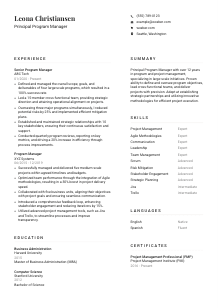
For a Principal Program Manager, the header should read like the top of an executive-facing document: clear, polished, and immediately relevant. Keep it focused on the details a hiring team actually needs to contact you, place you, and understand the level of role you are pursuing.
Set your name at the top in a clean, readable style so it anchors the page without competing with the content below. Senior program management resumes often pass through recruiters, executives, and panel interviewers, so legibility matters more than decorative formatting.
Place "Principal Program Manager" directly under your name when that is the role you are pursuing. Matching the target title helps frame your background at the right level from the first line and aligns with how the role is labeled in the posting.
Include a reliable phone number and a professional email address, ideally one based on your name. Add your city and state when location matters. In this example, listing Seattle, Washington directly supports a stated requirement, but only include location details that are genuinely relevant to the role you are targeting.
A LinkedIn profile or personal website can reinforce your resume if it shows the same titles, dates, and leadership scope. For senior program roles, this can also provide space for program portfolios, transformation work, or broader leadership context that does not fit neatly into one page.
Do not include age, marital status, photo, or other non-job-related personal details. Principal Program Manager hiring should stay centered on delivery record, leadership range, stakeholder management, and execution discipline.
This section should confirm who you are, what role you are targeting, and whether you meet basic logistics such as location. A clean header helps the reader move quickly to the part that matters most for this level: your program leadership track record.




The experience section carries the most weight for a Principal Program Manager because it shows whether you have led programs with real complexity. Hiring teams look for scope, cadence, risk ownership, stakeholder influence, and delivery results across multiple teams or business functions.
Study the posting for the words that define how the company runs programs. Here, terms such as "large-scale programs," "cross-functional teams," "stakeholders," "program reviews," and "metrics" point to the work the resume needs to foreground. Use those terms where they match your real experience so your background reads in the employer's operating language.
List your positions in reverse chronological order and make the progression visible. For this level, titles such as Program Manager, Senior Program Manager, Director-level PM, or equivalent should show increasing ownership over budget, scope, team leadership, or enterprise impact.
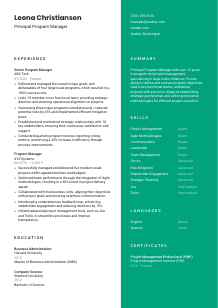
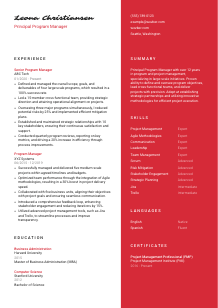
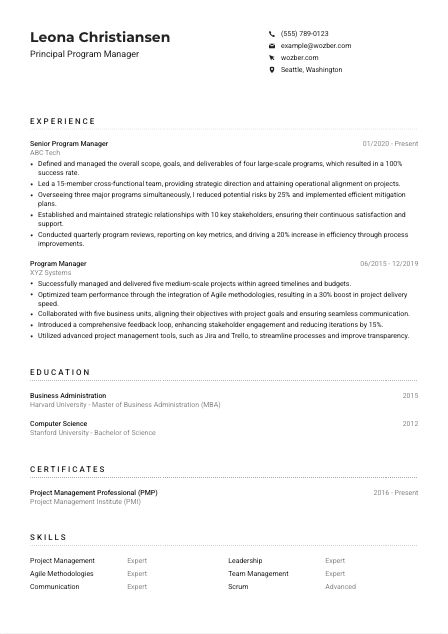
Avoid duty-only bullets like "managed timelines" or "worked with stakeholders." Instead, describe what program you led, what action you took, and what changed. The sample resume does this well with lines like managing four large-scale programs at a 100% success rate and leading a 15-member cross-functional team toward operational alignment.
Use numbers that are natural for program work: number of programs, size of teams, budget range, review cadence, efficiency gains, risk reduction, delivery speed, or stakeholder groups supported. Metrics such as a 25% reduction in risk exposure or a 20% improvement in efficiency help the reader understand the size and effectiveness of your leadership.
At principal level, every bullet should reinforce strategic ownership, execution quality, or business impact. Older or less relevant experience can be shortened if it does not help prove you can define program scope, lead across functions, manage dependencies, and deliver outcomes within constraints.
A Principal Program Manager resume should leave no doubt about the scale of work you have led and the results you delivered. When your bullets show ownership, metrics, and cross-functional influence, the reader can picture you running complex programs from kickoff through review and improvement.
Education will rarely outweigh delivery history for a Principal Program Manager, but it still helps confirm the foundation behind your leadership path. Present it clearly, especially when the posting names degree expectations or preferred academic background.
If the role asks for a Bachelor's degree in Business, Computer Science, or a related field, make that easy to find. When you also hold a relevant Master's degree, place it prominently. In the example, the MBA and Computer Science background align closely with both the business and technical sides of program leadership.
List degree, field of study, school, and graduation year in a consistent format. Hiring teams scanning for minimum qualifications should not have to decode abbreviations or search through extra wording.
Spell out credentials clearly when they add context, such as "Master of Business Administration" or "Bachelor of Science in Computer Science." For program management roles that sit between business strategy and technical execution, that wording can help clarify your range immediately.
Most senior candidates do not need a coursework list, but it can help if you are connecting your education to transformation programs, systems work, operations, or leadership disciplines. Keep it selective and relevant to the role's scope.
Honors, leadership posts, or major capstone projects can stay if they support your narrative and do not crowd out more important experience. For a seasoned program leader, this section should stay concise and complementary.
This section should quickly show that you meet the academic baseline and, where applicable, bring added business or technical depth. Clear degree presentation supports your candidacy without distracting from the program outcomes that will drive the decision.
Certifications matter in program management when they reinforce how you plan, govern, and deliver complex work. They are especially useful when a posting explicitly names a credential or methodology the employer values.
Start with credentials the employer specifically references, such as PMP. When Agile or Scrum experience is requested, list the certifications that directly support that language if you hold them. This makes it easy for the reader to connect your training to the delivery model they use.
Do not bury your strongest credentials under unrelated courses or expired badges. For a Principal Program Manager, recognized program, project, Agile, or governance certifications usually carry the most weight.
Show the year earned and renewal period when relevant, especially for active certifications like PMP. The sample resume handles this cleanly by showing the credential and current date range, which signals that the certification is maintained.
Senior program leaders are expected to keep pace with evolving delivery methods, tooling, and governance practices. If you have recent coursework or certifications in Agile scaling, change management, cloud programs, or portfolio governance, include them when they support the target role.
Relevant certifications tell the hiring team that your program leadership is backed by formal methods as well as experience. Keep the list focused on credentials that support complex delivery, governance, and stakeholder confidence.
The skills section should read like the operating toolkit of a senior program leader. It needs to show how you manage delivery, lead people, handle risk, and work within the methods and systems the employer uses.
Review the posting for a mix of hard and interpersonal requirements. For this role, that includes program management, Agile, Scrum, risk mitigation, communication, leadership, and team management. A balanced list reflects how Principal Program Managers actually work across planning, governance, and stakeholder alignment.
Lead with the capabilities most central to the role, such as large-scale program management, cross-functional leadership, strategic planning, stakeholder engagement, and reporting on metrics. Tools and secondary platform skills can follow after the core leadership and execution areas.
Choose skills you can support elsewhere in the resume through accomplishments, certifications, or summary language. The example works because skills like Agile methodologies, risk mitigation, Jira, and stakeholder engagement connect back to measurable delivery bullets rather than appearing as unsupported claims.
For a Principal Program Manager, the best skills list shows how you lead programs from planning through review, not just which buzzwords you recognize. If the skills section matches your accomplishments, the whole resume reads with more authority.
Language proficiency can matter more for senior program roles than candidates sometimes expect. Clear communication affects executive updates, team alignment, risk escalation, and stakeholder trust, so list languages in a way that supports that reality.
If the posting names a required language, place it first and state your level clearly. Here, English competency is mandatory, so it should be impossible to miss in the languages section.
Use familiar levels such as Native, Fluent, Professional, or Conversational. Senior program roles involve presentations, written updates, and negotiation, so vague labels do not help the reader gauge communication strength.
Extra languages can support global programs, vendor coordination, or collaboration across distributed teams. They are not a substitute for program leadership, but they can strengthen your profile when the organization works across regions or functions.
Do not overstate proficiency. If you can lead meetings, write updates, and handle stakeholder discussions in a language, say so with an appropriate level. If not, use a more modest label.
For Principal Program Managers, language skill is tied to influence as much as fluency. If your work includes executive reporting, cross-regional coordination, or customer-facing program reviews, multilingual ability can become a useful differentiator.
This section should quickly confirm that you can communicate at the level the role requires. For senior program leadership, clear language labeling supports the broader story that you can align teams, brief stakeholders, and manage difficult conversations well.
The summary is where you set the level of the conversation. For a Principal Program Manager, it should establish years of experience, the scale of programs led, and the leadership strengths that match the role before the reader reaches the detailed work history.
Read the posting for the leadership standard being asked for. In this case, the role points to large programs, cross-functional alignment, stakeholder management, risk control, and regular metrics reviews. Your summary should reflect that level of ownership in a few direct lines.
A clear opener such as "Principal Program Manager with 12+ years in program and project management" immediately sets seniority. This works well because it answers one of the first screening questions without wasting space.
Choose two or three strengths that match the role and recur in your work history, such as leading enterprise programs, steering cross-functional teams, improving delivery efficiency, or managing stakeholder relationships. The sample summary succeeds because it links leadership, program oversight, and execution methods in one compact paragraph.
Aim for three to five lines with no filler. The summary should sound like an executive snapshot, not a biography. Every phrase should help the reader understand the scale you have handled, how you lead, and what results tend to follow.
A focused summary helps the hiring team place you quickly in the right tier of candidate. When it reflects years of experience, program scope, and measurable leadership strengths, the rest of the resume has a clear frame to build on.
A Principal Program Manager resume should make your leadership range easy to judge: program scale, cross-functional influence, risk control, stakeholder management, and measurable delivery results. When those elements are clear across your summary, experience, skills, and credentials, you present yourself as someone who can lead large initiatives with structure and accountability.
Use Wozber's AI resume builder to tighten role-specific wording, improve ATS optimization, and organize your content in an ATS-friendly resume format that reflects how senior program work is actually evaluated. The finished resume should make one thing obvious fast: you know how to move complex programs forward.




