




Use Wozber and land your dream job
Create Resume
No registration required
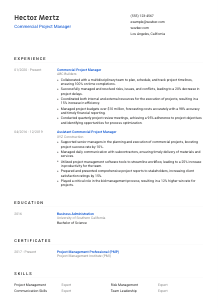
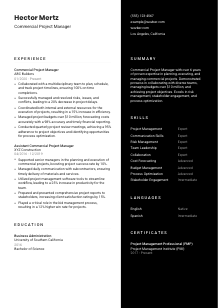
Navigating complex projects, but your resume feels like a maze? Check out this Commercial Project Manager resume example, created with Wozber free resume builder. It shows how to map your managerial prowess to match job milestones, driving your career as strategically and profitably as the projects you oversee!
Commercial project management sits at the intersection of schedule control, budget discipline, and constant coordination between owners, subcontractors, vendors, and internal teams. A resume for this work needs to show that you can keep a project moving when timelines tighten, costs shift, and issues surface across the field and the office.
Hiring teams usually scan first for proof that you have managed comparable project scope, financial reporting, and cross-functional execution, especially in commercial construction settings. Wozber's free resume builder helps you shape that experience into an ATS-compliant resume with the right project language, so your planning, cost forecasting, and risk management work comes through clearly from the first pass.
This section does not need flair. It needs accuracy, professionalism, and the few details that remove avoidable questions early, especially when the employer has stated location or communication requirements.
Use your full name in a larger, clean font so it anchors the top of the page. For a Commercial Project Manager, the header should feel straightforward and businesslike, similar to the tone you would use in a project status report or client update.
Place the role title directly under your name and match the wording of the job ad when it fits your background, in this case "Commercial Project Manager." This helps ATS matching and immediately tells the reader that your experience is aligned with commercial project delivery rather than a broader operations or general management track.
Make it easy for an employer to reach you quickly when they want to move from screening to interview scheduling.
If the posting specifies a location, include your city and state exactly as relevant. Here, listing "Los Angeles, California" directly addresses a stated requirement and helps avoid assumptions about relocation or availability for local project oversight.
Include LinkedIn or a professional site only if it reinforces your candidacy with consistent titles, project history, certifications, or recommendations. For project managers, that profile should support the same story as the resume, including commercial construction experience, software familiarity, and progression in project responsibility.
Your header should answer the practical basics fast: who you are, what role you do, how to contact you, and whether you meet any stated location requirement. That clean start keeps attention on your project record instead of administrative gaps.




For Commercial Project Manager hiring, the experience section carries the most weight. Employers want to see how you handled schedules, budgets, reporting, resource coordination, and project issues in live commercial environments, not just that you held the title.
Before editing bullets, identify the responsibilities that define success in the target role. In this posting, that means planning and tracking timelines, coordinating internal and external resources, managing budgets and forecasts, running review meetings, and resolving risks and conflicts. Those points should shape which projects and accomplishments you emphasize first.
Start with your current or most recent position and work backward. That structure helps hiring teams follow the progression of your project authority, whether you moved from assistant PM work into full commercial project leadership or expanded from supporting bids and subcontractor communication into direct budget and milestone ownership.
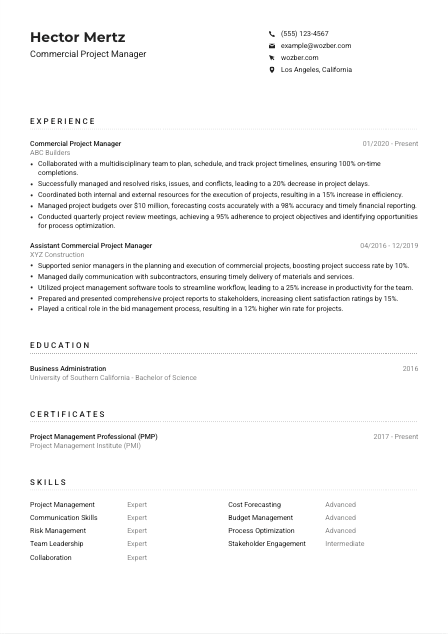
Each bullet should show what you managed, how you did it, and what changed because of your work. Strong Commercial Project Manager bullets often combine a workflow and a result, such as improving on-time delivery, reducing delays, increasing coordination efficiency, or improving reporting accuracy. The example resume does this well with details like managing budgets over $10 million and cutting project delays by 20%.
Numbers make project scope easier to judge. Use figures that belong naturally in this field, such as budget size, cost forecast accuracy, schedule adherence, delay reduction, team productivity gains, or project success rates. Metrics like 98% forecast accuracy or 95% adherence to project objectives tell a hiring manager far more than a generic claim about strong project oversight.
Prioritize experience that relates to commercial construction, project controls, subcontractor coordination, cost management, stakeholder reporting, or risk resolution. If you have older or less relevant roles, trim them back so the section stays centered on the work this employer needs: delivering commercial projects on time, on budget, and with issues managed before they become delays.
By the end of your experience section, a hiring manager should be able to see the scale of projects you handled, the financial discipline you brought, and how you kept execution on track when coordination got complicated. That is the core hiring question for this role.
Education is usually a checkpoint section for Commercial Project Manager roles, but it still matters because many postings specify a degree tied to business, engineering, construction, or a related field. Present it clearly so the requirement is easy to confirm in seconds.
Read the posting carefully and make sure your listed degree speaks to the baseline qualification. Here, the employer asks for a bachelor's degree in Business, Engineering, or a related field, so a Bachelor of Science in Business Administration is a direct and useful match.
List school, degree, field of study, and graduation year in a clean format. This section does not need long descriptions unless you are early in your career. Clear formatting supports ATS parsing and lets the reader confirm the credential without digging.
When your degree lines up with the job ad, do not bury the field of study. Business, engineering, construction management, and similar disciplines all support different sides of commercial project work, from cost controls to operations planning to stakeholder communication.
Most experienced project managers can skip course lists. Include them only if they clarify a less obvious degree or strengthen a transition into commercial project management, such as coursework in construction law, project controls, finance, scheduling, or operations management.
Honors, capstone projects, or leadership roles are worth adding only when they reinforce your professional direction. For example, a construction-related project, operations research work, or business analysis distinction can support your profile if your experience is still building.
This section should quickly confirm that you meet the academic baseline and, where relevant, support your commercial project background with a related field of study. Keep it concise and easy to read.
Certifications can sharpen your profile, especially when the role involves formal project controls, stakeholder management, and financial accountability. In commercial project management, the right credential shows that your methods are grounded in recognized project practice, not just job exposure.
Start with the certifications called out in the posting. This one prefers PMP or an equivalent credential, which means the employer values structured project planning, risk management, and execution discipline. If you hold that certification, make sure it is impossible to miss.
Keep this section focused on credentials tied to project delivery, construction, scheduling, contract administration, safety, or related management standards. A shorter, role-relevant list is stronger than a long list of certificates with little connection to commercial project execution.
Show the certificate name, issuing body, and date or active period. That helps the reader understand both credibility and currency. In the example, listing PMP with PMI and the active date range immediately reinforces alignment with the posting.
If you maintain credentials, complete renewal requirements, or pursue related training in project software, forecasting, or construction management methods, include that where it adds value. It shows that your approach to planning and delivery keeps pace with current practice.
A well-chosen certification section adds another layer of trust around your project methodology and professional discipline. For this kind of role, a visible PMP can help tip a close decision in your favor.
The skills section should read like the operating toolkit behind your project results. For Commercial Project Manager roles, that means balancing execution skills such as scheduling, budgeting, and risk management with communication and coordination skills that keep teams, vendors, and clients aligned.
Start with the language in the job description, then keep only the skills you can support elsewhere in the resume. For this opening, core themes include project management software, budget forecasting, communication, collaboration, risk resolution, and timeline tracking. Those should appear here and be reflected in your experience bullets.
Lead with the capabilities that affect project outcomes directly, such as project management, budget management, cost forecasting, scheduling, risk management, stakeholder engagement, and team leadership. The sample resume's mix of project management, risk management, collaboration, and cost forecasting is a solid model because it maps closely to the job's responsibilities.
Avoid padding this section with every soft skill you have ever used. A hiring manager for commercial projects wants a compact list that reflects how the work gets done, and an ATS resume scanner will read it more cleanly when the wording is specific and relevant rather than broad or repetitive.
Your skills should point clearly to your ability to run commercial projects through planning, coordination, reporting, and issue resolution. If the list feels generic, tighten it until it matches the work on the page.
Language skills are not the main decision point for most Commercial Project Manager roles, but they can matter when the employer specifies communication requirements or when projects involve diverse crews, vendors, and stakeholders. Keep this section factual and proportional.
If the posting names a language requirement, list it first and state your proficiency clearly. Here, the employer asks for a solid grasp of English, so English should appear at the top with an accurate level such as Native or Fluent.
Order languages by job relevance, not personal preference. For this role, English leads because it directly affects meetings, reporting, documentation, and day-to-day coordination across project participants.
Other languages can still add value, especially in construction environments where site communication or vendor coordination benefits from broader language coverage. The example's Spanish entry is useful because it can support communication across varied teams, even though it is not a formal requirement in the posting.
Stick to plain terms such as Native, Fluent, Intermediate, or Basic. That gives hiring teams a realistic sense of how you can communicate in meetings, written updates, or field coordination without forcing them to interpret vague labels.
If a second language has helped you coordinate with subcontractors, clients, or site teams, that value will usually land better in experience bullets or project context than in the language section alone. Keep the list concise and let the rest of the resume show where communication mattered.
For this posting, English proficiency needs to be easy to confirm. Any additional language should feel like a practical bonus for coordination, not filler.
The summary sits at the top of the resume, so it should quickly establish your level, your environment, and the kind of results you deliver. For a Commercial Project Manager, that usually means years of experience, commercial project scope, and two or three strengths tied to execution and financial control.
Start with a clear understanding of what the employer needs most. In this case, the summary should point to commercial project management experience, cross-functional coordination, budget oversight, and the ability to keep milestones and deliverables on track.
The first line should identify you as a Commercial Project Manager and state your experience level in a natural way, such as 6+ years in commercial construction project delivery. That gives immediate context and helps distinguish you from general project coordinators or operations managers.
Choose highlights that match the posting and your strongest evidence. Useful examples include managing multi-million-dollar budgets, improving schedule adherence, leading project review meetings, or reducing delays through proactive risk management. The sample summary works because it names both scope and results rather than leaning on broad claims.
Aim for a compact paragraph that can be read in under half a minute. Skip vague traits and focus on execution, commercial context, and measurable contribution. This is where Wozber's AI resume builder can help tighten wording and align your phrasing with the job description while keeping the summary natural and credible.
A strong summary should make it easy to understand your level, your commercial project background, and the type of project outcomes you are trusted to manage. That clarity sets up the rest of the resume well.
A Commercial Project Manager resume should make three things obvious within a quick review: the scale of projects you have handled, how you manage cost and schedule pressure, and how you coordinate people and problems without losing momentum.
Use Wozber's free resume builder, ATS resume scanner, and ATS-friendly resume format to align your wording with the posting, tighten each section, and present your experience in a structure that reads cleanly for both recruiters and software.
When that is done well, your resume gives hiring teams a clear read on whether you can step into commercial project delivery and keep the work moving.




