



Use Wozber and land your dream job
Create Resume
No registration required
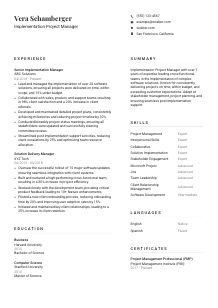
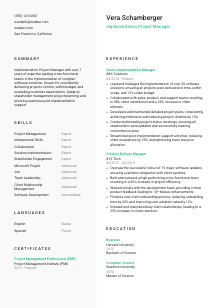
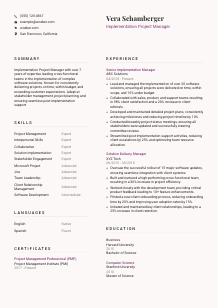
Driving projects forward, but your resume hits a roadblock? Navigate this Implementation Project Manager resume example, built with Wozber free resume builder. Learn how to spotlight your implementation prowess to match project directives, leading your career path to meet every milestone!
Implementation Project Managers sit at the point where software delivery meets client expectation. Hiring teams look for people who can move a rollout from kickoff to handoff without losing control of timeline, scope, budget, or stakeholder alignment. Your resume needs to make that operating discipline visible through implementation work, cross-functional coordination, and measurable delivery results.
A tailored resume changes how quickly your implementation background reads against the role. When the wording matches the job's language around software solutions, project plans, status meetings, and post-launch support, ATS screening is more likely to surface the right experience. Wozber's free resume builder helps organize that alignment into an ATS-compliant resume that makes your delivery history easy to recognize.
This section is simple, but it still affects how smoothly your application moves forward. For an Implementation Project Manager, the basics should immediately confirm professional identity, contact accuracy, and any location requirement stated in the posting.
Use your full name as the clearest heading on the page. Keep it prominent and easy to scan so the reader immediately connects the resume to the candidate behind the delivery record, stakeholder communication, and implementation results.
Place "Implementation Project Manager" directly under your name when that reflects the role you are pursuing. This creates instant alignment with the opening and helps frame the rest of the resume around implementation leadership rather than broader project coordination or account management.
Include a reliable phone number and a professional email address. If a hiring team wants to discuss rollout ownership, client-facing experience, or post-implementation transitions, they should not have to work around typos, outdated numbers, or informal contact information.
If the employer specifies a location, include it clearly. Here, listing "San Francisco, California" directly supports the stated requirement and removes an avoidable question early in review. For other applications, use location only when it helps confirm availability or regional eligibility.
Add a LinkedIn profile or professional website if it reinforces your resume with matching titles, project scope, recommendations, or implementation-focused achievements. Keep those profiles current so they support the same story your resume tells about software delivery, stakeholder management, and client success.
Your personal details should answer the practical questions first: who you are, how to reach you, and whether you meet any stated location requirement. Clean basics keep the focus on your implementation track record.




For this role, experience carries most of the weight. Employers want to see projects delivered, teams aligned, clients supported, and software rollouts managed with enough structure to hit milestones and keep post-launch issues under control.
Before editing bullets, isolate the recurring priorities in the posting. Here those include software solution implementation, cross-functional work with sales, product, and support, project planning, status reporting, and post-implementation support. Those themes should shape which achievements you feature first and how you phrase them.
List your most recent roles first so the reader sees your current level of ownership right away. For an Implementation Project Manager, job titles such as Senior Implementation Manager or Solution Delivery Manager work well when the bullets underneath clearly show rollout leadership, stakeholder coordination, and delivery accountability.
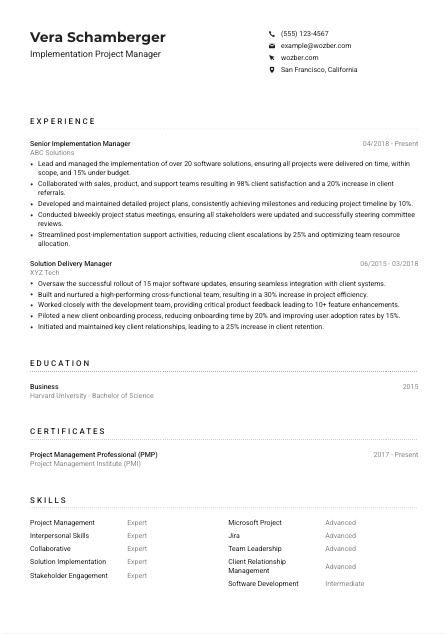
Each bullet should show what you led, what changed, and how the project performed. The example does this well with lines like leading more than 20 software implementations on time and 15% under budget. That tells the reader far more than a generic statement about "managing projects."
Quantify results with measures that matter in delivery environments: budget performance, milestone completion, onboarding speed, escalation reduction, user adoption, satisfaction scores, or referral and retention gains tied to client experience. Reducing project timelines by 10% or client escalations by 25% reads naturally in this field because it reflects real implementation performance.
Prioritize accomplishments that relate to software rollout, team coordination, client onboarding, governance meetings, or post-launch support. If a bullet does not help prove you can lead implementations across internal and client-facing teams, cut it and use the space for stronger delivery evidence.
Your experience section should show that you can run an implementation from plan to transition, keep stakeholders informed, and improve client outcomes along the way. That is the clearest proof that you can handle the role's operational demands.
Education matters here because the role sits between business process, software delivery, and stakeholder communication. A degree section should quickly confirm that you have the academic foundation for implementation work without taking attention away from your project history.
If the role asks for a Bachelor's degree in Business, Computer Science, or a related field, make sure that qualification is obvious. The example works because it shows business and technical study areas that align naturally with implementation planning, software understanding, and client-facing delivery.
List school, degree, field of study, and graduation year in a consistent format. Hiring teams do not need a long academic narrative here. They need a quick, accurate read on whether your education supports the level of project and solution work the role requires.
What matters most is how your education connects to the work. Business coursework can support planning, budgeting, and stakeholder management. Technical study can support software implementation conversations, issue triage, and collaboration with product or engineering teams.
Relevant courses are most useful when you are early in your career or targeting a more technical implementation environment. If your professional experience already demonstrates rollout leadership and system delivery, keep this section streamlined.
Academic honors, leadership roles, or related activities can be worth adding when they strengthen your case, especially for earlier-career candidates. For experienced implementation managers, they should stay secondary to project outcomes, client delivery, and operational scope.
This section should confirm that your background fits the business and technical demands of implementation work. Once that is clear, let your project results do the heavier lifting.
Certifications can strengthen your resume when they directly support delivery credibility. In implementation roles, they are most useful when they show recognized project management discipline or current knowledge in managing software rollouts.
When a job calls out PMP or an equivalent credential, place it where it is easy to find. In this case, a current PMP directly supports the employer's preference and reinforces your experience in structured project delivery, milestone management, and stakeholder reporting.
List the certifications that relate to implementation, delivery, agile project management, or relevant platforms. A focused list is stronger than a long one. Employers will care more about a recognized project credential than unrelated short courses with little connection to software implementation.
If the certification requires renewal or continuing education, include the date or active range. That helps show the credential is current and still relevant to the way you manage projects, documentation, governance, and delivery practices.
Implementation environments change with tooling, delivery methods, and client expectations. Maintaining a PMP or adding certifications that support agile execution, change management, or SaaS delivery can strengthen your profile when they reflect the work you actually do.
Certifications should back up your project leadership, not replace it. When they match the posting and stay current, they add another layer of credibility to your implementation experience.
This section should reflect how implementation projects actually get delivered. That usually means a mix of project control, stakeholder management, software rollout knowledge, and tool fluency that helps teams track work, resolve blockers, and communicate progress clearly.
Pull the skills the employer names directly, then compare them to your real experience. For this role, that includes project management, interpersonal skills, cross-functional collaboration, and tools such as Microsoft Project or Jira. Those belong near the top if they reflect your background.
Implementation Project Managers need both operating discipline and relationship management. Pair skills like project planning, solution implementation, Jira, or Microsoft Project with stakeholder engagement, team leadership, and client relationship management so the section reflects the full scope of the role.
Do not turn the skills section into a software inventory. Choose the capabilities most tied to running implementations successfully. A concise list of targeted skills gives a clearer picture of how you manage timelines, coordinate teams, and support clients through rollout and handoff.
The right skills section should mirror the operating reality of implementation work. A hiring manager should be able to see, at a glance, that you can manage both the project mechanics and the people side of delivery.
Language ability matters in implementation roles because so much of the work depends on clear communication. Kickoff meetings, stakeholder updates, issue resolution, and post-launch support all rely on precise language, especially when clients and internal teams need the same understanding of scope and next steps.
If the posting requires English mastery, state your English proficiency explicitly. That matters for presenting status updates, running steering meetings, documenting decisions, and handling client communication without ambiguity.
Extra languages can strengthen your profile when implementations involve multilingual clients, distributed teams, or regional rollouts. They are especially useful when they can improve onboarding, support transitions, or relationship management across markets.
Choose ratings you can support in a real working setting. If you say you are fluent, expect that you may need to handle client calls, project updates, or written communication in that language.
Some implementation roles are domestic and English-only. Others involve international accounts, offshore teams, or multi-region support. List language skills when they match the communication demands of the environment you are targeting.
Language skills can become more valuable as your role expands into broader client portfolios or global delivery work. Keep the section current if additional proficiency now supports the level of stakeholder communication you handle.
For an Implementation Project Manager, language skills are useful when they improve client communication, team coordination, or rollout support. Lead with required proficiency, then add the languages that genuinely strengthen your delivery profile.
Your summary should quickly establish the kind of implementations you lead and the results you deliver. In a few lines, it should connect your years of experience, software delivery scope, cross-functional leadership, and project outcomes in language that matches the role.
Start with your professional identity and level of experience. For this role, that means stating that you are an Implementation Project Manager with several years leading software or solution deployments, rather than opening with broad claims that could apply to any project role.
Use the summary to surface a few core strengths, such as cross-functional coordination, project planning, stakeholder communication, and post-implementation transition management. These are central to the work and help distinguish implementation leadership from general PM experience.
Bring in the outcomes the employer cares about most, such as delivering on time, within scope, and within budget, while maintaining client satisfaction. The example summary does this effectively by tying years of experience to delivery consistency and customer results.
Aim for 3 to 5 lines with no filler. Every sentence should earn its place by clarifying your implementation background, delivery track record, or stakeholder-facing strengths. If a line could fit almost any manager, rewrite it until it sounds grounded in software implementation work.
A well-written summary tells the reader, from the first few lines, that you understand implementation work and have delivered it successfully. That context makes the rest of the resume easier to read in the right way.
An Implementation Project Manager resume should make one thing easy to understand: you can guide software delivery from planning through post-launch support while keeping clients, internal teams, and project controls aligned.
Use Wozber's free resume builder and ATS resume scanner to tighten the language, strengthen ATS optimization, and present your experience in an ATS-friendly resume format that reflects the role's real priorities. The finished resume should make your readiness to lead implementations easy to judge.




