



Use Wozber and land your dream job
Create Resume
No registration required
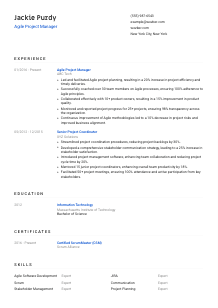
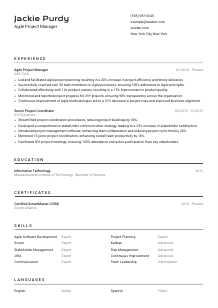
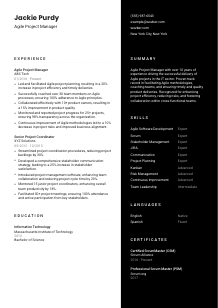
Juggling sprints but your resume feels stuck in a backlog? Check out this Agile Project Manager resume example, created with Wozber free resume builder. It shows how to showcase your adaptive leadership to match job demands, ensuring your career always stays ahead in the Agile game!
Agile Project Managers work in the middle of moving priorities, delivery pressure, and team dynamics. Hiring teams want to see how you run ceremonies, remove blockers, coach teams, and keep releases moving without losing transparency on risks, scope, or product quality. Your resume needs to make that operating rhythm visible, not just list Agile terms.
When the resume is tailored well, it quickly separates someone who has attended Scrum events from someone who has led delivery across sprint planning, retrospectives, stakeholder updates, and continuous improvement. Wozber's free resume builder helps structure that experience into an ATS-compliant resume that mirrors the language of the role, so your project outcomes, facilitation work, and Agile coaching are easier to recognize early.
For an Agile Project Manager, the header does more than identify you. It tells the reader whether you match the target function, whether you are reachable, and whether you meet practical filters such as location for hybrid or on-site delivery roles.
Use your full name in a clear, slightly larger format than the rest of the page. This keeps the top of the resume easy to scan in both ATS systems and recruiter review, especially when your document is being compared across multiple project management candidates.
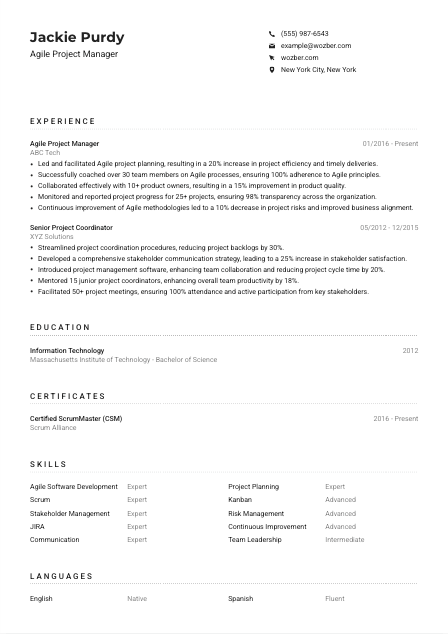
Place "Agile Project Manager" directly under your name when that is the role you are targeting. This immediately frames your background around Agile delivery leadership rather than broader project coordination or general operations work. If your recent title was adjacent, such as Senior Project Coordinator, your header can still reflect the target role while your experience shows the progression.
List a phone number you answer, a professional email, and only links that support your candidacy, such as LinkedIn or a portfolio with delivery case studies. For this profession, consistency matters. If your LinkedIn says Agile Coach and your resume says Agile Project Manager, fix the mismatch before applying.
If a posting requires a specific location, include your city and state in the header. Here, "New York City, New York" directly answers a stated requirement and avoids unnecessary doubt about availability. Do this when it reflects your real situation, not as a default for every application.
A polished LinkedIn profile can support your resume by showing role progression, certifications, and project context that may not fit on one page. Keep the content aligned with your resume's language around Scrum, Kanban, release planning, stakeholder collaboration, and delivery outcomes.
This section should confirm who you are, what role you are pursuing, and whether you meet practical application filters. For Agile Project Manager roles, that clarity matters before the reader reaches your sprint metrics or stakeholder work.




Experience is where Agile Project Manager resumes usually win or lose attention. Hiring teams look past generic responsibility lists and focus on whether you led Agile ceremonies, improved delivery flow, handled risks, and helped teams ship work with better predictability and quality.
Read the posting for the exact work patterns it emphasizes. For this role, that includes facilitating planning, daily stand-ups, reviews, retrospectives, sprint and release planning, coaching teams, reporting progress, and improving Agile practices. Mirror those terms when they reflect your real work so both the ATS and the reviewer can connect your experience to the role faster.
Start with your most recent role and show job title, employer, and dates cleanly. Agile hiring often values progression, so a path from project coordination into Agile project leadership is worth making obvious. The sample resume does this well by moving from Senior Project Coordinator into Agile Project Manager, which helps explain increasing ownership.
Each bullet should show what you led, how you worked, and what changed because of it. Useful examples include facilitating sprint planning across multiple squads, coaching teams on Scrum discipline, improving backlog flow, or giving stakeholders better visibility into risks and dependencies. A bullet like coaching 30+ team members to full Agile adherence works because it shows both facilitation and organizational impact.
Quantify results with measures that make sense for Agile environments, such as cycle time, release timeliness, defect reduction, backlog reduction, stakeholder satisfaction, project throughput, or risk reduction. The sample's "20% increase in project efficiency," "25+ projects monitored," and "10% decrease in project risks" are good illustrations because they tie Agile leadership to business and delivery performance.
Prioritize bullets that show cross-functional coordination, facilitation, coaching, reporting cadence, and continuous improvement. If an accomplishment does not strengthen your case for leading software or IT delivery, trim it or rewrite it. The section should leave no doubt that you can guide teams through iterative delivery, surface blockers early, and keep stakeholders aligned.
A strong experience section makes your delivery style visible. After reading it, a hiring manager should understand the scale you handled, the Agile practices you led, and the results you produced across teams, products, or releases.
Education matters on an Agile Project Manager resume, but it usually supports the story rather than carrying it. Once you have 5+ years of delivery work, the degree mainly confirms your foundation, especially for software, IT, or technical product environments.
List your degree, school, and graduation year or date in a clean format. If the posting does not require a specific academic background, there is no need to overbuild this section. Keep it easy to scan and consistent with the rest of the resume.
Degrees in information technology, computer science, business, or related fields can add context for Agile roles in software delivery. In the example, a Bachelor of Science in Information Technology supports the candidate's credibility in IT project environments without needing extra explanation.
If you completed coursework in software development, systems analysis, product delivery, or project management, include it only when it strengthens your fit or helps compensate for lighter experience. For established candidates, this is optional rather than expected.
Recent graduates can add honors, major projects, or relevant coursework that shows planning, collaboration, or technical exposure. If you already have years of Agile delivery experience, those details can usually stay out so the page remains focused on execution and results.
Place this section after experience unless the role or your background gives education unusual weight. For most Agile Project Manager applications, delivery history, stakeholder management, and facilitation record will carry more influence than academic depth.
This section should quietly reinforce your background without distracting from your Agile project work. A concise education entry is often enough when the rest of the resume already shows solid delivery leadership.
Certifications carry real weight in Agile hiring because they show formal grounding in frameworks and practices that teams rely on every day. They are especially useful when the job posting explicitly asks for Scrum credentials or values coaching capability.
When a posting mentions certifications such as Certified ScrumMaster or Professional Scrum Master, move those to the top of the section. That direct alignment matters here because the employer has already signaled that formal Scrum knowledge is desirable.
Keep the section focused on credentials tied to Agile delivery, team facilitation, coaching, or project leadership. A short list of relevant certifications is stronger than a long list of loosely related training items.
Add certification dates so the reader can see the timeline of your Agile training. This is useful in a field where frameworks evolve and organizations care about whether your practices are current, especially if you are leading retrospectives, process improvements, or release planning.
A CSM or PSM helps, but it will not carry the resume on its own. Pair each credential with experience bullets that show you actually facilitated Scrum events, coached teams, or improved delivery flow. The sample resume works because the certifications are backed by concrete delivery results.
For Agile Project Manager roles, the right certifications strengthen credibility fast. They work best when they clearly match the posting and sit beside experience that proves you have applied the framework in real delivery environments.
A useful skills section for an Agile Project Manager should reflect the mechanics of delivery, not just broad professional traits. Hiring teams expect to see framework knowledge, planning and reporting capabilities, collaboration strength, and the tools used to manage sprint and workflow visibility.
Start with the stated requirements, then read for the capabilities behind them. This role calls for Scrum, Kanban, Agile principles, communication, facilitation, stakeholder collaboration, and progress reporting. Those are the skills that deserve space because they connect directly to the day-to-day work.
Use the same terminology the employer uses when it is accurate to your experience. If the posting says "Agile methodologies," "Scrum," and "Kanban," use those terms rather than vague alternatives. The sample resume handles this well by listing Agile Software Development, Scrum, Kanban, Project Planning, Risk Management, and Stakeholder Management.
Organize skills so an ATS and a human reader can scan them quickly. You might group them mentally around frameworks, delivery management, collaboration, and tools, even if you present them in a single list. For this profession, clarity around JIRA, sprint planning, risk tracking, and continuous improvement is more useful than a long bank of generic soft skills.
Your skills section should sound like someone who runs Agile work, not someone who has only read about it. Prioritize frameworks, planning, team facilitation, stakeholder communication, and the tools that support day-to-day delivery.
Agile Project Managers spend a large part of the week facilitating conversations, resolving ambiguity, and translating delivery status for different audiences. Language proficiency matters when the role requires smooth communication across developers, product owners, executives, and sometimes global teams.
If the job asks for advanced English, list English clearly and use an accurate proficiency level. For a role that depends on stand-ups, retrospectives, risk discussions, and stakeholder reporting, this is a practical communication requirement, not filler.
Additional languages can strengthen your profile if you work with distributed teams, international stakeholders, or multilingual customer environments. They are supportive signals, not mandatory additions for every Agile Project Manager resume.
Terms like Native, Fluent, Professional Working Proficiency, or Conversational give the reader a realistic sense of how you can operate in meetings and documentation. Avoid vague wording that leaves room for doubt.
If you have led ceremonies or stakeholder sessions across regions, multiple languages can reinforce your ability to keep communication moving across time zones and team boundaries. In the example, English and Spanish together suggest wider collaboration range, but English remains the key requirement for this opening.
Only include languages you can actually use in professional settings. An inflated language claim becomes obvious quickly in interviews, especially for a role where facilitation, conflict resolution, and executive updates rely on precise communication.
For Agile Project Manager applications, language entries should reinforce your ability to facilitate and align people clearly. Keep them accurate, relevant, and easy to read.
Your summary should give a fast read on the level, environment, and impact of your Agile project work. In a few lines, it needs to show whether you have led software or IT delivery, worked across cross-functional teams, and produced measurable results through Agile methods.
Read the job description closely before writing this section. If the role centers on Agile project delivery, team coaching, stakeholder collaboration, and transparency on risks and progress, those themes should shape the opening lines of your summary.
Lead with your title and years of relevant experience, such as Agile Project Manager with 8+ years in software and IT delivery. This quickly sets your level and helps distinguish you from candidates whose experience is broader but less directly tied to Agile execution.
Choose strengths that match the role, then connect them to outcomes. Good examples include facilitating Scrum ceremonies, coaching teams on Agile adoption, improving delivery efficiency, reducing project risk, or strengthening stakeholder visibility. The sample summary works because it ties years of experience to product delivery, team coaching, risk reduction, and collaboration.
Aim for three to five lines with direct language and no filler. This section should sound like the top of a hiring conversation, not a mission statement. If a sentence does not clarify your Agile delivery scope, methods, or results, cut it.
A well-written summary gives the reader an immediate sense of your Agile environment, leadership scope, and delivery results. It should make the rest of the resume feel consistent before they even reach your experience bullets.
An Agile Project Manager resume works when it makes delivery leadership easy to see. That means clear role targeting, measurable project outcomes, credible Agile credentials, and language that reflects how you actually run ceremonies, coach teams, manage risks, and keep stakeholders informed.
Wozber's free resume builder helps turn that experience into an ATS-friendly resume format with cleaner structure and stronger alignment to the job description. With Wozber's ATS resume scanner and AI resume builder workflow, you can surface missing requirements, refine Agile terminology, and strengthen ATS optimization section by section.
Before you apply, check one last time that your resume shows how you improve delivery flow, team performance, and project transparency. That is the hiring question your resume should answer clearly.




