



Use Wozber and land your dream job
Create Resume
No registration required
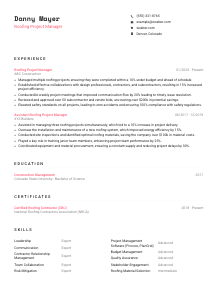
Leading crews on roofs, but your resume feels pitched? Scale the heights with this Roofing Project Manager resume example, created with Wozber free resume builder. Learn how to align your project management prowess with job specs, propelling your career to the summit with every assignment!
Roofing project management is judged in the field long before anyone sees the finished system. Hiring teams want to know whether you can keep crews moving, control change, manage subcontractors, and deliver installs or replacements without letting schedule, budget, safety, or quality slip. Your resume should make that operating range visible fast, especially if you oversee multiple jobs at once.
When the resume reflects the posting's language, the reader can quickly separate roofing-specific project managers from broader construction candidates whose experience is less direct. Wozber's free resume builder helps you shape that story in an ATS-friendly resume format, so tools like Procore or PlanGrid, bid review, safety compliance, and multi-project delivery are easy to spot where they belong.
This section does not need personality flourishes. It needs clean, accurate information that removes friction and confirms a few practical points right away, especially job title and location when a posting calls for local availability.
Use your full name in a slightly larger font than the rest of the page so it anchors the document immediately. On construction and project management resumes, clarity matters more than styling. The header should read like a professional document tied to site meetings, vendor calls, and client updates, not a design exercise.
Place "Roofing Project Manager" directly below your name if that is the role you are pursuing. This helps frame the rest of the resume around roofing-specific delivery, not general operations or unrelated construction work. If your current title is slightly different, such as Assistant Roofing Project Manager, you can still target the desired title here when your experience supports the move.
Include a phone number you answer and a professional email address that will not distract from your qualifications. If you add a website or LinkedIn profile, make sure it supports the same story as the resume, with project scope, certifications, or construction leadership experience presented consistently.
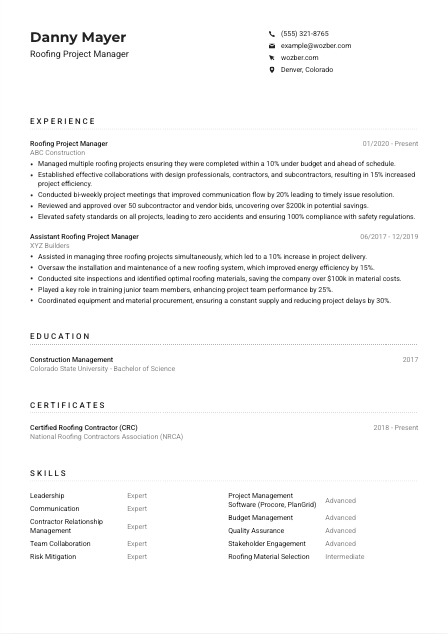
If a posting specifies local presence, include city and state in the header. In the example, "Denver, Colorado" addresses a stated requirement directly and avoids questions about relocation or travel readiness. For other roofing project manager roles, use location the same way only when geography affects mobilization, licensing, or client expectations.
A LinkedIn page or personal site can help if it shows useful detail such as commercial roofing projects, safety record, certifications, or software familiarity. Skip links to pages that are sparse or off-topic. Every item in this section should support the impression that you are organized, reachable, and ready to run active jobs.
By the time someone leaves your header, they should know who you are, what role you are targeting, how to contact you, and whether any location requirement is already covered.




For this role, experience is where hiring teams look for proof that you can keep roofing projects on track from kickoff through closeout. They want to see scheduling discipline, cost control, subcontractor coordination, safety oversight, and day-to-day decision making, not just a list of duties.
Read the posting closely and mark the responsibilities that define the work. Here, the priorities are clear: manage multiple roofing projects, coordinate with design professionals and subcontractors, run project meetings, review bids, and maintain safety and quality standards. Those themes should shape which bullets you write first and which results you measure.
Start with your most recent position and include job title, company name, and employment dates. That structure lets employers follow your progression from supporting roofing operations to leading them. In this field, that progression often matters because it shows how much exposure you have had to estimating, field coordination, procurement, punch lists, and client communication over time.
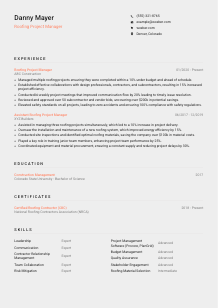
Each bullet should show what you managed and what improved because of your work. Strong roofing project manager bullets mention budget performance, schedule gains, vendor savings, quality outcomes, or safer execution. The example does this well by showing multi-project management, improved communication flow through bi-weekly meetings, and savings uncovered during subcontractor and vendor bid review.
Numbers make construction management claims believable. Use figures tied to budget variance, on-time completion, cost savings, accident reduction, inspection results, or number of bids reviewed. "Completed within 10% under budget," "over 50 bids reviewed," and "zero accidents" are effective because they sound native to how roofing work is judged in practice.
Prioritize work that shows roofing scope, crew or subcontractor coordination, material selection, scheduling, compliance, and stakeholder management. If you have broader construction experience, keep the bullets that translate directly into roofing project execution and trim the rest. The aim is to show that you can run the kind of projects this employer actually builds.
Your experience section should leave no doubt that you can manage roofing jobs from planning through closeout, keep multiple parties aligned, and protect budget, schedule, safety, and quality at the same time.
Education usually will not carry the resume on its own at this level, but it does answer an important screening question. When a posting asks for a degree in Construction Management, Civil Engineering, or a related field, this section should confirm that requirement cleanly and without extra clutter.
If you hold a bachelor's degree that matches the posting, list it clearly. For this opening, a Bachelor of Science in Construction Management directly supports the requirement and reinforces your grounding in project controls, estimating, scheduling, and construction coordination.
List degree, field of study, school, and graduation year in a consistent order. Hiring teams reviewing project manager resumes often scan quickly, so this section should be easy to confirm in seconds rather than styled as a long narrative.
Construction Management, Civil Engineering, and closely related programs carry the most weight because they connect naturally to bid analysis, construction sequencing, documentation, and jobsite coordination. If your degree title is broader, make sure the field still reads as relevant to building projects and construction delivery.
Most experienced roofing project managers do not need to list classes, but it can help early-career candidates if the coursework speaks directly to scheduling, safety management, structural systems, estimating, or contract administration. Keep it brief and tied to the work.
Honors, project work, or leadership activities can stay if they reinforce construction leadership or technical training. For someone with several years of project experience, they are secondary to field results, so include them only if they add something specific rather than fill space.
This section should confirm that you meet the degree expectation and support the broader picture of a project manager who understands construction methods, documentation, and site execution.
In roofing, certifications and licenses matter because they point to trade knowledge, professional standards, and, in some cases, legal ability to operate. If the posting mentions a contractor's license or recognized roofing credentials, make those items easy to find.
When a role calls for a valid state contractor's license or recognized roofing certification, put those items at the top of this section. The example's Certified Roofing Contractor and Certified Master Roofer credentials align directly with that request and help confirm roofing-specific expertise rather than general construction exposure.
List certifications that support roofing project delivery, safety, construction supervision, or compliance. A shorter list of highly relevant credentials is more persuasive than a long list of unrelated training.
Include issue dates and indicate when a certification is current. In regulated or safety-sensitive construction environments, current status matters because it shows your training and professional standing are up to date.
Roofing systems, code expectations, manufacturer requirements, and safety practices evolve. Ongoing certification or license maintenance signals that you stay current with the industry and can manage work to present-day standards, not outdated methods.
Relevant certifications and licenses support your technical credibility and can help separate you from project managers whose background is broader but less connected to roofing work.
A roofing project manager needs a mix of field coordination, commercial judgment, and software fluency. The skills section should reflect how the job is actually run, from subcontractor communication and budget tracking to quality checks and project documentation.
Start with the skills the employer names directly, then add the ones embedded in the responsibilities. Here that includes leadership, communication, interpersonal skill, project management software, bid review, budget control, safety compliance, and quality oversight. Those are stronger choices than broad placeholders that could belong on any resume.
Use the same terminology when it accurately reflects your background. If the employer mentions Procore or PlanGrid, include those platforms if you have used them. The example also includes contractor relationship management, risk mitigation, budget management, and quality assurance, which all reinforce the day-to-day realities of roofing project delivery.
List the most job-relevant skills first so the strongest matches appear early in the scan. For many roofing project manager roles, leadership, budget management, scheduling, subcontractor coordination, safety compliance, and project management software should sit above more secondary items. Keep the list selective and directly tied to how the projects are delivered.
A well-chosen skills section should read like the toolkit of someone who can manage roofing scope, keep teams aligned, and control project performance with the right systems and field judgment.
Language ability is not the center of most roofing project manager resumes, but it can matter when the posting names a required language or when the work involves diverse crews, subcontractors, and clients. Present it clearly and keep it honest.
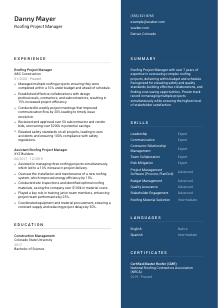
If the job says you must be conversant in English, list English at the top with an accurate proficiency level such as Native or Fluent. That immediately answers a stated requirement and supports the communication demands of meetings, reports, safety discussions, and coordination calls.
Include additional languages only if you can use them meaningfully on the job. Levels such as Native, Fluent, Intermediate, or Basic work well because they set realistic expectations. In the example, Spanish adds value because it may support communication across crews and subcontractors on active sites.
Some roofing environments benefit from bilingual communication, especially where field teams, vendors, or property stakeholders speak different primary languages. That does not make another language mandatory for every role, but it can strengthen your profile when it improves coordination and reduces communication friction.
Do not overstate fluency. A project manager may need to explain safety procedures, discuss schedule changes, or handle issues with subcontractors in real time, so your listed proficiency should match what you can do in those situations.
Extra language ability is most useful when it supports project communication, site culture, or stakeholder trust. Present it as a practical asset, not as filler. If it helps crews, vendors, or clients stay aligned, it belongs on the resume.
This section works best when it quickly confirms required English proficiency and, where relevant, shows added communication range that could help on active roofing projects.
The summary sets the tone for the entire resume. For a roofing project manager, it should quickly establish years of experience, type of project leadership, and the results you are known for, especially around schedule, cost, safety, and coordination.
Before writing the summary, identify the two or three priorities the employer is hiring for. In this case, multi-project oversight, budget and schedule control, stakeholder coordination, and safety compliance stand out. Your opening lines should address those realities directly rather than offering generic statements about being hardworking or results-driven.
Lead with a direct statement such as "Roofing Project Manager with 7+ years of experience" if that reflects your background. This immediately establishes seniority and specialization. The sample summary does this effectively by pairing years of experience with complex roofing project oversight.
Choose strengths tied to the job's actual work, such as delivering within budget and schedule, improving safety performance, managing subcontractor relationships, or finding cost savings through bid review. The example's references to safety and quality standards, cost-saving opportunities, and simultaneous project oversight all connect well to the employer's needs.
Aim for a compact paragraph of about three to five lines. Every phrase should earn its place by adding role-specific information, such as project scope, construction focus, measurable outcomes, or stakeholder management. A concise summary with roofing-specific detail will do more work than a longer paragraph full of generic claims.
By the end of the summary, the reader should already understand your level, your roofing project background, and the kind of budget, schedule, safety, and coordination performance you bring to the role.
A roofing project manager resume should read like someone ready to take ownership of active jobs, keep subcontractors aligned, and deliver work safely, on schedule, and within budget. When each section supports that picture, the application feels grounded in how roofing projects are actually run.
Use Wozber's free resume builder to organize that experience into an ATS-compliant resume, then strengthen the wording with its ATS resume scanner and AI-driven tailoring features so the right project terms, certifications, software, and performance results show up where employers expect them.
The finished resume should make one point easy to confirm: you can lead roofing projects from planning through closeout with control, credibility, and field-tested judgment.




