



Use Wozber and land your dream job
Create Resume
No registration required
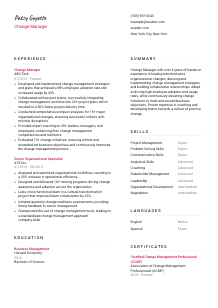
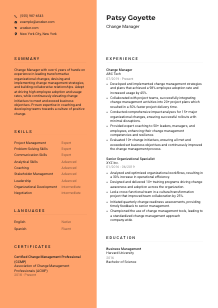
Driving organizational shifts, but your resume feels static? Build momentum with this Change Manager resume example, created with Wozber free resume builder. It shows how to clearly present your adaptability and leadership to match job expectations, empowering your career journey to evolve as dynamically as the transitions you manage!
Change management work sits where strategy meets behavior. Hiring teams want to see whether you can move a transformation from rollout plan to real adoption by mapping impact, preparing leaders, and reducing resistance across teams that do not all start from the same place.
The resume gets read quickly for that translation layer between project delivery and employee adoption. Wozber's free resume builder helps you align your wording with the target role in an ATS-compliant resume, so impact analyses, stakeholder coaching, and adoption results are easy to spot early. That makes it much clearer that you can support change in a structured, measurable way.
For a Change Manager, the header should confirm basic eligibility without slowing the reader down. Keep it clean and factual, and use it to remove obvious questions around role focus, contactability, and location when the posting asks for it.
Use your full name in a larger font than the rest of the header. Change management depends on credibility with executives, project leads, and frontline teams, so your resume should open with a professional, easy-to-read identity rather than decorative formatting.
Place "Change Manager" under your name if that matches the role you are pursuing. This immediately frames your background around change strategy, stakeholder engagement, and adoption planning instead of leaving the reader to infer your direction from broader titles such as project specialist or organizational consultant.
Include a phone number and a professional email address that you check regularly. If you add a website or LinkedIn profile, make sure it reflects the same employment dates, titles, and change-related accomplishments shown on the resume, especially if it includes transformation programs, communications work, or training initiatives.
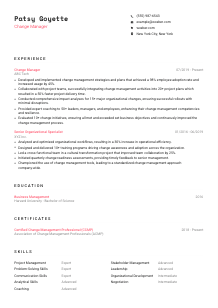
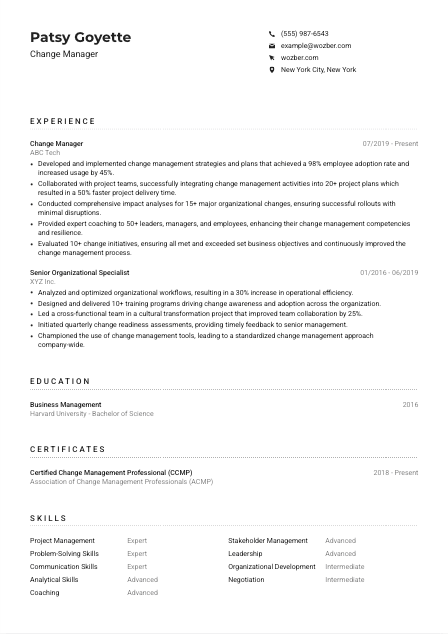
If the employer specifies a location, include your city and state in the header. Here, listing New York City, New York answers a stated requirement right away and avoids unnecessary concern about relocation or local availability. For other openings, only add location detail to the level the employer asks for.
A current LinkedIn profile can reinforce your resume when it shows the same change portfolio, cross-functional collaboration, and leadership support work. For this profession, that might include enterprise transformations, readiness assessments, communications planning, or adoption programs across business units.
Your header should confirm who you are, what role you do, and whether you meet any basic posting requirements. When those details are handled cleanly, the reader can move straight to your change work instead of pausing on logistics.




This section carries most of the hiring weight for a Change Manager. Employers look for the scale of change you handled, how you worked with project teams and leaders, and whether your efforts improved adoption, readiness, and business outcomes rather than stopping at communications or training alone.
Read the posting for the actions the employer repeats or describes in detail. For change management roles, those usually include building change plans, running impact assessments, identifying stakeholders, coaching leaders, and tracking adoption. Those phrases should shape the bullets you prioritize, because they show how you support implementation, not just project administration.
List your positions in reverse chronological order and make the most relevant titles do the most work. If your earlier title was broader, such as organizational specialist or project lead, use the bullets to show the change management parts of the job, including transformation support, readiness work, communications, training, or governance.
Each bullet should connect an action to a business or adoption result. The example does this well with outcomes such as a 98% employee adoption rate, 45% higher usage, and change activity integrated into 20+ project plans. Metrics like adoption, usage, speed of rollout, disruption reduction, participation, or leader engagement feel natural in this field because they show whether the change actually landed.
Choose bullets that cover diagnosis, planning, delivery, and follow-through. A strong experience section might show impact analysis, readiness assessment, stakeholder mapping, manager coaching, communications planning, training support, and post-implementation evaluation. That sequence tells the reader you understand the full arc of organizational change, not just one piece of it.
Many candidates stop at project participation. Go further and include examples of refining methods, standardizing tools, or improving how change was governed across initiatives. The sample resume's points about evaluating 10+ initiatives and standardizing a company-wide approach work because they show repeatable practice, not one-off involvement.
By the end of this section, the reader should understand what kinds of change you managed, who you influenced, and what improved because of your work. If your bullets show adoption, readiness, stakeholder leadership, and business follow-through, your experience will read like change management rather than adjacent support work.
Education matters most here as a baseline qualification and as context for how you entered the field. For Change Manager roles, degrees in business, information technology, organizational development, communications, psychology, or similar areas can all make sense when the rest of the resume shows practical change delivery.
If the posting asks for a bachelor's degree, make that easy to find. List the degree, field, school, and graduation year in a standard format. In this case, a business-related degree aligns neatly with a role that combines organizational planning, stakeholder communication, and implementation support.
Hiring teams do not need a long academic story for an experienced Change Manager. Present the section in a clean, scannable way so they can confirm the credential quickly and return to your project and transformation experience.
A degree title such as Business Management, Information Technology, or another related discipline can reinforce your foundation in process improvement, organizational behavior, or systems-driven change. If your degree is less directly connected, let your experience and certifications carry more of the role alignment.
Early-career candidates may benefit from listing coursework, honors, or university projects tied to organizational change, business transformation, leadership, or process analysis. If you already have more than 5 years of relevant experience, keep those extras brief unless they are unusually relevant.
Change management is shaped by evolving frameworks, leadership practices, and enterprise delivery models. If you have completed additional coursework in project management, organizational effectiveness, communications, or change leadership, include it when it adds useful context to your professional development.
Your education section should confirm that you meet the role's baseline requirement and support the story told by your experience. Once that is clear, let your change results and leadership work carry the rest.
Certifications have real weight in change management because they show training in established frameworks, stakeholder methods, and structured delivery. When a posting specifically asks for one, your resume should make that credential hard to miss.
If the role asks for CCMP or an equivalent, place that credential first. This is one of the clearest alignment points in the posting, and it immediately tells the reader you meet a profession-specific standard rather than bringing only informal change experience.
Choose certifications that support change execution, project delivery, organizational effectiveness, or leadership coaching. For this profession, a short list of directly relevant credentials is stronger than a long list of unrelated learning badges.
Add the year earned and, if relevant, the active period. Dates help the reader understand how your formal change training fits alongside your work history and whether the credential is current.
If you have pursued recent certification or coursework, it can reinforce that your methods are current. That matters in change management, where approaches to communication, adoption measurement, leadership enablement, and transformation governance continue to evolve.
This section should quickly reinforce that your change practice is backed by recognized training. When the posting names a credential such as CCMP, meeting it cleanly strengthens the rest of your application.
A Change Manager's skills section should do more than list broad strengths. It should show the mix of planning, analysis, communication, and influence needed to move people through change while keeping initiatives tied to business goals and project delivery.
Use the requirements and responsibilities to identify the capabilities the employer is prioritizing. In this description, analytical thinking, organization, problem-solving, communication, collaboration, and change management execution all stand out. Mirror that language where it matches your real experience so the resume reads naturally in both ATS screening and human review.
Change management sits between program structure and human adoption, so your skills should reflect both sides. Include capabilities such as project management, stakeholder management, impact analysis, readiness assessment, training support, communications planning, coaching, and leadership engagement if you have used them in practice.
Group or order skills in a way that lets the reader find the essentials quickly. An ATS-friendly resume format helps here, especially when your terms match the employer's wording without turning the section into a keyword dump. The example's mix of project management, coaching, stakeholder management, analytical skills, and communication is a solid model for that balance.
Your skills list should echo the work already proven in your experience section. When the same themes appear across both sections, the resume presents a consistent picture of how you lead change, support stakeholders, and deliver adoption.
Language ability matters in change management when it affects communication, training, leadership support, or rollout across diverse teams. Even when English is the only stated requirement, the way you list languages can still add useful context about stakeholder range.
If the posting states that you must be conversant in English, list English clearly with an accurate proficiency level. That removes doubt around a basic communication requirement in a role built on presentations, coaching, messaging, and cross-functional alignment.
Put the most important language first, then any additional languages that could support broader stakeholder communication. In multinational or highly diverse organizations, extra language capability can help with training delivery, manager support, and smoother rollout across regions or employee groups.
Use straightforward labels such as Native, Fluent, Professional, or Conversational. Change managers often work in high-stakes communication settings, so overstating language ability can create the wrong expectation for workshops, executive updates, or employee-facing materials.
Additional languages are worth listing when they support the environment you work in. They can strengthen your profile in organizations with global operations, multilingual workforces, or change programs that require local stakeholder engagement.
For some Change Manager positions, language skills are peripheral. For others, they directly affect adoption and communication quality across business units or countries. Use the posting and company context to decide how prominently this section should feature on your resume.
List the languages that matter, state your proficiency honestly, and let the section support the communication side of your change work. That is usually all this section needs to do.
The summary should quickly place you in the change landscape you actually work in. For this role, that usually means organizational transformation, adoption strategy, stakeholder coaching, and measurable outcomes tied to implementation rather than a generic statement about being results-driven.
Open with your title and experience level, then define the kind of change work you handle. A line such as "Change Manager with 6+ years of experience leading enterprise change initiatives" immediately places you closer to transformation delivery than to general operations or HR support.
Use the first sentence to anchor your niche. If your background centers on organizational change, digital transformation, process redesign, post-merger integration, or technology adoption, say so directly. This helps the reader understand your lens before they get into the details of your experience.
Choose achievements that fit how change work is measured, such as adoption rates, faster rollout, stakeholder engagement, reduced disruption, or successful execution across multiple programs. The example summary works because it mentions high adoption and continuous improvement, both of which are central to the field.
Aim for 3 to 5 lines with enough detail to establish scope, method, and impact. Skip broad claims that could apply to any management role. Use the space for signals that matter in this profession, such as change strategy, readiness assessment, coaching, communications, stakeholder alignment, and business outcomes.
A well-written summary tells the reader what kind of Change Manager you are before they reach the first job entry. If it names your scope, your approach, and the results you tend to deliver, the rest of the resume has a clear frame to build on.
A Change Manager resume should show that you can guide people through disruption with structure, communication, and measurable adoption. When each section supports that story, the document reads as a clear record of transformation work rather than a collection of general management claims.
Use Wozber's free resume builder to organize that story in an ATS-friendly resume format, then check the language with an ATS resume scanner so the terms in your resume match the priorities in the posting. The finished resume should make it easy to judge your ability to plan change, coach stakeholders, and deliver business-ready adoption.