



Use Wozber and land your dream job
Create Resume
No registration required
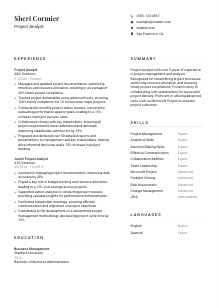
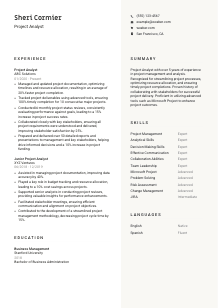
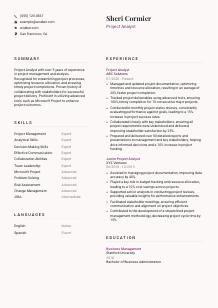
Decoding project puzzles, but your resume feels cryptic? Check out this Project Analyst resume example, created with Wozber free resume builder. Learn how to spotlight your analytical savvy to match job expectations, paving the way for your career projects to always hit the mark!
Project Analysts are often hired when projects are already moving fast, deadlines are visible, and someone needs to keep timelines, budgets, documentation, and stakeholder updates from drifting out of sync. Your resume should make that operating discipline easy to see. Show where you kept project information accurate, tracked deliverables across teams, and turned status data into decisions management could act on.
A tailored resume changes how quickly your project scope is understood. When your wording reflects the posting's language around documentation, resource allocation, status reviews, and stakeholder reporting, an ATS-compliant resume gives hiring teams a cleaner read on whether you can step into their reporting cadence and project controls workflow. Wozber's free resume builder helps you line up those terms clearly, so your background reads like project analysis experience rather than general coordination work.
For Project Analyst applications, the header needs to answer a few practical questions immediately: who you are, what role you do, and whether you meet any location or contact requirements. Keep it tight, professional, and easy to scan.
Use your full name in a slightly larger font so it stands apart from the rest of the page. This is simple, but it matters in a role built around organized reporting and clean documentation. An ATS-friendly resume format should make your identity easy to find without decorative elements getting in the way.
Place "Project Analyst" directly under your name when that is the role you are pursuing. Matching the title used in the posting helps position you correctly from the first line and avoids being read as a generic coordinator, operations assistant, or project support candidate.
Include a reliable phone number and a professional email address, ideally in a simple format such as firstname.lastname@email.com. Accuracy matters here. A resume for a project-focused role should not introduce preventable errors before the experience section even begins.
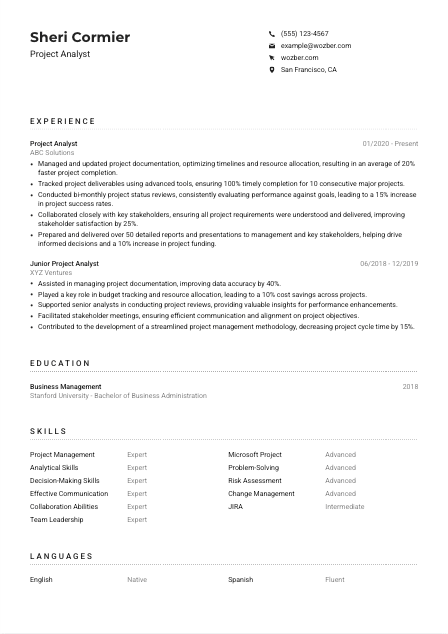
If a role has a location condition, include your city and state in the header. In the example here, listing San Francisco, CA immediately answers a stated requirement and removes doubt about availability. Use this approach whenever geography affects eligibility, hybrid expectations, or stakeholder access.
Link your LinkedIn profile or a professional website if it supports your application. For Project Analysts, this can reinforce your background with project reporting, PMO-adjacent work, software familiarity, or certifications. Make sure the information matches your resume dates, titles, and achievements.
Your personal details should confirm the basics without slowing the reader down. Clean formatting, an exact job title, and any required location detail help the hiring team move quickly to the parts that prove you can manage project documentation, reporting, and delivery tracking. Wozber's free resume builder keeps this section structured in an ATS-friendly resume format from the start.




This section carries the most weight for a Project Analyst. Hiring teams want to see how you handled project tracking in practice, whether you supported budgets and resources accurately, and how your reporting affected delivery, timelines, or stakeholder decisions.
Read the posting for the actual work rhythm behind the title. Here, the priorities are clear: maintain project documentation, track deliverables, run status reviews, coordinate with stakeholders, and report to management. Use those responsibilities as a filter when choosing which bullets to keep, rewrite, or cut from your experience.
List positions in reverse chronological order and give the most space to work that involved timelines, budgets, resource allocation, project tools, or cross-functional coordination. If your title was slightly different, your bullets can still establish relevance. In the sample resume, both "Project Analyst" and "Junior Project Analyst" clearly support that progression.
Project analysis is easier to trust when results are measured. Use metrics tied to project completion, budget control, reporting volume, accuracy, stakeholder satisfaction, or cycle time. The sample resume does this well with outcomes like 20% faster completion, 100% on-time delivery across 10 major projects, and over 50 reports presented to stakeholders.
Avoid filling this section with passive duty statements. Show what changed because of your work. "Updated project documentation" becomes stronger when paired with a result such as improved data accuracy, faster resource allocation, or smoother status reporting. This is where you distinguish project analysis from basic administrative support.
Use the same terminology the employer uses when it matches your real work. Phrases such as "project documentation," "resource allocation," "status reviews," "project deliverables," and "reports and presentations" should appear in context, not as a keyword pile. Wozber's ATS resume scanner can help you spot missing language and strengthen ATS optimization without flattening your bullet points.
By the end of this section, a hiring manager should be able to picture you running project updates, maintaining control over moving parts, and producing reports that support timely decisions. Keep the bullets outcome-based, tool-aware, and close to the language of the role. That is what makes Project Analyst experience feel immediately usable.
For Project Analyst roles, education usually works as a baseline qualification rather than the main selling point. Present it clearly, and make sure the degree supports the business, management, or analytical foundation the employer asked for.
When a posting asks for a bachelor's degree in Business, Management, or a related field, list the qualifying degree prominently and use the full name. In the example, Bachelor of Business Administration in Business Management lines up directly with the requirement and removes any ambiguity.
Include degree, field of study, school, and graduation year in a simple format. This section should read like well-kept project documentation: easy to scan, complete, and free of unnecessary extras. Consistency matters, especially in resumes for roles centered on organized information.
If you are early in your career or your experience is still developing, coursework in project management, business analysis, operations, finance, or data reporting can help bridge the gap. If you already have several years of direct project work, keep coursework brief or leave it out unless it strengthens a specific target role.
Honors, capstone projects, student consulting work, or leadership in business and operations organizations can be useful when they show planning, analysis, reporting, or cross-team coordination. Keep the connection practical. Focus on achievements that reflect how you approach structured work and problem-solving.
Use a standard section heading such as "Education" and avoid tables or unusual layouts that can break parsing. Wozber's free resume builder helps keep your education details in an ATS-friendly resume format, which is especially useful when the degree is a stated screening requirement.
Education should confirm that you meet the baseline requirement and support the analytical side of your background. Once that is clear, let your experience carry the deeper proof of how you handle timelines, stakeholders, and project reporting.
A Project Analyst skills section should reflect how the work actually gets done. That means pairing project tools and analytical ability with the communication skills needed to keep stakeholders aligned and project updates accurate.
Start with the posting and separate the skill types it implies. Here, that includes project management software, analytical problem-solving, decision-making, communication, and cross-functional collaboration. That mix is typical for Project Analysts because the role sits between project data, delivery teams, and management reporting.
Lead with the skills that support project tracking and reporting first. Software such as Microsoft Project belongs near the top when it appears in the job description. Pair it with relevant execution skills like project management, risk assessment, resource planning, stakeholder communication, and change management. The sample resume handles this well by combining tool knowledge with team-facing strengths.
Use skill names the employer is likely to search for, provided they reflect your real ability. This helps both ATS matching and human review. Wozber's built-in ATS resume scanner is useful for checking whether your skills section covers the right terms without becoming a disconnected list of buzzwords.
This section should quickly tell the reader that you can manage project information, work inside the required tools, and communicate clearly across teams. Choose skills that support actual delivery work, not generic descriptors that could belong on any resume.
Language skills matter for Project Analysts because status reporting, stakeholder updates, and cross-functional coordination all depend on clear communication. Keep this section straightforward and relevant to how you work.
If the job description calls for professional English, list English prominently and state your level clearly, such as Native or Fluent. This matters because much of the role depends on writing project updates, presenting reports, and communicating requirements accurately.
Additional languages can be useful when teams, vendors, or clients work across regions or multilingual environments. They are not always essential, but they can add value in project settings that involve varied stakeholder groups. In the example, Spanish is a useful secondary language to include.
Use clear levels such as Native, Fluent, Intermediate, or Basic. Avoid overstating ability. If you may need to present, write updates, or lead meetings in a language, the level should reflect that reality.
Language ability can support smoother requirement gathering, clearer stakeholder communication, or better collaboration with distributed teams. If multilingual communication has been part of your project work, that context can also appear in your experience section, not only here.
Use a standard "Languages" heading and list each language with one proficiency label. This section does not need heavy detail, but it should be clean and easy to parse. Wozber helps keep even smaller sections consistent within an ATS-friendly resume template.
For this role, languages are most useful when they support reporting, stakeholder communication, or collaboration across teams. Present them clearly, and let the listed proficiency match the level of communication the job will actually require.
Your summary should give a quick, accurate read on the kind of project work you handle. Focus on the mix of analysis, documentation, coordination, and reporting that defines the role, then anchor it with one or two concrete outcomes or tools.
Before writing, identify the capabilities the employer is trying to hire for. In this case, that includes project documentation, deliverable tracking, performance reviews, cross-functional collaboration, and reporting to stakeholders. Your summary should reflect that operating scope in a few lines.
Begin with a direct statement of who you are professionally, such as "Project Analyst with 5+ years of experience." This gives immediate context and helps position your background correctly for both ATS parsing and recruiter review.
Choose strengths that match the posting and are easy to prove elsewhere in the resume. Useful examples include resource allocation, project reporting, schedule tracking, stakeholder coordination, or proficiency with Microsoft Project. The sample summary works because it stays close to the actual responsibilities of the role instead of drifting into broad operations language.
Aim for three to five lines. That is enough space to show your professional focus, mention relevant tools or methods, and hint at outcomes like faster project completion or stronger stakeholder alignment. Leave the detailed metrics for the experience section, where they can do more work.
When this section is done well, the rest of the resume reads through the right lens. The hiring team should immediately understand that your background is grounded in project tracking, reporting discipline, and cross-functional execution support. Wozber's free resume builder can help tighten the wording so that first impression lands clearly in an ATS-friendly resume format.
A Project Analyst resume should leave little guesswork. The reader should quickly see that you can maintain project documentation, track deliverables, support budget and resource decisions, and communicate progress in a way that helps teams stay on course.
Before sending it out, review your wording against the posting and make sure the core project terms appear naturally across your summary, experience, and skills. Wozber's free resume builder and ATS resume scanner can help you refine the language, strengthen ATS optimization, and present your background in a clean ATS-friendly resume template. The final version should make it easy to judge your readiness for real project delivery support.




