



Use Wozber and land your dream job
Create Resume
No registration required
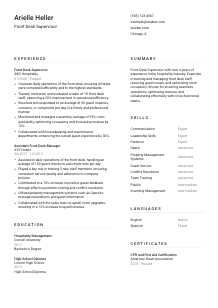
Leading the check-in but your resume's been waiting in the lobby? Elevate it with this Front Desk Supervisor resume example, created with Wozber free resume builder. Learn how to showcase your leadership and guest service prowess to meet job prerequisites, putting your career front and center!
Front desk supervision sits at the point where guest expectations, staffing decisions, and hotel operations meet in real time. Hiring teams want to see whether you can keep check-ins, departures, room status coordination, and service recovery running smoothly when the lobby gets busy. Your resume should make that operational control visible, not just show that you have worked at a reception desk.
A tailored resume also helps separate candidates who handled guest-facing tasks from those who actually directed front desk flow, coached staff, and used occupancy data to support revenue. Wozber's free resume builder helps you align that experience into an ATS-compliant resume, so systems and hiring managers can quickly see your command of guest service, team leadership, and daily hotel operations.
Hotels expect front desk leaders to be polished, easy to reach, and immediately identifiable. Your personal details should reflect that same standard by giving clear contact information without unnecessary extras or distracting formatting.
Place your full name at the top in the most prominent text on the resume. Keep it simple and readable. For a guest-facing leadership role, presentation matters, and a clean header sets the tone before the hiring manager reaches your experience.
Add "Front Desk Supervisor" directly under your name if that matches the role you are targeting. This helps frame the rest of the resume around front office leadership rather than general customer service or administrative work.
List one phone number and one professional email address that you check regularly. Hospitality hiring often moves quickly, especially for operational roles that need schedule coverage, so make it easy for a hiring manager to contact you without sorting through multiple options.
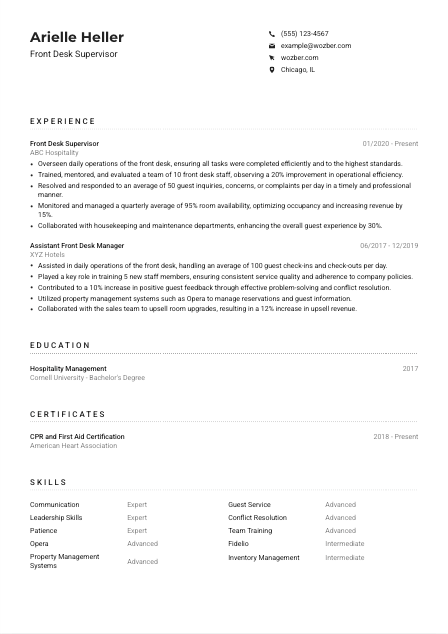
If the job calls for local availability or relocation, show your city and state. In this example, listing Chicago, IL immediately answers a stated requirement and removes uncertainty about whether you can work on site.
Include LinkedIn or a professional website only if it supports your candidacy with hospitality experience, leadership progression, or customer service achievements. If you include a link, make sure the job titles, dates, and tone match your resume.
This section should tell an employer exactly who you are, what role you are pursuing, and how to reach you. For front desk supervision, that clarity mirrors the kind of organized first impression you are expected to create for guests every day.




This is the section hiring teams will study most closely. Front Desk Supervisors are expected to manage service quality, keep the desk running during peak traffic, support occupancy goals, and guide team performance, so your bullet points need to show results in those areas.
Start with your current or most recent role and work backward. Include the job title, employer, and employment dates for each position so your progression from guest-facing work into front office leadership is easy to follow.
Shape each role around the work that matters most in front desk supervision: guest issue resolution, shift oversight, staff coaching, room inventory awareness, and coordination with housekeeping or maintenance. The sample does this well by emphasizing daily operations, complaint handling, and cross-department collaboration instead of listing general hotel tasks.
Quantify impact wherever you can. Useful metrics in this field include guest inquiry volume, check-ins and check-outs handled, occupancy rate, upsell revenue, response time, team size, guest satisfaction movement, or operational efficiency. Example bullets such as improving efficiency by 20% or increasing revenue by 15% give hiring managers a clearer sense of your scale and effectiveness.
You do not need to document every task you performed at the front desk. Prioritize the work that supports a supervisor title, especially anything involving service recovery, policy enforcement, team oversight, training, scheduling support, or revenue-conscious room management. That focus helps distinguish you from a front desk agent resume.
Training matters because front desk supervisors are often responsible for consistency across shifts. Include bullets about onboarding new hires, mentoring agents, evaluating performance, or improving adherence to service standards. In the example, managing and developing a team of 10 staff members immediately reinforces supervisory scope.
Your experience section should show that you can run a front desk, not just work at one. When your bullets connect guest service, team leadership, and hotel performance, hiring teams can picture you managing the operation in real conditions.
Education usually plays a supporting role here, but it still helps establish your foundation in hospitality, service operations, or business. Keep this section clean and relevant so it reinforces your background without taking attention away from your front desk results.
Some Front Desk Supervisor roles ask for a degree, while others focus more on operational experience. In this opening, the emphasis is on guest-facing background, systems knowledge, and leadership, so education should support your profile rather than carry it.
Start with your highest completed education, then include school name, degree, field of study, and graduation year or date. Keep the format easy to scan so hiring managers can move quickly from your schooling to your hospitality experience.
If you studied hospitality management, tourism, business, or a related field, say so clearly. A degree such as Hospitality Management, like the one in the example, adds context for your understanding of guest service standards, hotel operations, and revenue awareness.
Academic distinctions, student leadership, or hospitality-related activities can be worth including early in your career. Use them when they show service leadership, event coordination, or customer-facing responsibility, not just because they happened during school.
If you completed short courses in hospitality operations, conflict resolution, emergency response, or hotel systems, include them when they add current value. Ongoing training can help show that you stay current with service standards and operational expectations.
For this role, education should reinforce your hospitality grounding and then step aside for your work history. A concise, relevant education section adds credibility without competing with the operational experience that usually drives the hiring decision.
Certifications can add practical value in hospitality, especially when they relate to guest safety, emergency response, or service operations. Use this section to highlight credentials that make sense for a front desk leadership role, not to list every training item you have ever completed.
Lead with certifications that the posting mentions or clearly values. For this job, CPR and First Aid are preferred, so they deserve a prominent place if you hold them. That kind of credential supports the calm, guest-facing judgment expected at the front desk.
Prioritize certificates tied to safety, guest care, hotel operations, leadership, or service standards. A shorter, targeted list is stronger than a long catalog of unrelated courses because it keeps attention on your readiness for front office supervision.
If a certification expires or requires renewal, show dates clearly. Current credentials matter more than old completions, especially for emergency response items such as CPR and First Aid.
Updated training can strengthen your resume when it reflects real front desk demands, such as de-escalation, guest safety, or system-specific training. The example's active CPR and First Aid certification works well because it matches a stated preference and adds practical value.
A well-chosen certification section shows preparation, judgment, and professionalism. For a Front Desk Supervisor, the most useful credentials are the ones that connect directly to guest safety, service quality, and steady response under pressure.
The skills section should quickly confirm that you can handle the tools and people side of the front desk. That means combining hotel systems knowledge with service recovery, communication, and team supervision instead of listing broad traits without context.
Start with the requirements named in the job description and the work implied by the responsibilities. Here, that includes property management systems, interpersonal communication, leadership, professionalism under pressure, and guest-facing problem resolution.
Front Desk Supervisors need both operational and interpersonal range. Include technical abilities such as Opera, Fidelio, reservation management, or property management systems alongside skills like conflict resolution, team training, coaching, and guest service. The sample resume handles this balance well by pairing Opera and PMS knowledge with leadership and communication.
Choose skills that support front office execution and supervisory scope. A focused list with terms like room inventory management, complaint resolution, staff training, upselling, and cross-department coordination is more persuasive than a generic collection of soft skills.
Employers need to see that you can manage both the system side and the human side of the front desk. When your skills list reflects PMS fluency, service recovery, and staff leadership, it reads like someone ready to supervise a live hotel operation.
Language skills matter in hospitality because clear communication affects check-in accuracy, complaint handling, and overall guest comfort. Present this section honestly and with the role in mind, especially when the posting specifies a required language.
If the job requires English proficiency, list English first and mark your level clearly. For this opening, proficient English is essential, so that should be immediately visible.
Additional languages can strengthen your profile, especially in hotels serving international travelers or multilingual local markets. Spanish in the sample resume is a good example of an added service advantage, even though it is not listed as a formal requirement.
Describe each language with straightforward levels such as native, fluent, intermediate, or basic. Avoid vague wording. Front desk work depends on real-time communication, so accuracy matters.
Include languages that could help with guest requests, check-in conversations, service recovery, or coordination in diverse hospitality environments. This makes the section more relevant than treating languages as a general personal interest.
Language ability is most valuable here when it helps you welcome guests, resolve concerns, and reduce friction at the desk. Present it as a service asset tied to the day-to-day realities of hospitality work.
A useful language section shows how you communicate with guests clearly and confidently. For front desk supervision, that can support smoother arrivals, faster issue resolution, and a better experience across a wider range of travelers.
Your summary should quickly establish your level, your hospitality background, and the kind of front desk operation you can manage. Keep it concise, but make sure it covers the mix of guest service, team leadership, and operational control that defines this job.
Review the posting and note the few themes that matter most. Here, those include supervising front desk operations, handling guest concerns professionally, leading staff, working with property management systems, and supporting occupancy and revenue.
Start with a direct line that identifies you as a Front Desk Supervisor or front office leader with hospitality experience. Mention your years of experience only if they strengthen the message. The example's opening works because it quickly establishes more than 4 years in hospitality.
Include a few role-specific strengths such as training teams, improving service quality, resolving high guest volumes, or optimizing occupancy. The strongest summaries borrow from achievements already proven in the experience section, such as revenue improvement or staff development.
Aim for 3 to 5 lines with no wasted wording. A hiring manager should be able to scan it quickly and understand your front office scope, your leadership level, and the kind of guest experience you can protect under pressure.
A sharp summary tells the reader what to look for in your experience before they reach the first bullet. For a Front Desk Supervisor, it should point clearly to operational oversight, service recovery, staff leadership, and hotel performance awareness.
A Front Desk Supervisor resume should show that you can keep the guest experience steady while managing people, systems, and the pace of daily hotel operations. When each section supports that picture with clear titles, relevant tools, and measurable results, the application feels grounded in real front office work.
Use Wozber's AI resume builder to tighten role-specific wording, improve ATS optimization, and present your experience in an ATS-friendly resume format that stays easy to scan. The finished resume should make one thing immediately clear: you can lead the front desk with professionalism, control, and guest focus.




