



Use Wozber and land your dream job
Create Resume
No registration required
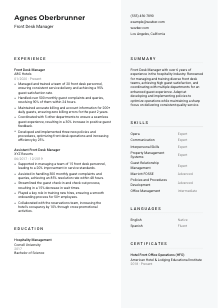
Commanding the reception, but feel your resume is acting more like a call on hold? Check out this Front Desk Manager resume example, created with Wozber free resume builder. Learn how to align your managerial savvy with job specifications, ensuring your career trajectory is as impressive as your greeting skills!
Front desk leadership sits at the point where guest experience, team performance, and daily hotel operations meet. A Front Desk Manager resume needs to show more than a friendly service style. It should show that you can run a shift, coach desk staff, resolve escalations, protect billing accuracy, and keep arrivals, departures, and cross-department handoffs moving smoothly.
When that information is tailored well, hiring teams can quickly distinguish someone who has supervised real front office operations from someone with only guest-facing experience. Wozber's free resume builder helps you shape that story into an ATS-compliant resume by aligning your language with the posting and making operational strengths easier to spot, especially around team leadership, PMS use, and guest issue resolution.
Hotels move fast, and basic contact details are usually reviewed first for practical reasons. For a Front Desk Manager, this section should immediately confirm who you are, what role you hold, and whether you meet obvious logistics such as location and professional presentation.
Use your full name in a clear, prominent format so it anchors the resume immediately. For hospitality management roles, polished presentation matters, and your header should feel as orderly as the front desk operation you are applying to manage.
Place "Front Desk Manager" directly under your name when that is the role you are pursuing. Matching the posted title helps with ATS alignment and signals that your background is centered on front office supervision rather than broader hotel operations or general customer service.
Your phone number and email should make it easy for a hotel recruiter or operations leader to reach you for interviews, schedule discussions, or relocation follow-up.
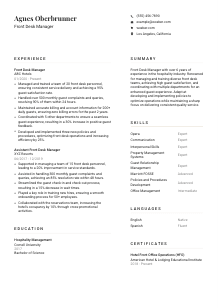
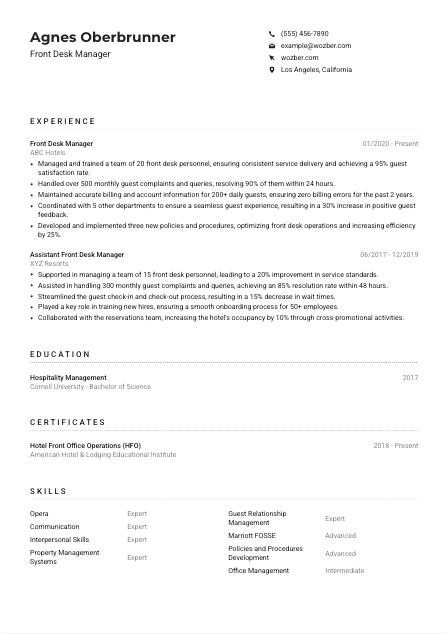
If the posting names a city, include your city and state to remove doubt about availability. In the example, listing Los Angeles, California directly supports a stated location requirement. If you are relocating, make that clear in a brief note so the employer does not have to guess.
Include LinkedIn or a professional profile only if it supports the same story as your resume. For a Front Desk Manager, that means matching titles, dates, hospitality employers, and visible progression into team leadership or front office operations.
This section should answer the practical questions fast: who you are, what role you do, how to reach you, and whether you are available for the property's location. Keep it clean and hotel-ready.




This is where hiring teams look for evidence that you have managed live front office work, not just supported it. Your bullets should show guest volume, team oversight, complaint handling, billing accuracy, coordination with housekeeping or reservations, and measurable service outcomes.
Read the job description and mark the operational responsibilities that define the role. For this position, that includes managing and training front desk personnel, handling guest complaints, maintaining billing accuracy, coordinating with other departments, and improving procedures. Those duties should shape which accomplishments you feature first.
Use reverse chronological order and include your title, employer, and dates for each role. That format helps employers quickly see whether you have the required depth, such as progression from Assistant Front Desk Manager to Front Desk Manager or experience across multiple hotel properties.
Do not stop at describing tasks. Show what your management produced. The example works because it connects front desk supervision to outcomes such as a 95% guest satisfaction rate, faster complaint resolution, and zero billing errors over a sustained period. Those details tell a hiring manager how you operate under real guest-facing pressure.
Metrics carry weight when they reflect front office performance. Guest satisfaction scores, complaint volume, resolution time, daily guest count, wait-time reduction, training scope, and operational efficiency gains are all relevant here. Numbers like 500 monthly guest issues resolved or 200+ daily guest accounts maintained give your experience real scale.
Prioritize experience that speaks directly to the work of a Front Desk Manager. A strong bullet might highlight staff coaching, PMS-driven billing accuracy, check-in flow, or cross-functional coordination with housekeeping, reservations, and maintenance. Leave out unrelated duties that do not strengthen your case for managing the guest arrival-to-departure experience.
Your experience section should make it easy to picture you running the desk, guiding the team, and fixing issues before they affect guest satisfaction scores or revenue accuracy. If that is clear, the section is doing its job.
Education matters most here when it strengthens your credibility for hotel operations, guest service leadership, and front office management. Keep it straightforward, and give extra attention to a hospitality-related degree if the posting calls it out or lists it as preferred.
If you have a Bachelor's degree in Hospitality Management or a related field, make that easy to find. This posting prefers that background, so a degree such as a Bachelor of Science in Hospitality Management should be presented clearly rather than buried under less relevant academic details.
List the degree, school, field of study, and graduation year. Hiring managers reviewing many hotel resumes usually want to confirm the credential quickly and return to the operational sections of the resume.
If the posting asks for hospitality management and that is your field, say it directly. The example's "Bachelor of Science" in "Hospitality Management" mirrors the employer's preference without overstating anything. That kind of clean alignment helps both ATS parsing and human review.
For experienced Front Desk Managers, coursework is optional. Add it only if it reinforces front office work, such as hotel operations, guest relations, revenue management, or property systems, or if you are earlier in your career and need more hospitality-specific context.
Honors, hospitality society involvement, or university projects are worth adding only if they reinforce management potential or industry commitment. Once you have several years of hotel leadership experience, these should stay secondary to your operational results.
Education should confirm relevant hospitality grounding, not compete with your experience. Present it cleanly, match the field of study where appropriate, and let it support the front office leadership story.
Certifications can sharpen your resume when they point directly to hotel operations, guest service standards, or front office procedures. For a Front Desk Manager, the right credential shows that your knowledge extends beyond on-the-job familiarity and into recognized hospitality practice.
Lead with credentials that support the responsibilities in the posting. A Hotel Front Office Operations certification is a strong example because it relates directly to desk procedures, guest handling, and front office standards that matter in hotel management.
A short list of targeted hospitality certifications works better than unrelated training. If a certificate does not strengthen your case in guest service leadership, hotel operations, or front desk systems, it does not need space on the resume.
Show the year earned and any current validity when applicable. In hospitality, recent certification can suggest that your knowledge of service standards, front office workflows, or operational compliance is still active and current.
If you are adding new credentials, focus on areas that affect front office performance, such as guest relations, hotel revenue processes, supervisory training, or recognized brand systems. Choose education that supports the work you want to manage, not just general professional development.
The best certificates on this resume are the ones a hotel hiring team can connect directly to guest handling, front office procedures, and team oversight. Keep the section targeted and current.
A Front Desk Manager skills section should read like the toolkit of someone who runs a busy guest-facing operation. That means balancing system knowledge with supervisory and service skills that affect check-in flow, billing accuracy, staff performance, and guest recovery.
Start with the skills named or implied in the posting. Here, that includes property management systems, communication, interpersonal skills, complaint handling, staff training, billing accuracy, and procedure development. These are not generic traits. They are the daily mechanics of front desk leadership.
Move required or preferred skills to the top when you genuinely have them. If you know Opera, Marriott FOSSE, or other PMS platforms, list them clearly. The example does this well by naming both specific systems and broader strengths such as guest relationship management and policies and procedures development.
Group skills in a way that helps a hotel recruiter read them quickly. You might separate PMS and operational tools from leadership and guest service capabilities, or simply order them by relevance to the job. Either way, make the section fast to review and closely tied to front office work.
A useful skills list should reinforce that you can manage people, systems, and guest expectations at the same time. If the section reads like real hotel operations, it is on the right track.
Language ability matters in front office roles because communication affects guest satisfaction, complaint resolution, and team coordination in real time. Include languages with honest proficiency levels, especially when the posting specifies professional English or the property serves a diverse guest base.
If the posting specifies professional English, make that visible. A Front Desk Manager handles guest concerns, trains staff, explains billing, and coordinates with multiple departments, so English proficiency is central to the work, not a minor detail.
List English prominently and label your level accurately, whether native, fluent, or professional. In the example, "English - Native" immediately confirms alignment with the requirement and supports the communication demands of the role.
Extra languages can be a real advantage in hospitality, especially in markets with international or multilingual guests. Spanish, for instance, can strengthen guest interactions, reduce friction during check-in, and help resolve issues more smoothly when serving a broader visitor mix.
Avoid inflating your level. If you can greet guests and handle simple exchanges, say conversational. If you can resolve complaints or explain billing details comfortably, fluent or professional may be appropriate. Accuracy matters because these skills are tested quickly in hospitality settings.
For front office leadership, languages are most valuable when they improve guest communication, de-escalate issues, or support staff interaction across shifts. Present them as practical service assets, not just background details.
Language skills should help a hiring team picture smoother guest interactions and fewer communication gaps at the property. Keep the section truthful, relevant, and tied to service delivery.
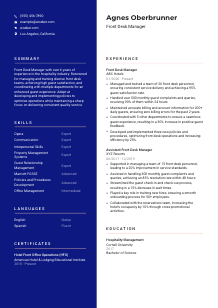
Your summary should quickly establish your level, your operating strengths, and the kind of hotel environment you are prepared to lead. For a Front Desk Manager, that usually means blending team supervision, guest service outcomes, systems knowledge, and process discipline in a few tight lines.
Pull the defining priorities from the posting before you write. In this case, leadership of front desk personnel, guest complaint resolution, billing accuracy, cross-department coordination, and policy development are stronger summary material than broad statements about being people-oriented.
Start with a direct line that identifies you as a Front Desk Manager or front office leader and states your years of relevant hotel experience. The example does this well by leading with more than 6 years in hospitality, which immediately establishes professional level.
Use the next sentence or two to point to strengths that matter in daily operations. That might include managing desk teams, lifting guest satisfaction, resolving escalations quickly, using PMS platforms effectively, or improving procedures that reduce wait times and service inconsistency.
Aim for 3 to 5 lines with concrete language. Skip generic claims and focus on the operating value you bring. A concise summary that mentions team leadership, guest issue resolution, and front office efficiency will do more work than a longer paragraph filled with broad adjectives.
Your summary should make the hiring team expect a candidate who can supervise the desk, steady service standards, and keep guest operations running cleanly. That is the impression to create before they reach the first job entry.
A Front Desk Manager resume should leave no doubt that you can lead desk staff, handle guest issues with judgment, maintain accurate accounts, and coordinate the details that shape the stay experience. Each section should support that story with real hospitality context, from PMS familiarity to team supervision and measurable guest service results.
Use Wozber's free resume builder to organize that experience into an ATS-friendly resume format, refine your wording with role-specific terminology, and check alignment with an ATS resume scanner before you apply. The result should make it easy for a hotel employer to see how you would run the front desk from the first shift.