



Use Wozber and land your dream job
Create Resume
No registration required
Balancing guests' requests, but your resume feels vacant? Unpack this Hotel Assistant Manager resume example, created with Wozber free resume builder. Learn how to align your operational excellence with specific job requirements, ensuring your hospitality career earns a five-star rating!
Hotel Assistant Managers sit at the point where guest experience and daily operations meet. A hiring team wants to see that you can keep the front desk, housekeeping coordination, staff supervision, and service recovery moving smoothly while standards stay intact. Your resume should make that operating range visible, not bury it under generic hospitality language.
When the resume is tailored well, the difference is immediate. Keywords tied to hotel operations, PMS use, staff supervision, budgeting, and guest issue resolution are easier to pick up in an ATS scan and easier for a General Manager to connect to day-to-day hotel performance. Wozber's free resume builder helps you shape that alignment in an ATS-friendly resume format so your background reads clearly as management support that can keep service quality and hotel operations on track.
Hotel hiring starts with practical details. For an Assistant Manager opening, your header should confirm who you are, how to reach you, and whether you meet any immediate logistical requirement without forcing the reader to search for it.
Use your full name as the most visible text, followed by a clear role label. For this position, "Hotel Assistant Manager" works well if it reflects your target role or current title. It quickly frames your background around hotel operations, guest service, and team supervision.
If you have already worked in hotel supervision or assistant management, place the target title directly under your name. That helps the hiring team connect your resume to the opening faster, especially when they are reviewing candidates across front office, housekeeping, and broader operations backgrounds.
This opening specifies New York City, New York, so listing that location removes an immediate question. More broadly, if a hotel role has an on-site requirement, a local address or city line helps show you can support daily operations without relocation delays.
A LinkedIn profile can support your application if it matches the resume and includes hospitality experience, promotions, property scope, or service results. Keep titles, dates, and major achievements consistent so the hiring team sees one clear career story.
The header does not need flair. It needs to confirm that you are a real, reachable candidate whose background already points toward hotel leadership responsibilities.




This is the section that carries the most weight for a Hotel Assistant Manager. Hotels need people who can supervise teams, resolve guest issues fast, support occupancy and service goals, and keep daily operations aligned with standards and budgets.
Read the posting for the work that defines success in the role, then reflect that work in your bullets. Here, the priority areas are daily hotel operations, guest satisfaction, staff supervision and training, complaint handling, budget control, and collaboration with the General Manager. These should show up in your experience in the language of actual hotel work, not generic management phrasing.
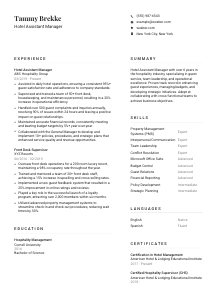
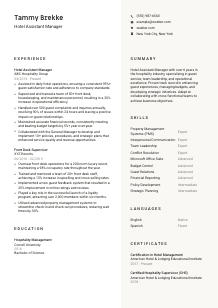
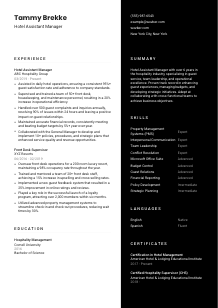
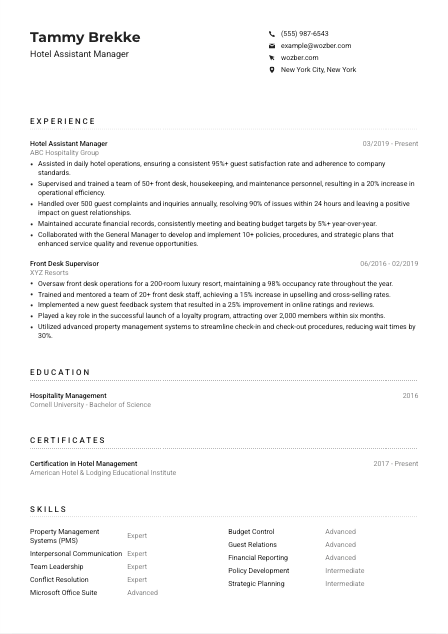
List roles in reverse chronological order with title, employer, and dates. If you moved from front desk supervision into broader operational management, make that progression obvious. The sample resume does this well by moving from Front Desk Supervisor to Hotel Assistant Manager, which naturally supports readiness for wider departmental oversight.
Each bullet should show what you managed, improved, or resolved. Instead of saying you "helped operations," specify outcomes such as guest satisfaction scores, complaint resolution times, upsell performance, staff training results, or policy changes that improved service delivery. The example bullets work because they connect responsibilities to measurable hotel outcomes like a 95%+ guest satisfaction rate and faster issue resolution.
Hospitality resumes benefit from metrics that feel native to the business. Good examples include occupancy rate, guest satisfaction, online review improvement, check-in wait time reduction, team size, complaint volume handled, budget performance, or revenue gains from upselling. Numbers like "trained 50+ staff," "reduced wait times by 30%," or "beat budget targets by 5%+" help a hiring manager picture your operating scale and control.
Prioritize experience that shows cross-department coordination, frontline leadership, guest recovery, and financial awareness. If you have older hospitality experience that is more junior, keep only the parts that support the move into assistant management. The resume should read like someone who can support a General Manager, coach staff, and keep service standards consistent across the property.
Your experience section should leave no doubt that you can handle the pace, people, and problem-solving that define assistant management in a hotel.
Education is usually not the deciding factor at this level, but it still matters when the posting names a degree requirement. In hotel management hiring, the education section works best when it quickly confirms the academic foundation behind your operational experience.
This posting asks for a Bachelor's degree in Hospitality Management or a related field, so list that information in a straightforward way. If your degree is an exact match, make sure the field of study is written clearly rather than abbreviated or buried.
Include degree, field of study, school, and graduation year. Hiring teams scanning multiple resumes should be able to confirm your qualification in seconds. A simple structure keeps attention on the credential instead of the formatting.
If you studied Hospitality Management, Hotel Administration, Tourism Management, or another closely related discipline, present it plainly. In the sample resume, the Bachelor of Science in Hospitality Management from Cornell immediately aligns with the requirement because the field is stated directly and needs no interpretation.
Honors, hospitality coursework, or student leadership can help if you are earlier in your career or if the experience section is still developing. For a candidate with several years in hotel supervision, those details are optional unless they connect to operations, service management, or business performance.
If you completed later training in revenue management, guest experience, leadership, compliance, or hotel systems, include it either here or under certifications, depending on format. Ongoing development is useful in hospitality because service standards, systems, and operating expectations keep evolving.
For this kind of role, education should quickly support your credibility and then let your operational experience do the heavier work.
Certifications are especially useful when they support leadership in hotel operations, guest service, or supervisory practice. They show continued investment in the field and can help separate you from candidates whose resumes stop at basic experience.
The job description says certification in Hotel Management or a related field is a plus, so any credential in hotel management, lodging operations, or hospitality supervision belongs near the top. Lead with certificates that strengthen your fit for service delivery, team oversight, and property operations.
Choose credentials that support how Assistant Managers are hired, such as hotel management, hospitality supervision, service excellence, or operational leadership. In the example, "Certification in Hotel Management" and "Certified Hospitality Supervisor" both reinforce readiness for staff oversight and hotel standards.
Add issue dates or validity ranges, especially if the credential is current or ongoing. In hospitality, recent learning can matter because service models, compliance expectations, and property systems do not stay static.
As you take on broader accountability, certifications in budgeting, revenue management, labor management, safety, or hospitality leadership can strengthen your profile further. Add credentials that reflect the level of hotel operation you want to manage next, not just the role you held last.
A concise certificates section can reinforce that your hospitality knowledge is current and backed by formal training, especially when it supports supervision and hotel operations.
For a Hotel Assistant Manager, the skills section should read like the toolset behind smooth property performance. Focus on the systems, people skills, and operational abilities that support guest satisfaction, staff coordination, and financial control.
This posting gives you a clear shortlist: property management systems, Microsoft Office Suite, interpersonal communication, and strong communication skills overall. It also implies leadership, training, complaint resolution, budgeting, and policy execution. Build your skills section around that mix rather than around broad hospitality buzzwords.
Balance hard and soft skills. PMS proficiency, financial reporting, budget control, and Office tools matter because the role touches records, reporting, and operational follow-through. Team leadership, guest relations, and conflict resolution matter because you are managing service breakdowns, coaching staff, and keeping standards consistent across departments.
Do not overload the section with every skill you have used in hospitality. Lead with the skills most relevant to assistant management and support them with evidence elsewhere in the resume. The sample list works because it stays close to hotel operations, including PMS, guest relations, budget control, financial reporting, and team leadership.
A hiring manager should be able to glance at this section and immediately see someone who can run shifts, guide staff, handle guests professionally, and keep hotel processes under control.
Language skills matter in hospitality because service happens in real time. For an Assistant Manager, your language section should help the employer understand whether you can communicate clearly with guests, staff, and managers in the environment they run.
This role requires advanced English speaking and comprehension, so English should be listed prominently with an accurate proficiency level. That matters because guest complaints, staff instructions, and operational updates all depend on clear communication.
Start with the language required for the role, then add any additional languages that could support guest service. In many hotels, extra language ability can help with front desk interactions, service recovery, and smoother communication with diverse guest groups.
If you speak another language fluently, include it. In the sample resume, Spanish adds useful hospitality value because multilingual communication can improve guest comfort and broaden service coverage, especially in high-traffic urban properties.
Use clear labels such as Native, Fluent, Intermediate, or Basic. Hotels rely on direct communication, so overstating language skill can create immediate problems in guest-facing or supervisory situations.
Not every hotel role requires multiple languages, but they can be a real advantage in busy markets, international travel hubs, or properties serving diverse clientele. Include them when they reflect your true ability to support guest experience and team communication.
For hotel management roles, language ability matters when it helps you communicate clearly, de-escalate issues, and support guests and staff without friction.
Your summary should quickly position you as someone who can support hotel operations, lead staff, and protect the guest experience. Keep it concise, but make sure it reflects the business side of the role as well as the service side.
Before writing, identify the mix that defines the role: operational support, team supervision, guest satisfaction, complaint handling, and budget awareness. Your summary should reflect that combination so the reader sees assistant management scope right away.
Start with your title or closest equivalent, years of experience, and the part of hospitality you know best. For example, experience in hotel operations, front office leadership, guest relations, or staff supervision gives immediate context and helps separate you from broader customer service candidates.
Choose strengths that connect to the posting and to measurable work. Good examples include improving guest satisfaction, leading multi-department teams, controlling budgets, reducing service issues, or supporting policy execution with the General Manager. The sample summary works because it combines guest service, team leadership, budgeting, and strategic support without drifting into vague claims.
Aim for 3 to 5 lines. This section should be compact enough for a hiring manager to absorb in one pass while still carrying real detail about your hotel background and operating value.
A well-written summary should make the hiring team expect stronger detail in the experience section and see you as someone prepared to support a hotel's daily performance from day one.
A Hotel Assistant Manager resume works when it shows how you support service standards, staff performance, guest issue resolution, and day-to-day property operations in measurable terms. Keep the language close to the job description, especially around PMS use, supervision, budgeting, and guest satisfaction, so the resume reads clearly to both hiring managers and ATS filters.
Use Wozber's free resume builder and ATS optimization tools to tighten that alignment, surface the right hospitality keywords, and present your background in a clean ATS-friendly structure. The final read should make one thing easy to judge: you can step into hotel operations and help keep the property running well.




