



Use Wozber and land your dream job
Create Resume
No registration required
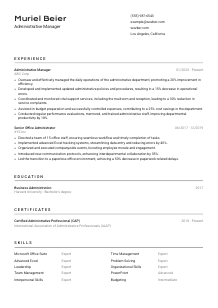
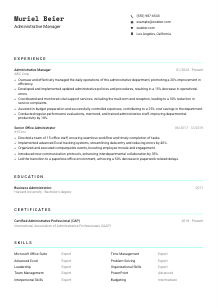
Running the show, but your resume not in command? Check out this Administrative Manager resume example, created with Wozber free resume builder. Learn how to highlight your managerial strengths to match job demands, leading your career to the top of the organizational chart!
Administrative managers keep office operations steady when the work behind the scenes gets complicated. Hiring teams look for people who can tighten procedures, keep support functions running, guide staff performance, and control administrative spend without slowing the business down. Your resume should make that operational range visible fast.
A tailored resume helps separate broad office support experience from true administrative leadership. When your bullets use the same language as the posting, such as policy updates, budget support, facilities coordination, and staff development, an ATS-compliant resume is far more likely to surface for review. Wozber's free resume builder helps organize that alignment cleanly so hiring teams can quickly see whether you can run an administrative department, not just contribute to one.
Administrative management starts with organization and professional judgment, and your header should reflect both. This section needs to confirm who you are, how to reach you, and whether you meet any location or communication requirements without cluttering the page.
Use your full name as the clearest element in the header, with a clean professional format that is easy to scan. Administrative managers are expected to present information clearly, and that standard starts before the first bullet point.
Place "Administrative Manager" under your name when that is the role you are pursuing. Matching the title in the posting helps frame the rest of your resume around department oversight, policy administration, support services, and team leadership rather than general office support.
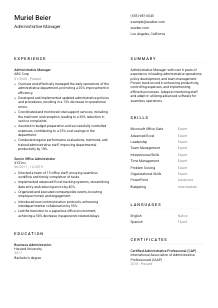
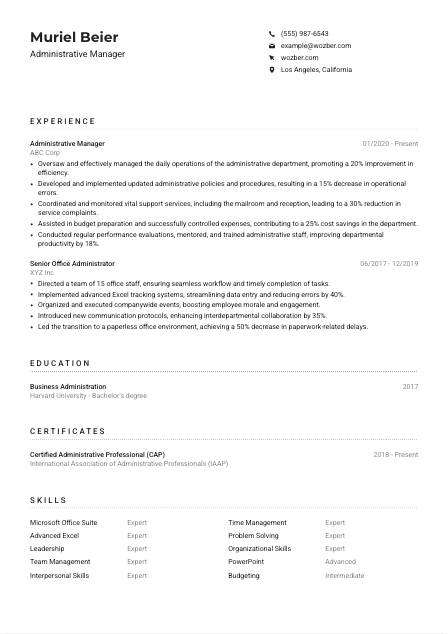
Include a reliable phone number and a professional email address you check regularly. If the posting includes a location requirement, address it here. In the example, listing Los Angeles, California immediately answers a stated requirement and removes a basic screening question.
A LinkedIn profile or professional website can help if it reinforces your management background, reporting scope, software strengths, or cross-functional work. Make sure the titles, dates, and achievements match your resume so there is no confusion when someone reviews both.
Do not use space on age, marital status, photo, or other details unrelated to managing administrative operations. Keep the focus on professional identity, contact access, and any requirement the employer has specifically stated.
Your header should answer the practical basics in seconds: who you are, what role you target, how to reach you, and whether you meet obvious screening requirements. For an Administrative Manager, that clean start already reflects the level of order the role demands.




This is the section hiring teams study most closely for Administrative Manager roles. They want to see evidence of department oversight, process improvement, staff supervision, service coordination, and budget control, with results that show the operation ran better because you were managing it.
Before rewriting your experience, mark the responsibilities that define the job. For this role, that includes daily administrative operations, policy and procedure updates, support services oversight, budget monitoring, and staff evaluations or training. Your strongest bullets should map directly to those functions.
List roles in reverse chronological order and use job titles that accurately reflect your level of responsibility. Administrative hiring teams notice the difference between office coordination and department management, so make scope visible through titles, team size, business functions supported, or the services you supervised.
Replace generic task descriptions with results tied to operations. The example works because it shows outcomes such as a 20% efficiency improvement, a 15% drop in operational errors, and a 30% reduction in service complaints. Those metrics tell a hiring manager that the candidate did more than maintain the office. They improved how it ran.
Administrative management is often measured through cost control, service reliability, turnaround time, staffing output, and process consistency. Use numbers where they naturally fit: budget savings, complaint reduction, productivity gains, fewer errors, faster workflows, or headcount managed. Even one clear metric per role can make your impact much easier to judge.
Prioritize bullets that show planning, delegation, policy ownership, vendor or facilities coordination, reporting, and people management. If you include earlier office support roles, frame them around advancement and increasing responsibility. In the sample, leading a team of 15 and building Excel tracking systems helps bridge senior office administration into full administrative management.
Your experience section should show that you can run administrative functions at a department level, improve procedures, and lead staff with measurable results. If those points are clear, the reader can picture you handling the daily operational load from day one.
Education matters most when the posting names a degree threshold, as it does here. Keep this section straightforward and easy to verify so the reviewer can quickly confirm that your academic background supports the role.
If you hold a bachelor's degree in Business Administration or a related field, list it clearly and use the full degree name. That direct wording helps when a role specifies an educational requirement and makes it easier for both recruiters and ATS filters to register the match.
Include degree, field of study, school, and graduation year or date. Administrative managers are expected to present information cleanly, and a tidy education entry supports that impression while keeping the requirement easy to confirm.
When your field closely matches the posting, say so directly. In the example, "Bachelor's degree" in "Business Administration" lines up neatly with the employer's request. If your degree is in a related discipline, use the official title and let your experience carry the rest of the case.
Most experienced Administrative Managers do not need a list of classes. Coursework is more useful if you are early in your career or trying to highlight preparation in operations, business communication, budgeting, or management.
Honors, leadership roles, or notable projects can help if they reflect planning, coordination, or operational responsibility. Keep them brief. This section should support your candidacy, not compete with your management experience.
When a posting specifies a degree, your education section should confirm it immediately. A clear entry keeps the review moving and supports the broader story that you have both the training and the practical experience to manage administrative operations.
Certifications are usually secondary for Administrative Manager roles, but the right one can strengthen your profile. They are most useful when they point to process knowledge, administrative standards, leadership development, or ongoing professional growth.
List certifications that connect to office administration, operations support, management, or business processes. A credential such as Certified Administrative Professional fits well because it supports the core work of procedure management, coordination, and administrative leadership.
A short list of relevant certifications is stronger than a long list of loosely connected courses. Focus on credentials that support the type of work the role covers, such as team supervision, process improvement, budgeting, records management, or administrative systems.
Show when you earned the certification and, if relevant, whether it is current. This gives context for your professional development and helps the reader understand whether the credential reflects recent engagement with the field.
Administrative management changes with reporting tools, compliance expectations, digital workflows, and service standards. A current certification can show that you keep your knowledge up to date rather than relying only on past experience.
Relevant certifications can strengthen your profile, especially when they support process discipline and administrative leadership. Keep the section focused and it will add useful weight without distracting from your work history.
Administrative Manager postings often combine software expectations with people leadership and process control. Your skills section should reflect both sides of the role so the reader sees that you can manage systems, workflows, and staff in the same seat.
Start with the terms the employer already uses. For this role, that includes Microsoft Office Suite, advanced Excel, PowerPoint, leadership, team management, communication, and interpersonal skills. If those skills reflect your real background, use that wording so your resume aligns naturally with ATS screening.
Lead with the abilities most central to the role. Advanced Excel matters because administrative managers often track budgets, headcount, service issues, or departmental metrics. Team management matters because the job includes mentoring staff and conducting performance evaluations. Put the most role-critical skills first.
You can group skills by category if it improves readability, such as software, operations, and leadership. The sample resume handles this well by combining technical tools like Microsoft Office and PowerPoint with management strengths like leadership, interpersonal skills, and budgeting. That mix reflects how the role actually works.
This section should show that you can run administrative work through both tools and people. When the list reflects the posting and matches the evidence in your experience section, it strengthens the full case for your candidacy.
Administrative Managers often sit at the center of communication between staff, vendors, leadership, and support functions. If a posting calls for clear English communication, your language section should confirm that plainly and, if relevant, show added range for a multilingual workplace.
When the job specifically asks for clear English communication, list English at the top with an accurate proficiency level. This is especially relevant in roles involving staff evaluations, policy communication, vendor follow-up, and daily cross-functional coordination.
Use clear labels such as Native, Fluent, Advanced, or Intermediate. For communication-heavy management roles, inflated language claims create risk, so keep the wording honest and easy to understand.
Additional languages can be useful in offices serving diverse employee groups, customers, or community partners. In the example, Spanish adds context that could be helpful in many workplace settings, even though English is the stated requirement.
Choose levels that reflect how well you can actually write, speak, and handle workplace conversations. Administrative managers are often responsible for instructions, documentation, and escalation handling, so precision matters more than appearance here.
Some Administrative Manager positions involve multilingual teams, external vendors, or regional offices. If language ability supports smoother service delivery or stronger staff communication, it is worth including. If not, keep the section simple and focused on the required language.
Language skills matter most when they support the real communication demands of the job. For this role, clear English should be unmistakable, and any additional language should strengthen the picture of how you manage people and operations.
The summary is where you establish your level quickly. For an Administrative Manager, that means showing operational oversight, team leadership, process improvement, and the kind of business results that make a department run more smoothly.
Read the posting and identify the two or three themes that matter most. Here, those themes are administrative operations, policy development, staff leadership, and budget awareness. Build your summary around those priorities instead of broad claims about being organized or hardworking.
Start with a direct line that tells the reader who you are professionally. The sample summary does this well with "Administrative Manager with over 6 years of experience," which immediately sets seniority and relevance without wasting space.
Use the next sentence or two to show the work you are known for, such as improving productivity, reducing operational errors, controlling expenses, updating procedures, or mentoring staff. Mention software strengths like advanced Excel or Microsoft Office only when they support the operational story.
Aim for three to five sentences with no filler. This section should read like a high-level briefing on your management scope and results, giving the reader a quick reason to expect stronger detail in the experience section.
Your summary should make it obvious that you are prepared to lead administrative operations, not simply assist with them. When it names your experience level, core strengths, and a few concrete outcomes, the rest of the resume has a much clearer foundation.
Your resume should now present a clear management profile: operational oversight, policy and procedure work, support service coordination, budget awareness, and staff development backed by measurable results. That is the combination hiring teams usually need to see before moving an Administrative Manager candidate forward.
Use Wozber's free resume builder to shape that experience into an ATS-friendly resume format, then refine the wording with Wozber's AI resume builder and ATS resume scanner so the language matches the role without sounding forced. The final document should make it easy to judge one thing quickly: whether you can keep an administrative department running efficiently and lead the people behind it.