



Use Wozber and land your dream job
Create Resume
No registration required
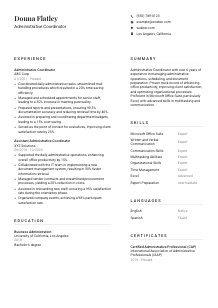
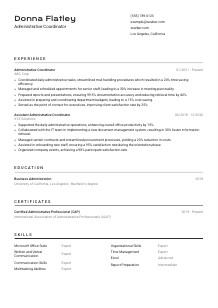
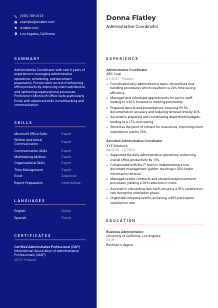
Juggling admin tasks, but your resume seems disorganized? Sync up with this Administrative Coordinator resume example, created with Wozber free resume builder. Learn how to show off your coordination skills in the layout, guiding your career path without a paper pile-up!
Administrative Coordinator hiring often comes down to one practical question fast: can this person keep executive schedules, records, reporting, and day-to-day office flow moving without dropped details? Resumes for this field work best when they show dependable coordination, clean documentation habits, and the ability to manage competing requests across calendars, correspondence, and administrative processes.
A tailored resume changes how quickly those strengths come through. When your wording reflects the posting's priorities, from scheduling and report preparation to budget support and client-facing communication, Wozber's free resume builder helps you shape that experience into an ATS-compliant resume that is easy to scan and easy to trust for an Administrative Coordinator opening.
Administrative work starts with accuracy, and your contact section sets that tone immediately. For an Administrative Coordinator, this area should read as reliable, professional, and aligned with any practical requirements named in the posting.
Use your full name as the clearest heading on the page. Keep it slightly more prominent than the body text so hiring teams can identify your application quickly when they are reviewing several resumes for support and coordination roles.
Place "Administrative Coordinator" directly under your name if that is the role you are pursuing. Matching the title from the job ad helps frame your experience correctly, especially when your previous positions include related titles such as Administrative Assistant or Assistant Administrative Coordinator.
List a reliable phone number and a professional email address. Administrative roles depend on prompt communication, so even small mistakes here can undermine the impression you want to create. Check every digit and character before sending the resume.
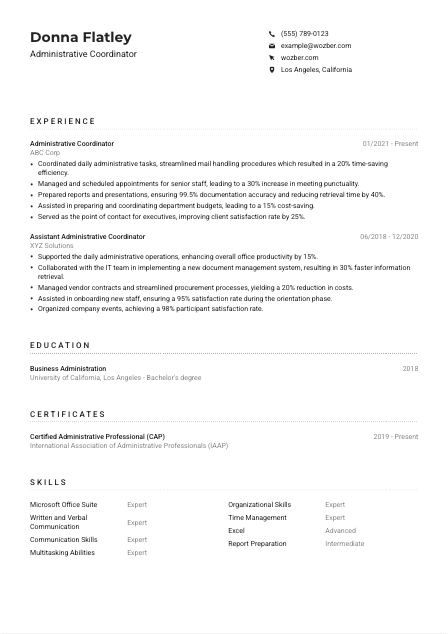
If the employer asks for candidates in a specific area, include your city and state. In the example, listing "Los Angeles, California" immediately answers a stated requirement and removes uncertainty about local availability.
Include LinkedIn or a professional website when it supports your candidacy with consistent job history, recommendations, or additional business-facing credentials. Make sure the profile matches your resume titles, dates, and overall tone.
When these details are clean and complete, your resume starts with the same precision the role requires in scheduling, documentation, and executive support.




This is the section where Administrative Coordinators separate themselves from general office support candidates. Hiring teams want to see how you handled workflow, protected accuracy, supported senior staff, and improved office operations under real conditions.
Read the job description and mark the recurring tasks. For this opening, that includes scheduling meetings and travel, maintaining records, preparing reports and presentations, supporting budgets, and serving as a contact point for executives and clients. Those are the duties your bullets should reflect if you have done them.
List your most recent role first, followed by earlier positions, with company name, title, and dates. Administrative hiring often values progression from general support into broader coordination responsibility, so your timeline should make that growth easy to follow.
Do not stop at "handled calendars" or "prepared reports." Show what changed because of your work. The sample resume does this well with bullets such as improving meeting punctuality through scheduling and maintaining 99.5% documentation accuracy through better report preparation and file management.
Metrics are especially effective here when they reflect office efficiency, response time, accuracy, cost control, retrieval speed, punctuality, or stakeholder satisfaction. A 20% time saving in mail handling or a 15% reduction in department costs tells far more than saying you were "responsible for administration."
Choose accomplishments that support the target role, even if you have broader office experience. Vendor coordination, onboarding support, records management, presentation prep, and executive communication all strengthen an Administrative Coordinator resume. Trim bullets that do not reinforce organization, communication, or operational support.
Your experience section should make it easy to picture you managing schedules, records, reporting, and internal coordination with steady control.
For many Administrative Coordinator openings, education is a straightforward qualification check. Keep it simple, accurate, and aligned with the degree level or field the employer has requested.
If the posting asks for a Bachelor's degree in Business Administration or a related field, make sure that information is easy to find. In the example, the Business Administration degree directly supports the role's stated educational requirement.
List degree, field of study, school, and graduation year or date. Administrative resumes benefit from orderly presentation, and this section should reflect that same clarity.
When your degree closely matches the posting, keep the wording explicit instead of shortening it too much. "Bachelor's degree, Business Administration" reads more clearly than a vague abbreviation and helps both human readers and ATS systems connect your background to the requirement.
Most experienced Administrative Coordinators do not need an expanded education section. Add honors, coursework, or projects only if they reinforce useful strengths such as business operations, spreadsheet work, communication, or office systems.
Leadership roles, scholarships, or relevant campus project work can help early-career candidates who need more proof of coordination ability. If you already have several years of administrative support experience, keep this section brief and let your work history carry more weight.
When the degree requirement is visible at a glance, the reader can move quickly to the parts of your resume that show how you operate in the role.
Certifications are rarely the main decision point for Administrative Coordinator roles, but they can strengthen your profile when they reflect office operations, business communication, or professional standards in administrative support.
Start with the job ad. This example does not require a certification, which means certificates should support your application rather than dominate it. Add them when they sharpen your profile, not as filler.
Choose credentials that connect to the actual work of coordination, documentation, office systems, or executive support. A Certified Administrative Professional credential is a solid example because it reinforces professional training in the core demands of the role.
List the year earned and, if relevant, the active period. For certifications that remain current over time, a range such as "2019 - Present" quickly shows the credential is still active and maintained.
If you pursue additional learning, focus on areas that often strengthen Administrative Coordinator performance, such as advanced Excel, business writing, records management, or office software workflows. Those additions can support both ATS alignment and hiring confidence when they match the posting.
A focused certificate section can reinforce your professionalism and continued development without distracting from the coordination work already shown in your experience.
Administrative Coordinator skills should read like tools you actually use to keep people, information, and schedules organized. The most effective lists mirror the posting while staying grounded in your real day-to-day work.
Look for software, communication demands, and operational strengths. Here, Microsoft Office Suite, advanced Excel, written and verbal communication, organization, and multitasking are direct priorities. Those belong near the top if they reflect your background.
Choose skills that support scheduling, reporting, recordkeeping, executive support, budget tracking, and office coordination. The sample resume does this well by combining Office Suite and Excel with communication, time management, and report preparation instead of listing unrelated abilities.
A focused skills section is easier to review and stronger for ATS optimization than a long list of generic traits. Group your best-matching competencies and avoid repeating the same idea under slightly different wording unless the phrasing appears in the job description.
By the time someone finishes this section, they should understand which tools and coordination strengths you would bring into the office on day one.
Language ability matters in administrative roles because the work depends on accurate communication, polished correspondence, and steady interaction with staff, leaders, clients, and vendors. Present your language skills in a way that is honest and useful.
If the posting specifies English competency, list English prominently with an accurate proficiency level. That immediately confirms a core communication requirement for a role centered on scheduling, reporting, and professional correspondence.
Use clear proficiency labels such as Native, Fluent, Intermediate, or Basic. Administrative roles often involve direct communication with executives or external contacts, so inflated language claims can quickly create problems in interviews or on the job.
Additional languages can be useful in offices that serve diverse teams, customers, or vendors. In the example, Spanish strengthens the profile without being treated as a universal requirement for every Administrative Coordinator position.
Keep your rating terms standardized across the section so the reader can scan them quickly. Consistency also helps your resume look more polished and structured overall.
Language skills matter most when they improve real work outcomes such as smoother client communication, clearer front-office support, or better coordination across teams. Include them when they contribute to that picture, not just to lengthen the resume.
For this kind of role, clear language reporting supports the larger impression that your communication is accurate, business-ready, and dependable.
Your summary should quickly establish the kind of administrative support you handle, the scope of your experience, and the tools or outcomes that make you worth a closer look. Keep it compact, but make it specific enough to distinguish you from general office applicants.
Administrative Coordinator work can range from calendar management to reporting, records control, budget support, and executive communication. Shape your summary around the functions you actually perform so the reader understands your operating range right away.
A direct first line works well here. The sample's "Administrative Coordinator with over 6 years of experience" is effective because it anchors seniority immediately before moving into operations and process support.
Highlight the capabilities most relevant to the target role, such as scheduling for senior staff, document accuracy, Excel proficiency, office process improvement, or stakeholder communication. If you have measurable wins like cost savings or higher client satisfaction, mention one to add weight.
Aim for a short paragraph of three to five lines. That gives you enough room to cover experience level, core administrative strengths, and one or two concrete outcomes without turning the summary into a repeat of the experience section.
A well-written summary tells the reader, within seconds, that you can manage the administrative backbone of a team with accuracy, pace, and professional communication.
An Administrative Coordinator resume works best when every section supports the same message: you keep schedules, records, communication, and office processes under control. Align your experience with the posting, keep your metrics relevant to administrative work, and make practical requirements like education, software proficiency, and location easy to confirm.
Wozber's free resume builder can help you turn that information into an ATS-friendly resume format, strengthen phrasing with AI-assisted tailoring, and check alignment with an ATS resume scanner. The final result should make one thing clear fast: you can step into the role and keep the work moving.




