



Use Wozber and land your dream job
Create Resume
No registration required
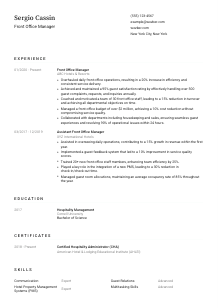
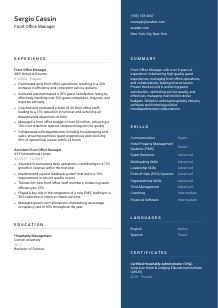
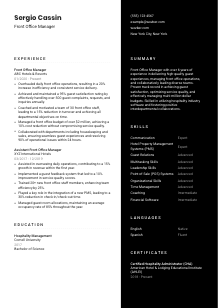
Welcoming guests, but your resume feels like the wrong keycard? Step into this Front Office Manager resume example, created with Wozber free resume builder. Learn how to present your leadership and service prowess to fit the job's doorway, ensuring your career checks in with all the right receptions!
Front office management sits at the point where guest expectations, staffing pressure, and daily hotel operations meet. Hiring teams want to see whether you can keep service steady during busy check-ins, resolve guest issues without escalation, and lead a desk team that works well with housekeeping, sales, and other departments. Your resume should make that operating range visible from the start.
A tailored resume helps separate hotel front office leadership from general customer service experience by showing the right mix of guest relations, PMS and POS usage, team supervision, and budget ownership in language that matches the posting. Wozber's free resume builder supports that kind of ATS optimization by helping you align keywords and structure clearly, so the hiring team can quickly see whether you can run the desk, coach staff, and protect the guest experience.
For a Front Office Manager, the header should answer practical questions fast: who you are, what role you do, and whether you meet any location or contact requirements. Keep it clean and professional so nothing gets in the way of a quick hiring decision.
Use your full name in a slightly larger font than the rest of the header. Hotel hiring moves quickly, and your name should be immediately visible on printed resumes, email attachments, and ATS previews.
Place "Front Office Manager" under your name if that is the role you are pursuing. This removes ambiguity, especially if your recent background includes titles such as Assistant Front Office Manager, Guest Services Manager, or Rooms Division roles with overlapping duties.
Your phone number and email should be current and straightforward. A missed digit or an overly casual email address creates avoidable friction for a role that depends on polished guest communication and professionalism.
If the employer specifies a city, add it in your header when you already live there. In this example, listing "New York City, New York" directly supports the stated requirement and removes questions about relocation or local availability.
A LinkedIn profile can strengthen your application if it reflects the same titles, dates, and hospitality achievements shown on your resume. If it is outdated or inconsistent, leave it off until it matches your current front office leadership story.
This section is brief, but it does real work. When your details, title, and location are easy to scan, the employer can move straight to your hotel operations experience without chasing basic information.




This is the section that carries the most weight for a Front Office Manager. Hotels need more than guest-facing warmth. They need someone who can manage desk flow, coach staff, respond to complaints, control labor, and keep service quality high during busy shifts and unexpected issues.
Start with the responsibilities that appear in the posting and make sure your recent roles answer them directly. For this kind of job, that usually means front office operations, guest complaint handling, team leadership, performance coaching, cross-department coordination, and budget oversight. If your past work included those functions, name them clearly instead of hiding them behind generic hospitality wording.
List roles in reverse chronological order and make each entry easy to scan with title, hotel or company name, and dates. Career movement from assistant management into full front office leadership is valuable here because it shows increasing responsibility for service delivery, staffing, and departmental results.
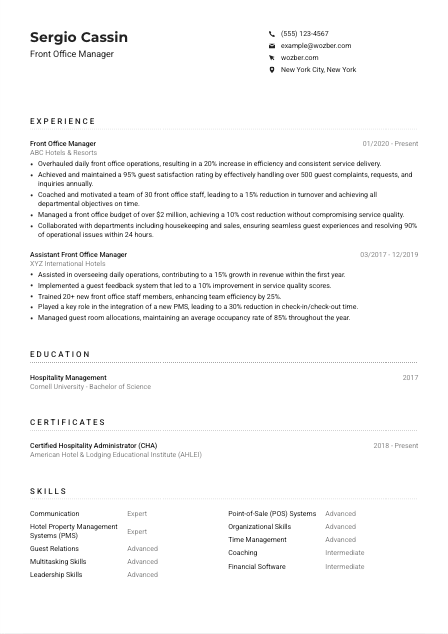
Each bullet should show what you improved, resolved, led, or controlled. The sample resume works because it ties core front office duties to concrete results, such as handling more than 500 guest issues while maintaining a 95% satisfaction rating or reducing turnover through coaching. That reads much stronger than simply saying you were responsible for guest relations or staff supervision.
Quantify your scope wherever possible. Guest satisfaction scores, check-in and check-out speed, occupancy support, complaint volume, team size, turnover reduction, labor savings, and departmental budget figures all help hiring teams understand your level. Metrics like a 20% efficiency gain or a $2 million budget are useful because they reflect how hotel performance is actually measured.
Prioritize experience that supports the target role, especially from hotels, resorts, or other hospitality settings. If you have older or less relevant customer service jobs, keep them brief unless they show transferable strengths such as guest recovery, POS handling, shift leadership, or high-volume service coordination.
A hiring manager should be able to look at your experience section and quickly understand the size of your team, the guest service standards you managed, and the operational results you delivered. That is the level of detail that makes a Front Office Manager resume credible.
Education rarely outweighs hands-on hotel experience for this role, but it still helps frame your professional background. A degree in hospitality management, business, or a related field can reinforce your understanding of guest service standards, hotel operations, and team management.
If you have a degree connected to hospitality, tourism, business, or management, list it clearly. A Bachelor of Science in Hospitality Management, like the one shown in the example, immediately supports a resume built around hotel operations and guest experience.
Include your degree, field of study, school name, and graduation year. Clear formatting matters because this section is usually scanned quickly after experience, and hiring teams should not have to decode it.
When your degree lines up with the work, you do not need extra explanation. Hospitality management coursework already suggests exposure to rooms operations, service standards, revenue basics, and organizational leadership, all of which support front office management.
Relevant courses can help if you are earlier in your career or if your degree is less directly tied to hospitality. Subjects such as hotel operations, customer experience management, or hospitality finance are worth noting when they strengthen your match for the role.
Honors, leadership activities, or hospitality-related student involvement can be useful if they add context. Keep them brief and include them only when they reinforce management potential, service orientation, or commitment to the industry.
For most Front Office Manager applications, education is supporting material rather than the main selling point. Present it cleanly, let relevant study reinforce your hotel background, and keep the focus on the operational experience that follows.
Certifications can add weight when they reflect hotel operations, guest service, or management development. They are especially useful when they show continued investment in the hospitality field rather than general training with no connection to front office leadership.
Start with certifications that relate directly to hospitality or management. In the example, the Certified Hospitality Administrator credential strengthens the candidate's positioning because it supports leadership in a hotel setting. A certification only helps if the hiring team can connect it to front office performance.
Do not crowd this section with every course or minor credential you have completed. A shorter list of relevant certifications is easier to scan and gives more weight to the qualifications that matter for hotel service, operations, and team leadership.
If a certification is active, renewed, or has an ongoing validity period, include that date information. Current credentials show that your knowledge is up to date, which matters in service environments shaped by changing systems, compliance expectations, and guest experience standards.
Front office leaders often grow through training in hospitality administration, customer service recovery, revenue awareness, leadership development, or property systems. Adding new credentials over time helps show that you are keeping pace with the operational demands of hotel management.
This section works best when every item points back to hotel operations, guest service, or leadership. A focused list can strengthen your case without distracting from the experience that carries the most value.
A Front Office Manager skills section should read like the toolkit behind a smooth guest arrival, a well-run shift, and a reliable desk team. Focus on the capabilities that support service quality, operational control, and staff leadership in a hotel environment.
Start with the abilities the employer has named or clearly implied. For this role, that includes guest relations, leadership, communication, multitasking, organization, time management, PMS proficiency, and POS familiarity. These are central to front office work, so they should appear in your skills section if they reflect your actual background.
Choose skills you can back up in the experience section. If you list PMS expertise, your bullets should show system-related improvements or front desk efficiency gains. The example does this well by linking PMS implementation to a 30% reduction in check-in and check-out time.
Order matters. Lead with the capabilities most closely tied to running front office operations, such as guest relations, team leadership, PMS, POS, and communication. That gives the employer a fast read on whether you meet the core demands of the role.
When this section is aligned with your experience, it reinforces your credibility instead of repeating buzzwords. Keep it focused on the systems, service abilities, and leadership strengths that a hotel front office actually depends on.
Language ability matters in hospitality because front office teams handle guests, internal coordination, and service recovery in real time. Even when only one language is required, listing languages clearly can strengthen your profile for properties serving diverse travelers and local communities.
If the job asks for English proficiency, list English at the top with an accurate rating. For a Front Office Manager, that covers spoken guest interaction, written communication, shift handoffs, and coordination with other departments.
Additional languages can be a real asset in hotels, especially in cities with international visitors. Spanish, for example, may help with guest communication and team coordination, but list it as an added strength rather than assuming every employer requires it.
Terms such as Native, Fluent, Intermediate, and Basic are easy to understand and set practical expectations. Avoid vague labels that do not tell the employer whether you can handle live guest conversations or only simple exchanges.
Language skills matter most when they improve service delivery. If a property serves international guests, hosts events, or operates with a multilingual staff, your language ability can support smoother check-ins, fewer misunderstandings, and stronger guest satisfaction.
Include languages that genuinely help you build rapport, resolve issues, or support team communication. In hospitality, that kind of communication range can strengthen the guest experience in very practical ways.
This section should show how you communicate in the environments hotels actually run in. Clear language ratings help employers judge whether you can handle guest interaction, coordination, and service recovery with confidence.
Your summary should quickly establish the level of hotel operation you have managed and the guest service results you are known for. Keep it short, specific, and built around the strengths that matter most for front office leadership.
Start with a direct line that names your target role and your years in hospitality or front office leadership. A phrase such as "Front Office Manager with 6+ years of hospitality experience" gives immediate context and helps frame everything that follows.
Mention two or three core strengths that match the posting, such as guest satisfaction, front office operations, team leadership, PMS and POS proficiency, or budget management. The sample summary is effective because it combines guest experience, operations, leadership, and budget scope in a compact format.
Aim for a short paragraph, not a biography. Focus on proven capabilities and a few concrete strengths rather than broad claims about passion or dedication. Hiring teams want a quick read on your service standard, management level, and operational value.
Your summary should prepare the reader for the details in your experience section. If you claim excellence in guest relations, service quality, or cross-department coordination, the bullets that follow should show the numbers, team size, and outcomes behind those claims.
A well-written summary gives the employer an immediate sense of your front office range, from guest handling to staff oversight and operational control. Keep it aligned with the role so the rest of the resume lands with more force.
A Front Office Manager resume works when it makes the day-to-day realities of the job easy to picture: leading the desk team, handling guest issues, managing systems, and keeping service consistent under pressure. Every section should support that picture with clear titles, relevant skills, and measurable hotel results.
Use Wozber to shape those details into an ATS-compliant resume that matches the posting language and stays easy to scan. When the final version shows guest service performance, team leadership, and operational control in clear terms, hiring teams can quickly see your readiness to lead the front office.




