



Use Wozber and land your dream job
Create Resume
No registration required
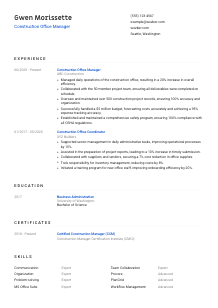
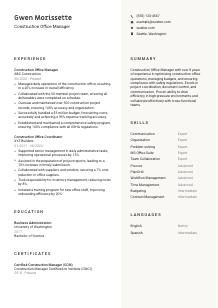
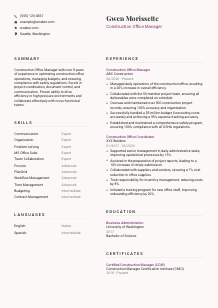
Organizing job sites, but your resume seems disassembled? Nail it together with this Construction Office Manager resume example, built with Wozber free resume builder. It shows how to present your managerial expertise to match job requirements, setting your career's foundation as solidly as the structures you oversee!
Construction offices run on coordination. Schedules shift, subcontractor paperwork piles up, budgets move, and project teams need clean information fast. A Construction Office Manager resume has to show that you can keep document control, office workflow, and project support moving without losing track of cost, compliance, or deadlines.
When that operational range is tailored well, hiring teams can quickly separate general office managers from candidates who understand construction records, vendor communication, budget tracking, and safety-related administration. Wozber's free resume builder helps shape that experience into an ATS-compliant resume that uses the right construction language, so your application reads like someone ready to support active projects from day one.
For this role, the contact section does more than identify you. It immediately confirms practical basics such as role alignment, location fit, and professional presentation. In construction hiring, those details matter early because project-driven teams often need someone who can step into an active office environment without avoidable friction.
Place your full name at the top in a clean, readable format. Keep it more prominent than the rest of the header so hiring managers can quickly connect your resume to emails, interview notes, and application records.
Add "Construction Office Manager" directly under your name if that matches the role you are pursuing. This is especially useful when your past titles vary, such as Construction Office Coordinator or Office Administrator, because it frames your experience around the function the employer needs now.
List a current phone number and a professional email address. Avoid clutter in this section. Construction employers often move fast when scheduling calls, so your contact information should be immediate and easy to scan on both desktop and mobile.
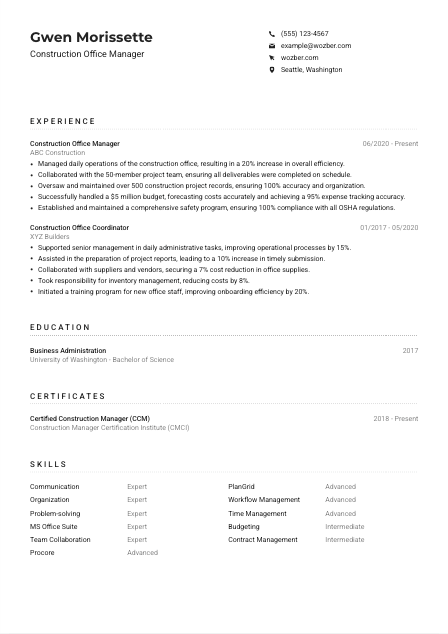
If a posting asks for a local candidate or someone willing to relocate, include your city and state. In the example, Seattle, Washington is worth showing because the employer specifically asked for location alignment. If you are relocating, note that clearly instead of leaving the reader guessing.
Add LinkedIn or a professional website only if it supports your candidacy with consistent information, project history, certifications, or industry experience. Make sure the title, dates, and scope of work match your resume, especially if you have managed project documentation, budgets, or construction administration across multiple employers.
This section should confirm that you are reachable, professionally presented, and logistically aligned with the opening. For a Construction Office Manager, that quick clarity helps the reader move straight to your operations experience.




This is the section most likely to decide whether you move forward. Construction employers want to see how you handled the flow of work behind active projects, from records and contracts to team coordination, cost tracking, and compliance support. Generic administrative bullets will undersell you here.
Start by marking the responsibilities that define the job, such as workflow management, document control, project coordination, budgeting, forecasting, expense tracking, and regulatory compliance. Then make sure your experience bullets use that same language where it truthfully reflects your work. If you have used construction management software, contract files, RFIs, submittals, or budget reports, name them rather than hiding them behind vague office terms.
List roles in reverse chronological order with title, company, and dates. If your career moved from general office support into construction coordination or office leadership, let that progression show. The sample resume does this well by moving from Construction Office Coordinator to Construction Office Manager, which immediately signals increasing scope and ownership.
Each bullet should describe a task you owned and the result it produced. For this role, strong bullets often cover faster document turnaround, cleaner project records, improved scheduling coordination, fewer administrative delays, tighter expense tracking, or stronger support for field and project teams. The example bullet about increasing office efficiency by 20% works because it links day-to-day operations to a measurable business result.
Construction administration is easier to evaluate when you give numbers. Include team size, record volume, budget value, project count, reporting cadence, or compliance rates when you can. The sample resume gives useful scope markers such as managing over 500 project records, coordinating with a 50-member project team, and tracking a $5 million budget. Details like these help employers judge whether your past environment matches their own.
Keep the section focused on work that supports a construction office. General administrative tasks belong only if they connect to project delivery, vendor coordination, cost control, onboarding, or reporting. If a bullet could fit any office job without change, rewrite it so it shows your construction context, systems, stakeholders, or compliance responsibilities.
After this section, a hiring manager should understand the size of office you supported, the records and budgets you handled, and how your work kept projects organized and compliant. That is the level of detail that moves a Construction Office Manager resume forward.
Education matters here because employers often use it as an early qualification check, especially for office managers who interact with project teams, contracts, budgets, and reporting. Keep the section straightforward, but make the degree alignment easy to spot.
If you hold a bachelor's degree in Business Administration, Construction Management, or a related field, list it clearly. The example uses a Bachelor of Science in Business Administration, which aligns neatly with the requirement and supports the budgeting and office operations side of the role.
Include your degree, school, field of study, and graduation year or date. Clear structure helps both ATS parsing and human review, especially when education is one of the stated requirements in the posting.
If your field is closely connected rather than identical, such as operations management, accounting, or construction administration, keep the wording specific so the connection is obvious. You want the reader to see why your coursework supports project coordination, forecasting, records management, or office leadership.
Relevant coursework, capstone work, or projects can help if you are early in your career or if they directly support the job. For example, coursework in budgeting, business operations, contract administration, or construction project management can add context. If you already have several years of strong experience, keep this part brief.
Industry credentials can reinforce your education, especially when they relate to construction management or safety. Still, give them their own section when possible so items like CCM or OSHA-related training are easier to find and do not get buried under your degree entry.
This section does not need long explanation. It needs to show, at a glance, that your academic background supports the office, coordination, and business side of construction work.
Certifications carry extra weight in this profession when they strengthen your understanding of project workflows, safety expectations, or construction management standards. Use this section to reinforce role-specific knowledge, not to list every course you have ever completed.
Start with certifications that support the actual job. If the posting mentions OSHA familiarity, relevant safety training belongs here. If you hold credentials related to construction management, contract administration, or compliance, place those first because they connect directly to how a construction office is run.
Focus on credentials that help explain your ability to manage documentation, coordinate projects, support compliance, or work within construction processes. In the example, the Certified Construction Manager credential adds weight because it supports both industry knowledge and management responsibility.
Add issue dates, renewal dates, or active status when relevant. This matters most for certifications tied to safety standards, compliance, or industry-recognized qualifications that need to remain current.
Construction software, safety practices, and regulatory expectations change over time. Ongoing certification or training in tools like Procore, safety compliance, or construction documentation systems can strengthen your resume, especially if the role involves fast-moving project support and regulated environments.
When this section is focused, it tells the employer that you understand construction beyond general administration. That matters when the job includes budgets, records, safety expectations, and coordination across office and field teams.
A Construction Office Manager needs a mix of technical fluency and operational judgment. Your skills section should reflect how the office actually functions, with the software, coordination habits, and administrative control that keep projects moving. Avoid generic lists that could belong to any office role.
Use the posting to identify the skills the employer is actively screening for. In this case, that includes construction management software such as Procore or PlanGrid, communication, organization, problem-solving, budgeting, and compliance awareness. If you have those skills, use the same terminology so both recruiters and ATS systems can match them correctly.
Put the most role-relevant skills first. Construction-specific software, document control, workflow management, expense tracking, contract management, and cross-team coordination usually deserve more attention than broad office skills alone. The sample resume gets this mostly right by pairing Procore and PlanGrid with workflow management and budgeting rather than leaving them buried.
If your format allows, separate technical tools from operational and interpersonal strengths. For example, software and systems can sit alongside project coordination, while communication and problem-solving support your work with project managers, vendors, field staff, and executives. This makes your capability mix easier to scan in a busy hiring review.
By the time someone finishes this section, they should see that you can work inside construction systems, keep information organized, and support project delivery with dependable administration. That is far more useful than a long list of generic strengths.
Language ability matters when the role depends on clear communication across project teams, vendors, and internal staff. For a Construction Office Manager, that can affect scheduling, documentation, follow-up, and day-to-day coordination. Keep this section practical and tied to how you work.
If the employer asks for English proficiency, list it clearly. Do not assume it is implied. In this posting, English is specifically mentioned, so showing it in the language section removes doubt immediately.
Additional languages can be valuable in construction settings where office staff coordinate with diverse crews, suppliers, or clients. If you speak another language well enough to help with day-to-day communication, include it. The example's Spanish entry is useful because it could support broader coordination, even though it is not a universal requirement.
Describe your level with standard terms such as Native, Fluent, Intermediate, or Basic. That gives the reader a realistic sense of whether you can handle calls, emails, documentation support, or simple conversation in that language.
Only feature languages that would realistically matter in the workplace. If a second language helps with vendor communication, staff onboarding, front-office coordination, or project support, it is worth listing. If not, keep the section lean.
Language skills develop over time, especially in work environments with repeated practical use. If your level improves through field exposure, classes, or regular communication with crews and vendors, revise your resume to reflect that growth accurately.
For this role, language skills should help the employer understand how you communicate in a real construction environment. Lead with required proficiency, then add any additional language ability that supports smoother coordination.
Your summary is the fastest way to frame your background before the reader gets into your bullet points. For this role, it should quickly establish your years of experience, your command of construction office operations, and the type of scope you have already handled.
Review the posting before writing the summary and pull forward the themes that define the job. For a Construction Office Manager, that usually means office operations, project coordination, document control, budgeting, and compliance support. Build your opening around those areas instead of using a broad management statement that could fit any industry.
Lead with your title or closest equivalent, your years of experience, and your construction focus. A line like the sample summary works because it quickly establishes more than 8 years of experience and points to office operations, budgeting, and safety compliance rather than generic administration.
Use the next sentence to name the capabilities the employer is most likely to care about first. That may include project coordination, construction records management, Procore or PlanGrid experience, expense tracking, or communication across project teams. Keep the wording natural, but close enough to the posting that the alignment is obvious.
Aim for a compact summary of two to four sentences. The section should introduce your value quickly, not repeat your entire experience history. If every line mentions a concrete part of construction office work, the summary will do its job.
When written well, this section tells the reader exactly what kind of construction office environment you can manage and what results you tend to deliver. That context makes the rest of your resume easier to interpret and stronger in ATS review.
A strong Construction Office Manager resume should now show the operational side of your work clearly, from document control and project coordination to budgeting, software use, and compliance support. Each section should make it easier to judge whether you can keep a construction office accurate, responsive, and organized under project pressure.
Use Wozber's free resume builder to tighten wording, improve ATS optimization, and shape your experience into an ATS-friendly resume format that matches the role's language. The finished resume should make one point clear fast: you can keep the office side of construction moving as reliably as the jobsite depends on it.




