



Use Wozber and land your dream job
Create Resume
No registration required
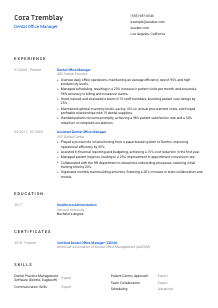
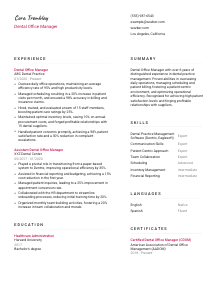
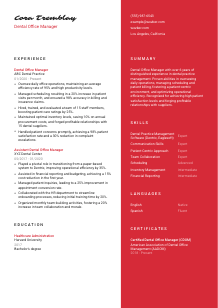
Orchestrating dental operations, but your resume feels in need of a root canal? Check out this Dental Office Manager resume example, created with Wozber free resume builder. It shows how to align the story of your management journey with dental office needs, setting your career trajectory for success with every smile!
A Dental Office Manager keeps the practice running on two fronts at once: patient experience and operational control. Hiring teams look for someone who can keep scheduling, billing, insurance workflows, staff coordination, and front-office standards moving without disrupting care. Your resume needs to show that you can manage a busy practice environment, not just perform general office administration.
When that experience is tailored well, the hiring team can quickly distinguish dental practice leadership from broader healthcare or administrative work. Wozber's free resume builder helps you shape an ATS-compliant resume around the language of the role, so software proficiency, revenue-cycle tasks, staff oversight, and patient service are easy to read in both ATS screening and human review. That makes it much easier to see whether you can run the office side of a dental practice with confidence.
In dental office management, small administrative misses create bigger operational problems. Your contact section should reflect the same accuracy and professionalism expected when handling patient communication, schedules, and insurance follow-up.
Place your full name at the top in a clean, readable format. For a management role, this should feel polished and businesslike, the way your front desk systems and patient-facing communication would be expected to feel in practice.
Add "Dental Office Manager" directly under your name when that is the role you are pursuing. This creates immediate alignment with the posting and helps position your background around practice operations, team supervision, and patient flow from the first line.
Use a reliable phone number and a professional email based on your name. For a role that often handles patient concerns, vendor coordination, staff communication, and insurance questions, accuracy here matters more than it might in less communication-heavy positions.
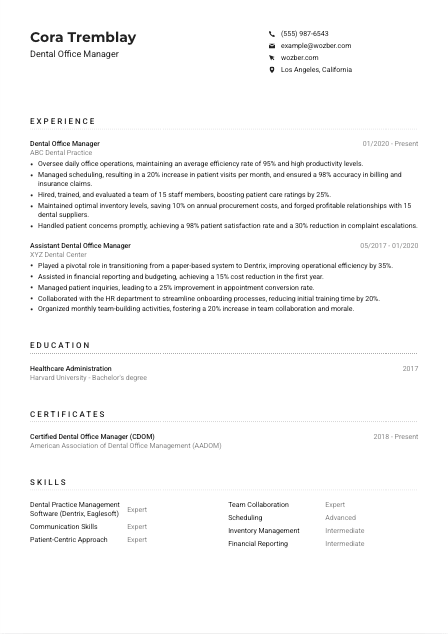
If a practice specifies a local requirement, show your city and state clearly. In the example, listing Los Angeles, California directly supports the employer's stated need for a local candidate. Treat this as tailoring to the posting rather than a rule for every Dental Office Manager resume.
If you include LinkedIn or a professional website, make sure it matches your resume titles, dates, and achievements. For office managers, that profile should reinforce operational leadership, software familiarity, staff development, and patient service rather than read like a generic online presence.
Your personal details should confirm that you are organized, reachable, and already aligned with the practical requirements of the opening. For a Dental Office Manager, even this top section should reflect operational precision.




This is the section where employers look for proof that you can keep a dental office efficient, financially stable, and patient-focused. Generic admin bullets will not carry much weight here. Hiring teams want to see practice operations, measurable improvements, and the systems you have managed.
Read the posting like a checklist of daily office pressures. In this case, the role centers on office operations, scheduling, billing, insurance claims, staff management, inventory, vendor relationships, and patient issue resolution. Your experience bullets should map to those functions using the same language where it reflects your real work.
List your most recent role first and make advancement visible. A progression from Assistant Dental Office Manager to Dental Office Manager, like in the example, tells employers you have already grown from supporting office systems to leading them.
Focus each bullet on a responsibility that matters in a practice setting, then tie it to a result. Good examples include increasing patient visits through tighter scheduling, improving billing accuracy, reducing complaint escalations, or raising patient satisfaction. The sample resume does this well by linking scheduling to a 20% increase in monthly visits and patient issue handling to a 98% satisfaction rate.
Numbers are especially persuasive in this role because so much of the work affects workflow and revenue. Use metrics tied to productivity, collections, billing accuracy, insurance turnaround, staffing scope, supply cost control, or patient satisfaction. The example's 95% efficiency rate, 10% procurement savings, and management of a 15-person team all give the hiring team a clearer view of scale and performance.
Prioritize experience that shows how you support clinical operations through strong administration. General office tasks are worth including only when they connect to dental scheduling, treatment coordination, insurance processing, vendor management, or staff leadership. Relevance matters more than trying to include every duty you have ever handled.
Your experience section should make it easy to picture you running the front-office side of a dental practice. Lead with work that improved operations, supported patient care, and protected financial performance.
Dental Office Manager roles often sit at the intersection of healthcare operations and business administration. Your education section should show that foundation clearly, especially when the employer asks for a bachelor's degree in a related field.
If the posting asks for a bachelor's degree in Healthcare Administration, Business Administration, or a related field, list that information in a direct, easy-to-scan way. When your degree lines up closely, as it does in the example with Healthcare Administration, make that match obvious.
Include degree, field of study, school name, and graduation year or date in a standard structure. For an operations-heavy role, a tidy education section reinforces the same attention to order and accuracy expected in scheduling systems, reporting, and office procedures.
If your field of study supports healthcare administration, business operations, finance, or leadership, do not bury it. Dental practices hiring for management roles often want confidence that you understand both administrative process and the service environment around patient care.
Honors, leadership roles, or coursework can be useful if they connect to management, healthcare systems, finance, or organizational operations. This is most valuable earlier in your career, before your practice results and management scope carry the section on their own.
If you completed training tied to supervision, healthcare operations, compliance, or office administration, include it when it supports your candidacy. Keep the emphasis on education that helps explain why you can lead a dental office effectively.
This section does not need to be long, but it should clearly support the administrative and healthcare side of your background. When the degree aligns with the posting, make that alignment easy to find.
Certifications matter most when they reinforce your ability to manage a dental practice, supervise office processes, or stay current with healthcare administration standards. Used well, they strengthen the practical side of your resume rather than just decorate it.
List certifications that directly support the work, especially when the posting mentions them. A credential like Certified Dental Office Manager aligns naturally with responsibilities such as overseeing workflow, managing staff, and maintaining patient service standards.
A short, focused list is stronger than a long list of unrelated credentials. For this profession, employers will care more about certifications connected to dental operations, healthcare administration, compliance, or practice leadership than broad professional development courses.
If the certification is active, renewed, or current, show the dates clearly. That helps employers understand whether your credential still reflects recent knowledge of office procedures, management practices, or industry standards.
Continued certification or renewal activity suggests that you keep up with changes in practice management, patient communication standards, and administrative expectations. That matters in offices where systems, payer rules, and workflow demands shift over time.
Relevant certifications reinforce that your management skills are grounded in the realities of dental practice operations. If a credential directly supports the role, make sure it is easy to spot.
A Dental Office Manager skills section should read like the toolkit behind a functioning practice. The right mix includes office systems, revenue-cycle tasks, staff coordination, and patient-facing communication, all written in language an ATS and a practice owner will recognize.
Start with the requirements and responsibilities named in the job description. Here, that includes dental practice management software, scheduling, billing, insurance claims, interpersonal communication, patient service, inventory management, and staff leadership. Use those terms when they match your experience.
List both hard and soft skills, but keep them role-specific. Software such as Dentrix or Eaglesoft, billing accuracy, financial reporting, and scheduling belong alongside team collaboration, patient communication, and handling concerns professionally. The example resume shows this balance well.
Do not overload the section with every capability you have developed. Prioritize the skills most likely to matter in a dental office environment and use clear phrasing that will parse well in an ATS-friendly resume format. A focused list helps employers quickly confirm that you can run daily operations without missing the human side of the role.
This section should show that you understand both the systems and the service standards of a dental practice. Keep it specific enough that the hiring team can see how you would support workflow, revenue, and patient experience.
Language ability matters in dental settings because office managers communicate constantly with patients, providers, insurers, and front-office staff. Even when only one language is required, this section can help clarify how you operate in a patient-facing environment.
If the posting names a required language, list it first with an accurate proficiency level. Here, English fluency is mandatory, so it should appear clearly and without ambiguity.
After the required language, list any additional languages that could support patient communication or office coordination. In many dental practices, an additional language can help with scheduling calls, intake questions, billing conversations, and complaint resolution.
Additional languages can strengthen your profile when they help with patient service or community demographics. In the example, Spanish adds value because it suggests broader communication reach, but that should be included only if you can genuinely use it in practice.
Choose clear levels such as native, fluent, intermediate, or basic. Dental offices rely on precise communication around appointments, treatment coordination, payments, and insurance matters, so overstatement here can create real problems later.
For most Dental Office Manager positions, language skills are supportive unless the employer calls them out directly. Meet the stated requirement first, then let any additional languages serve as a practical bonus rather than the centerpiece of your resume.
Keep this section straightforward and useful. The main priority is showing that you can communicate clearly in the language required for patient care, office coordination, and administrative follow-through.
Your summary should quickly establish your management scope, your dental-office context, and the results you are known for. Skip generic leadership language and focus on the parts of your background that matter most in a practice setting.
Before writing the summary, identify the few priorities that define the opening. In this case, those include daily office operations, scheduling and billing oversight, software proficiency, staff management, and patient satisfaction. Use those themes to decide what belongs in your opening lines.
Start with a direct statement of who you are professionally. A phrase like "Dental Office Manager with 6+ years of experience" works because it immediately places you in the right field and level of responsibility.
Choose strengths that reflect actual practice management work, such as improving office efficiency, managing insurance and billing workflows, leading staff, or maintaining a patient-centered front office. The sample summary works because it mentions overseeing operations, managing billing, and fostering a patient-centric environment.
Aim for a short paragraph that reads quickly but carries real weight. A hiring manager should come away knowing your scope, your specialty in dental operations, and the kind of outcomes you have delivered, without reading a long career narrative.
Your summary should immediately position you as someone who can manage the administrative engine of a dental practice. When it is tailored well, the rest of the resume simply adds detail to that first impression.
A Dental Office Manager resume works best when it shows how you keep the office efficient, financially organized, and patient-focused every day. Each section should reinforce that operational picture, from software and scheduling to staff supervision and service recovery.
Use Wozber's free resume builder to shape that experience into an ATS-friendly resume template, then refine the wording with its ATS resume scanner and AI resume builder features so the language matches the role naturally. The finished resume should make one thing easy to judge: you can run the business side of a dental practice without losing sight of the patient experience.




