




Use Wozber and land your dream job
Create Resume
No registration required
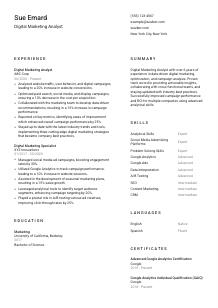
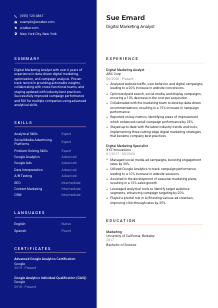
Crafting data-driven campaigns, but your resume still feels like a clickbaity headline? Check out this Digital Marketing Analyst resume example, created with Wozber free resume builder. It shows how to match your analytical prowess to job requirements, making sure your career metrics always trend towards the top!
Digital Marketing Analysts are hired to turn campaign data into decisions. Hiring teams look for people who can read traffic patterns, explain performance shifts, connect ad spend to business outcomes, and recommend the next move with confidence. Your resume should make that analytical judgment visible, not bury it under generic marketing tasks or broad channel exposure.
When the resume is tailored well, the reader can quickly separate a reporting-heavy marketer from someone who actually improves conversion rate, cost per acquisition, and campaign ROI. Wozber's free resume builder helps structure that experience into an ATS-friendly resume format, so tools and hiring teams can both see the same core story: you know how to analyze digital performance and act on it.
For a Digital Marketing Analyst, the header should read like the top line of a clean dashboard. It needs to identify you fast, match the role you are targeting, and remove basic friction around contactability and location before the reader gets to campaign metrics or platform expertise.
Place your name at the top in a clean, readable format. Skip decorative styling. In analytics-focused hiring, presentation matters because it hints at how you organize information, and a cluttered header can create the wrong first impression before anyone reaches your Google Analytics or paid media experience.
Add "Digital Marketing Analyst" under your name if that is the role you are pursuing. This creates immediate alignment with the opening and helps frame the rest of the resume around analysis, reporting, attribution, and optimization rather than broader marketing support work.
Include a phone number you answer and a professional email address, ideally in a simple firstname.lastname format. Check both carefully. If a hiring manager wants to follow up after seeing strong campaign results or platform knowledge, you do not want a typo slowing that down.
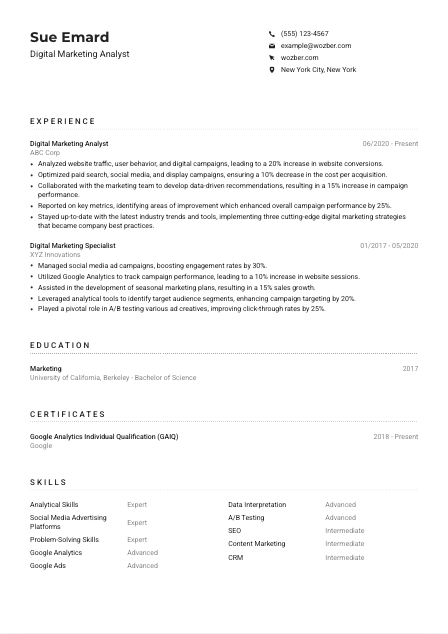
If the job requires a specific location, reflect that plainly in your header. Here, listing "New York City, New York" answers a stated requirement and removes questions about availability. Treat this as tailoring to the posting, not a universal rule for every Digital Marketing Analyst application.
Include LinkedIn or a professional website if it supports your application. For this profession, a strong profile might reinforce channel experience, certifications, campaign case studies, or marketing analytics tools you use regularly. Make sure the information matches your resume exactly.
Your personal details should confirm who you are, how to reach you, and whether you meet basic requirements tied to the role. Keep it clean and accurate so the resume can move quickly to the work that proves your value in digital marketing analysis.




This is where a Digital Marketing Analyst resume earns attention. Hiring teams want to see how you used analytics platforms, campaign data, and testing results to improve marketing performance, not just that you were involved in digital channels. The strongest bullets connect the work to outcomes such as conversion growth, lower acquisition costs, better targeting, or clearer reporting for decision-makers.
Read the posting for the operating themes behind the role. In this case, the priorities are campaign analysis, paid media optimization, reporting on key metrics, and collaboration with the marketing team on recommendations. Those themes should shape the bullets you choose and the language you use in your recent roles.
List positions in reverse chronological order and make sure each entry includes title, employer, and dates. For Digital Marketing Analyst work, progression matters. Moving from a specialist role into a more analytics-driven position can show growing ownership of reporting, optimization, audience analysis, and performance strategy.
Each bullet should show what you analyzed, what you changed, and what happened next. Strong examples include reviewing user behavior in Google Analytics, adjusting paid search or social campaigns, identifying underperforming segments, or recommending A/B tests that improved results. The sample resume does this well by pairing analytical tasks with actions such as campaign optimization and data-driven recommendations.
Use metrics that matter in digital marketing. Conversion rate, cost per acquisition, website sessions, click-through rate, engagement rate, ROI, and campaign performance lifts all help a hiring manager understand your impact. Results like a 20% increase in conversions or a 10% drop in CPA are much more persuasive than saying you "improved performance."
Prioritize bullets that show channel analytics, paid media management, reporting cadence, testing, and optimization. General marketing tasks can stay only if they support the story, such as audience segmentation or campaign planning tied to measurable outcomes. Every line should move you closer to the job you want, not just document what you were asked to do.
Your experience section should show a pattern of analytical thinking tied to measurable marketing results. If the reader can quickly see that you improve campaigns through data, testing, and platform-level decisions, this section is doing its job.
Education matters here because many Digital Marketing Analyst roles still ask for a business, marketing, or related degree as a baseline. Keep this section straightforward, then let your experience and results carry more weight if you already have several years in campaign analytics or paid media performance.
Start by checking the posting for the required academic background. Here, the role asks for a bachelor's degree in Marketing, Business, or a related field. If your degree fits that requirement, state it plainly so the reviewer does not need to infer relevance.
List your degree, field of study, school, and graduation year in a clean order. This section is usually reviewed quickly, especially when the role has a stated degree requirement, so make the qualification easy to find.
If your degree directly supports the role, say so clearly. A Bachelor of Science in Marketing, like the example resume uses, aligns naturally with work in campaign analysis, consumer behavior, and digital performance measurement.
Relevant coursework, academic projects, or honors can help if you are earlier in your career or moving into analytics from a related marketing track. Courses in statistics, market research, digital advertising, consumer insights, or data analysis are more useful here than generic academic detail.
Marketing research projects, analytics competitions, or student work involving campaign reporting can reinforce early-career applications. If you already have solid professional results in paid search, social advertising, or conversion analysis, keep this section lean and let your experience lead.
For this role, education should quickly confirm that you meet the stated baseline. Clear degree information is usually enough, especially when the rest of the resume already proves your command of digital analytics and campaign optimization.
Certifications carry real weight in digital marketing analytics because they show current platform knowledge, especially in tools employers rely on for tracking, attribution, and campaign management. They are particularly useful when the job posting names Google Analytics credentials or similar platform-based validation.
Lead with certifications that map directly to the tools and analysis work in the role. For this posting, Google Analytics credentials deserve prime placement because they support the requirement for analytics proficiency and data interpretation.
A shorter list is often stronger if it stays focused on job-relevant platforms. Certifications tied to Google Analytics, Google Ads, paid media, or campaign measurement should appear before less relevant learning badges, especially on a resume aimed at marketing analytics work.
Include the earned date and, if applicable, the active period or renewal status. Recruiters and hiring managers often want to know whether platform knowledge is current, particularly when tools and reporting interfaces change frequently.
Digital marketing moves fast across attribution models, privacy changes, ad platforms, and reporting standards. Ongoing certification work signals that you stay current with the tools behind campaign decisions, not just the theory. The example resume strengthens this by listing both GAIQ and Advanced Google Analytics Certification.
A focused certificates section helps confirm that your analytics knowledge is current and relevant to the platforms in the job description. For a Digital Marketing Analyst, that extra proof can support both ATS matching and human review.
The skills section should read like a practical toolkit for campaign analysis and optimization. Keep it tight, relevant, and aligned with the language used in the posting. This is where platform fluency, analytical strengths, and supporting marketing capabilities can be surfaced quickly for both recruiters and ATS parsing.
Start with the tools and capabilities the employer explicitly names. Here, that includes Google Analytics, Google Ads, social media advertising platforms, analytical skills, data interpretation, and problem-solving. These terms should appear if they reflect your real experience.
Use wording that matches the job description where appropriate. If the employer asks for "social media advertising platforms," do not hide that experience behind vague labels like "digital tools." Clear language improves ATS optimization and makes your fit easier to read at a glance.
List the most relevant skills first and keep the mix grounded in the role. For a Digital Marketing Analyst, that usually means analytics platforms, paid media tools, testing, reporting, segmentation, and optimization skills before broader items such as content marketing. The sample resume handles this well by elevating Google Analytics, Google Ads, A/B testing, and analytical strengths over secondary skills.
A focused skills section should immediately tell the reader which platforms you know, how you think about performance, and where you can contribute fastest. Relevance matters more than volume here.
Language skills matter in digital marketing when the role involves client communication, cross-functional collaboration, or campaign work across multiple markets. If the posting names a language requirement, treat it as a baseline qualification and present it clearly rather than assuming it will be inferred elsewhere on the resume.
If the job requires English for professional communication, list English prominently with an honest proficiency level. That immediately confirms that you can handle reporting, stakeholder conversations, and written recommendations in the working language of the role.
Order languages by relevance to the job, not personal preference. For this posting, English should come first. Additional languages can follow and may strengthen your profile for audience analysis, market expansion, or multilingual campaign work.
Extra language ability can be useful in digital marketing, especially when campaigns target different customer segments or geographies. A second language like Spanish can add value, but it should support the application rather than distract from your core analytics strengths.
Use clear labels such as "Native," "Fluent," "Intermediate," or "Basic." Hiring teams may need to gauge whether you can present findings, write campaign notes, or collaborate with partners in that language, so vague descriptions do not help.
Some Digital Marketing Analyst roles focus on one domestic market, while others support regional or international campaigns. Include multilingual ability when it reflects real business value, such as analyzing multilingual audiences or coordinating with global marketing teams, rather than treating it as filler.
For this role, language details should confirm that you can communicate professionally and, where relevant, support broader campaign reach. Keep the section concise, clear, and tied to business use.
The summary should quickly establish you as someone who understands digital performance, not just digital marketing in general. In a few lines, show your level of experience, the channels or tools you work with, and the kind of outcomes you influence through analysis, optimization, and reporting.
Review the posting and identify the work at the center of the job. Here, that means analyzing website and campaign data, optimizing paid channels, reporting on performance, and recommending next steps. Your summary should reflect those priorities rather than opening with broad marketing language.
Lead with your title or closest equivalent, your years of experience, and your core specialization. For example, "Digital Marketing Analyst with 6+ years of experience in campaign analysis, paid media optimization, and performance reporting" tells the reader far more than a generic statement about being results-driven.
Follow with two or three specifics that connect tools to business impact. Mention platforms such as Google Analytics or Google Ads if they are central to your background, then tie them to outcomes like improved conversion rate, stronger ROI, lower CPA, or better campaign targeting. The sample summary works because it connects data-driven marketing to measurable performance improvement.
Aim for three to five lines with no filler. This section should give the reader a fast view of your analytical profile and make them want to see the metrics in your experience section, not repeat the entire resume in paragraph form.
Your summary should make it easy to place you in the Digital Marketing Analyst seat from the first few lines. When it highlights platform fluency, analytical judgment, and measurable marketing impact, the rest of the resume has a clear direction.
A Digital Marketing Analyst resume works when it makes one thing clear fast: you can turn campaign data into better decisions and stronger results. That means aligning your experience, skills, certifications, and summary around performance metrics, optimization work, and the tools you actually use.
Use Wozber's AI resume builder to tighten that alignment, improve ATS optimization, and present your background in an ATS-compliant resume that reflects the language of the role. The final read should make it easy for a hiring team to see your value in reporting, analysis, and campaign improvement.