



Use Wozber and land your dream job
Create Resume
No registration required
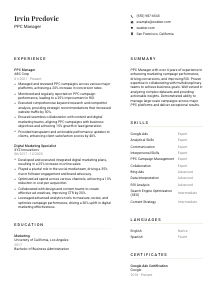
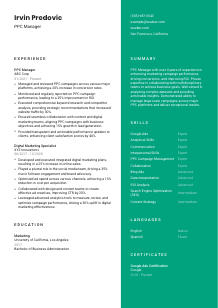
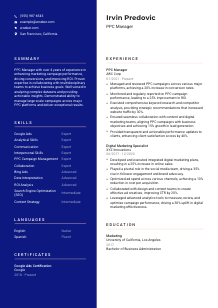
Driving ad clicks but your resume isn't getting conversions? Check out this PPC Manager resume example, created with Wozber free resume builder. Learn how to blend your pay-per-click prowess with job criteria, putting your career at the top search result of success!
PPC managers are hired to turn spend into measurable business results. A resume for this role needs to show how you manage budgets, optimize campaigns across channels, read performance data, and turn that analysis into better conversion rates, lower acquisition costs, or stronger ROI. Generic marketing language tends to blur that picture.
Screening gets much faster when your resume makes channel experience, platform depth, and performance outcomes easy to connect to the target role. Wozber's free resume builder helps shape that into an ATS-compliant resume with job-matched phrasing and clean structure, so hiring teams can quickly see whether you can run profitable paid campaigns, collaborate with content and digital teams, and explain results clearly to clients or stakeholders.
For PPC hiring, the header should answer the practical basics immediately. Recruiters and clients do not need creativity here. They need clear contact information, the role you are pursuing, and any location detail that affects eligibility for the position.
Use your full name in a clean, readable format at the top of the page. Keep the styling professional and easy to scan. For a PPC Manager, the real differentiator is not decorative formatting but the campaign results and platform expertise that follow.
Place "PPC Manager" directly under your name if that is the role you are targeting. This helps align your resume with the posting right away and keeps your positioning consistent for both ATS parsing and human review. If your current title is slightly different, such as Digital Marketing Specialist, your headline can still reflect the PPC-focused role you want next.
List a reliable phone number and a professional email address. PPC managers often work across internal teams, agencies, or client accounts, so communication details should feel polished and dependable. Double-check every character. A typo here undercuts the operational precision the role requires.
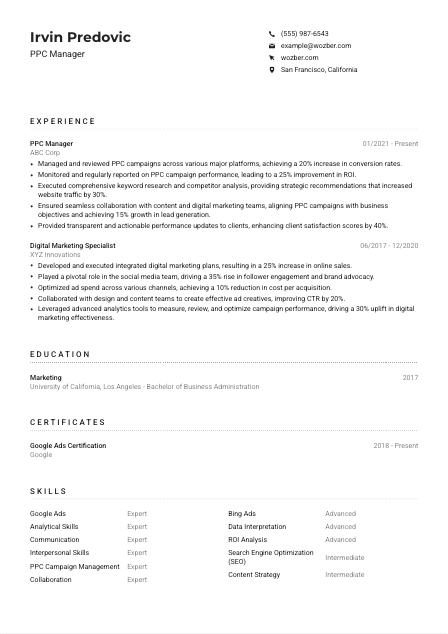
If the job has a location requirement, show your city and state clearly. In the example, "San Francisco, California" supports a stated local requirement and prevents avoidable screening issues. Treat that as tailoring to the posting, not a universal rule for every PPC role.
Include LinkedIn or a professional website if it strengthens your application. For PPC work, a profile that references campaign strategy, platform certifications, reporting experience, or digital marketing achievements can reinforce the story told in your resume. Make sure the content matches your current positioning.
This section should remove questions, not create them. Clear identity, accurate contact details, and relevant location information help the hiring team move straight to your campaign experience and performance record. Wozber makes it easy to present these details in a clean ATS-friendly resume format.




This is where a PPC Manager resume either becomes credible or stays generic. Hiring teams look for channel ownership, optimization decisions, reporting habits, and business outcomes. Your bullets should show how you handled campaigns and what changed because of your work.
Start by marking the language that defines the role. For this posting, that includes managing PPC campaigns across search, display, and social, monitoring performance, improving conversion rates, conducting keyword research, analyzing competitors, and sharing updates with clients. If those tasks match your background, reflect that wording naturally in your experience section so the alignment is obvious.
List positions in reverse chronological order with company name, title, and dates. For paid media work, this structure helps reviewers quickly understand your progression from broader digital marketing responsibilities into deeper PPC ownership. A path like Digital Marketing Specialist to PPC Manager tells a stronger story when the bullets show increasing control over budget, optimization, and reporting.
Each bullet should show an action and a measurable result. PPC hiring responds well to metrics such as conversion rate, ROI, CTR, CPA, lead volume, traffic growth, or revenue contribution. The sample resume does this well with results like a 20% increase in conversion rates and a 25% improvement in ROI. That kind of specificity carries far more weight than saying you "managed campaigns successfully."
Do not stop at end results. Briefly indicate the levers you used, such as keyword research, bid adjustments, audience targeting, ad creative testing, landing page alignment, or cross-channel budget optimization. A line about competitor analysis that drove a 30% increase in traffic works because it connects a PPC workflow to a business result.
Trim older or broader marketing tasks unless they support the role you want. If you have social, content, or digital marketing experience, keep the parts that show paid media collaboration, analytics, testing, or spend efficiency. In the example, bullets about reducing cost per acquisition and improving CTR are more valuable for a PPC Manager application than general brand marketing tasks.
Your experience section should make it clear that you can run campaigns, interpret data, and improve results over time. When those points are backed by channel scope and measurable outcomes, the hiring team can quickly picture you managing live accounts, reporting on performance, and making sound optimization decisions.
Education matters most here as a qualification checkpoint and as context for your foundation in marketing, business, analytics, or related fields. It does not need to be long, but it should be accurate and easy to scan.
If the role asks for a bachelor's degree in Marketing, Business, or a related field, make sure that information is unmistakable. The example uses a Bachelor of Business Administration in Marketing, which lines up well with the posting. If your degree is in a related area, list it clearly rather than assuming the connection will be obvious.
Use a straightforward structure: degree, field of study, school, and graduation year. PPC managers are hired for campaign execution and analytical judgment, so the education section should communicate qualifications quickly without extra narrative.
If you have multiple degrees, put the one most connected to marketing, business, communications, or analytics first. For candidates earlier in their careers, a directly relevant field can strengthen the case for platform knowledge, campaign logic, and commercial understanding.
Courses in digital marketing, consumer behavior, analytics, statistics, advertising, or business strategy can be useful if you are light on experience or if they reinforce a specific PPC angle. If you already have several years of campaign ownership, this level of detail is usually optional.
Honors, major projects, or competition work are worth adding when they support your candidacy, especially for newer professionals. Once your resume includes solid PPC results, these details become secondary to platform execution, reporting, and business outcomes.
This section only needs to confirm the academic base behind your marketing work. A concise, relevant education entry keeps attention where it belongs, on your campaign management experience and the results you can deliver.
In paid media, certifications help confirm platform familiarity and current knowledge. They are especially useful when the job emphasizes tools like Google Ads or Bing Ads, or when you want to show ongoing engagement with changing ad products and best practices.
Review the posting for any named platforms or credential expectations, then list certifications that support that stack. For this PPC Manager opening, Google Ads and Bing Ads proficiency are central, so certifications tied to those ecosystems are the most relevant place to start.
Prioritize certifications connected to campaign setup, optimization, measurement, analytics, or paid media strategy. A Google Ads Certification carries weight because it maps directly to common PPC responsibilities. Keep the list focused on credentials that strengthen your value for campaign management rather than general online learning badges.
PPC platforms change often, so dates matter. Include the year earned and, where relevant, the active validity period. In the example, listing Google Ads Certification as "2018 - Present" helps show continued currency, which matters more in paid media than in many slower-moving fields.
A PPC Manager is expected to keep up with bidding models, targeting options, tracking changes, and reporting features. Updating certifications and adding new relevant ones shows that your platform knowledge has kept pace with the market. That is especially useful if you work in a fast-moving agency or performance marketing environment.
Certifications will not replace campaign results, but they do strengthen your credibility when they match the platforms and responsibilities in the role. Keep them current, relevant, and easy to scan in an ATS-friendly resume.
The skills section should read like a focused map of your paid media toolkit. Hiring teams want to see platform capability, analytical strength, and the collaboration skills needed to work with creative, content, marketing, and client-facing teams.
Pull core skills straight from the job description when they honestly match your experience. Here, that includes Google Ads, Bing Ads, data analysis, campaign management, communication, and collaboration. This improves ATS alignment and also shows that you understand the actual operating needs of the role.
Do not list only tools. PPC management depends on analytical interpretation, reporting, stakeholder communication, testing discipline, and coordination with content or digital teams. The sample skills list works because it combines platform knowledge with analytical skills, ROI analysis, communication, and collaboration.
Choose skills that support paid acquisition performance. That usually means platform expertise, campaign optimization, keyword research, data interpretation, conversion analysis, and relevant collaboration skills. Cut anything that does not help explain how you plan, run, measure, or improve PPC campaigns.
A focused skills section helps reviewers connect your experience to the tools and judgment the role requires. Wozber's ATS resume scanner is especially useful here for checking whether your resume reflects the language, platforms, and capabilities emphasized in the target posting.
Language ability matters in PPC when the role includes client updates, cross-functional collaboration, or campaigns that touch more than one market. Keep this section practical and tie it to communication needs rather than treating it as filler.
If the posting calls out English, make sure it appears clearly in your languages section. For this job, effective English is a stated requirement, which matters because PPC managers often present performance updates, explain optimizations, and discuss results with clients or internal stakeholders.
Additional languages can strengthen your profile if the business serves multilingual audiences, international markets, or diverse client accounts. They are especially useful when campaign messaging, audience research, or stakeholder communication extends beyond one language.
Label each language honestly with terms such as Native, Fluent, Intermediate, or Basic. Clear levels help employers judge whether you can handle client calls, reporting discussions, or market-specific collaboration without guessing.
If your work has included international targeting, multilingual creative review, or region-specific audience coordination, your language section becomes more than a nice extra. Even when the job is domestic, an added language can still support client relationships and broader campaign coverage.
Language ability should reflect your present working level. If you are actively improving a language that may support future campaign markets or client communication, that is useful to know, but only if the proficiency label stays honest.
For PPC roles, languages matter most when they support communication, reporting, or market reach. Listed clearly, they can strengthen your profile without distracting from the central story of campaign performance and paid media execution.
The summary should quickly establish your level, your paid media focus, and the kind of outcomes you deliver. In a PPC resume, this section works best when it sounds like the opening of a performance review, not a generic self-introduction.
Start with your title and years of experience, then define your area of strength. A line like "PPC Manager with 4+ years of experience managing performance campaigns across major ad platforms" tells the reader what kind of marketer you are right away.
Use one or two concrete outcomes that reflect PPC success, such as improved ROI, higher conversion rates, lower acquisition costs, or stronger lead volume. The sample summary works because it points to campaign performance, conversions, and ROI rather than relying on broad marketing claims.
Mention strengths that matter for the target role, such as cross-channel campaign management, data interpretation, strategic recommendations, or client-facing reporting. Choose the two or three capabilities that best match the posting instead of trying to summarize your entire career.
Aim for a compact paragraph that can be scanned in seconds. Avoid vague words like "dynamic" or "results-oriented" unless they are backed by actual PPC context. Specific platform experience, measurable outcomes, and business-facing communication do more to establish credibility.
Your summary should quickly tell the reader that you understand paid media economics and can improve campaign performance. Wozber's free resume builder helps you shape that message with ATS optimization and job-aligned wording, so your opening already points to the value you can bring in a PPC Manager seat.
A PPC Manager resume works when it shows more than platform familiarity. It should connect campaign ownership to outcomes, whether that means better conversion rates, stronger ROI, lower acquisition costs, or clearer reporting to clients and internal teams.
Tailor each section to the posting, keep the language close to the work you have actually done, and use metrics wherever they clarify scale or impact. With Wozber's ATS-friendly resume template, free resume builder, and ATS resume scanner, you can organize that experience into a polished, ATS-friendly resume that makes your paid media judgment easy to recognize.
When your resume makes budget stewardship, optimization skill, and performance reporting clear, you are ready to apply with confidence.




