



Use Wozber and land your dream job
Create Resume
No registration required
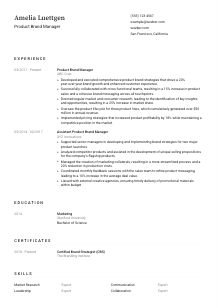
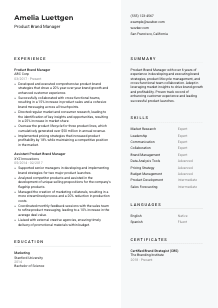
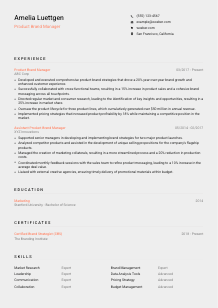
Managing brands, but your resume feels like a generic knock-off? Check out this Product Brand Manager resume example, created with Wozber free resume builder. Learn how to position your brand brilliance to match job demands, ensuring your career story stands out as a premium choice amidst a sea of generics!
Product brand management sits at the intersection of market insight, commercial judgment, and execution. Hiring teams want to see how you shaped positioning, guided launches, worked across product, sales, and marketing, and turned research into growth, share gains, stronger pricing, or a better customer experience. Your resume should make that progression visible fast.
When the resume is tailored well, it becomes much easier to connect your work to the brand and revenue outcomes the role owns. Wozber's free resume builder helps you align your language with the posting, keep the document ATS-friendly, and surface terms tied to product lifecycle, market research, messaging, and forecasting so the resume clearly reads as product brand management rather than general marketing.
For a Product Brand Manager, the top of the resume should establish professional alignment immediately. This section is simple, but it still carries useful hiring cues, especially when the role includes title, communication, or location requirements.
Use your full name as the main header in a clean, readable font. Brand roles care about presentation, and a cluttered header can undercut the polished judgment expected from someone who will own positioning, messaging, and launch materials.
Place "Product Brand Manager" directly under your name when that is the role you are pursuing. Matching the job title helps frame the rest of the resume around product strategy, go-to-market work, and brand leadership instead of broader marketing support.
Include a reliable phone number and a professional email address, ideally in a straightforward format such as firstname.lastname@email.com. If you also maintain a portfolio, LinkedIn profile, or personal site with launch work, messaging frameworks, or campaign results, make sure it matches the story your resume tells.
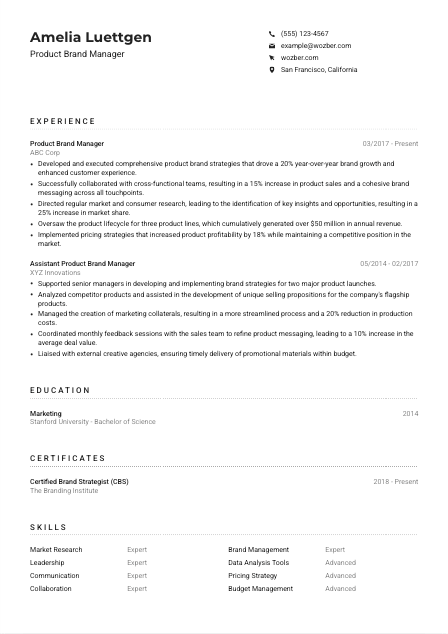
Some brand management roles are location-specific because they involve close work with product, sales, or leadership teams. In the example here, listing "San Francisco, California" directly addresses a stated requirement. Use that approach when the employer names a city or region, but do not treat location as a universal rule for every Product Brand Manager resume.
A LinkedIn profile or professional website can add depth if it shows relevant accomplishments such as product launches, portfolio positioning, category work, or cross-market campaigns. Skip anything outdated or inconsistent. For this role, every visible detail should support commercial credibility and brand judgment.
This section should confirm who you are, what role you are targeting, and whether you meet practical requirements such as contactability and location. Keep it polished and direct.




This is the section that usually determines whether a Product Brand Manager moves forward. Employers want more than a list of duties. They want to see how you built positioning, worked with cross-functional teams, managed launches, read the market, and influenced growth, profitability, or share.
Read the description closely and identify the work themes that appear repeatedly. For this role, the priority areas are brand strategy, market and consumer research, cross-functional collaboration, product lifecycle ownership, pricing, forecasting, and budget oversight. Those themes should shape which achievements you lead with and how you word them.
List your experience in reverse chronological order, but give the most space to roles that show responsibility for positioning, launch execution, portfolio performance, or customer-facing brand decisions. The sample resume does this well by centering a current Product Brand Manager role before an assistant-level brand role, making the progression in scope easy to follow.
Each bullet should show what you owned, what action you took, and what changed because of it. Product brand management is measured through results such as revenue growth, market share gains, pricing performance, launch success, adoption, or customer response. A bullet like "Directed regular market and consumer research, leading to a 25% increase in market share" works because it ties insight work to a commercial outcome.
Metrics matter in brand roles because they show whether strategy translated into performance. Use numbers tied to brand growth, sales lift, profitability, revenue, launch volume, margin, or budget scale. In the example, figures such as 20% year-over-year brand growth, 15% higher product sales, and $50 million in annual revenue immediately give weight to the candidate's scope.
If a bullet could belong to a general marketing coordinator, it is not pulling enough weight for a Product Brand Manager application. Prioritize achievements tied to messaging, category insight, product positioning, launch planning, pricing, portfolio management, and collaboration with sales or product teams. That keeps your experience section aligned with how this profession is actually evaluated.
Your experience section should make one thing easy to judge: when you owned brand strategy work, did it lead to measurable market or business results? That is the standard this role is hired on.
Education will not carry the application on its own, but it still matters when the posting names a degree requirement. For Product Brand Manager roles, this section usually confirms your foundation in marketing, business, consumer behavior, or a related field.
If the posting asks for a Bachelor's degree in Marketing or a related field, list that information clearly and without extra formatting noise. In the example, a Bachelor of Science in Marketing aligns exactly with the requirement, which removes any doubt on that point.
Include degree, field of study, school name, and graduation year or date. Hiring teams should be able to scan this section in seconds while reviewing stronger sections like experience and summary. Clear structure matters more than decorative detail.
When the role calls out Marketing specifically, do not hide the field behind abbreviations or crowded formatting. Put the discipline where it is easy to read. That small detail helps the resume line up cleanly with both recruiter review and ATS parsing.
For early-career candidates, relevant coursework in brand strategy, consumer insights, pricing, or market research can strengthen the section. For someone with 5+ years of experience, those details are usually secondary unless they are unusually relevant to the category or market focus of the target role.
Marketing competitions, capstone projects, or research work can be worth adding if they connect to product positioning, go-to-market planning, or consumer analysis. Keep the emphasis on substance. This section should support your qualifications, not distract from your operating experience.
When your education meets the stated requirement and is formatted clearly, it does its job. That lets the hiring team focus on the experience and commercial judgment that matter most for Product Brand Manager hiring.
Certifications are rarely the main screening factor for Product Brand Manager roles, but they can strengthen your profile when they reflect relevant strategic training. The best ones support the kind of work the role actually involves, such as positioning, brand strategy, market insight, or product marketing.
This posting does not require a certification, so treat this section as a value-add rather than a substitute for experience. A relevant credential can still reinforce your depth, especially if your recent work spans product launches, brand architecture, pricing, or multi-market strategy.
List certifications that connect clearly to brand and product responsibilities. The example uses Certified Brand Strategist, which fits because the target role centers on developing product brand strategies and maintaining consistent value propositions across the lifecycle.
Show the certification name, issuing organization, and date or active period. That makes the credential easy to interpret and helps distinguish a current professional qualification from an outdated course completion.
Brand roles change with shifts in consumer behavior, channels, analytics tools, and launch expectations. If you pursue additional learning, focus on areas that strengthen your practical toolkit, such as market research methods, pricing strategy, portfolio planning, or product marketing frameworks.
A relevant certification can round out your profile, but it should reinforce the same story your experience already tells: you understand how to build, position, and grow products in the market.
A Product Brand Manager skills section should read like the toolkit behind launch decisions, research interpretation, positioning work, and commercial planning. Keep it focused on capabilities that support product growth and cross-functional execution, not a generic mix of marketing buzzwords.
Start with the capabilities the employer named directly. Here, that includes brand management, product marketing experience, market research, data analysis, communication, collaboration, and leadership. Add adjacent hard skills that naturally support the role, such as pricing strategy, sales forecasting, budget management, and product lifecycle planning.
Use the same wording as the posting when it matches your real experience. That improves ATS optimization and makes the connection between your background and the role easier to see. The sample skill list does this well by using terms such as "Market Research," "Brand Management," and "Data Analysis Tools" rather than vague substitutes.
Put the most role-critical skills first. For Product Brand Manager hiring, strategic and commercial capabilities usually belong near the top, followed by collaboration and execution skills. In practice, that means leading with areas like brand management, market research, pricing, forecasting, and cross-functional leadership before more secondary tools or supporting abilities.
This section should quickly confirm that you can do the core work: shape brand strategy, read the market, collaborate across teams, and make sound commercial decisions.
Language ability matters in brand work when the role requires clear communication, stakeholder alignment, or support for regional and international markets. Include it when it is relevant to the posting or to the scope of products and audiences you have worked with.
This role requires proficiency in English, so list English clearly with an accurate proficiency level. That is enough to satisfy the requirement. If English is your native language, say so plainly.
Additional languages can be useful when the company serves multilingual customers, runs campaigns across regions, or coordinates with international teams. In the example, Spanish adds context that could support broader market communication, but that kind of advantage depends on the role and market footprint.
Choose clear levels such as Native, Fluent, Intermediate, or Basic. In brand and product roles, overstating language ability can create problems quickly if the job involves presentations, research interviews, agency coordination, or local market messaging.
If another language has been part of your actual work, such as supporting launches in multiple markets or collaborating with local teams, it can strengthen your candidacy. Keep that connection practical. Language skill matters most when it helps with real market execution.
For a Product Brand Manager, language ability is useful when it improves research, customer understanding, or coordination across markets. Include it for that reason, not just to add another line to the resume.
When language skills support communication, research, or multi-market work, they add substance. Present them plainly and keep them tied to how brand work gets done.
The summary is where you frame your level, your focus, and the kind of results you bring. For this role, a few lines should establish your brand management experience, your commercial scope, and the outcomes you have influenced through strategy, research, and cross-functional execution.
Start with your title and years of experience. A line such as "Product Brand Manager with over 6 years of experience" works because it immediately sets seniority and specialization. From there, move into the work you are known for, such as brand strategy, product launches, positioning, or lifecycle management.
Build the summary around the few strengths that matter most for the target role. In this case, that includes developing brand strategies, using market insights, collaborating across teams, and driving growth or profitability. The example summary handles this well by linking strategy work to customer experience and business outcomes rather than listing broad marketing traits.
Aim for a tight paragraph, not a biography. Three to five lines is usually enough. Every phrase should earn its place by clarifying your scope, tools, or results, whether that is launch leadership, pricing impact, market analysis, or multi-market experience.
A Product Brand Manager summary should sound different from a general brand marketer or product marketing manager summary if the job leans more heavily into lifecycle ownership, pricing, and cross-functional brand stewardship. Use the posting to decide which responsibilities deserve space, then align your wording accordingly.
A strong summary should tell the reader, in a few seconds, that you understand products, markets, positioning, and growth. That sets the tone for everything that follows.
A Product Brand Manager resume should make your market judgment, launch experience, and commercial impact easy to see. When each section is tailored to the posting, the hiring team can quickly connect your background to the work they need done, from research and positioning to pricing and growth planning.
Use Wozber's free resume builder to organize that story in an ATS-friendly resume format, sharpen the language with role-specific terms, and check alignment with an ATS resume scanner before you apply. The final resume should leave no doubt that you can guide a product brand from insight to market results.




