



Use Wozber and land your dream job
Create Resume
No registration required
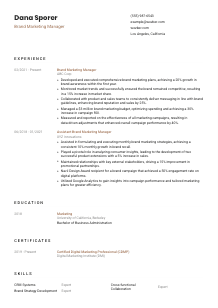
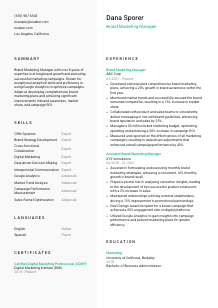
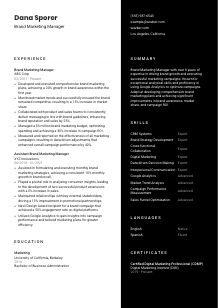
Crafting market strategies, but your resume lacks that branding spark? Check out this Brand Marketing Manager resume example, created with Wozber free resume builder. It shows how to connect your brand-building prowess to job specifications, positioning your marketing career as sought-after as your clients' top labels!
Brand marketing managers are expected to connect strategy to market results. Hiring teams want to see whether you can shape positioning, guide consistent messaging across channels, and turn campaign investment into measurable gains in awareness, acquisition, or market share. Your resume should make that commercial impact visible early, not bury it under broad marketing language.
A tailored resume changes how quickly your campaign record and brand leadership come through in review. With Wozber's free resume builder, you can align your wording with the job description, keep the structure clean for ATS optimization, and make it easier for a hiring team to see the mix of planning, cross-functional execution, and performance reporting they need from a Brand Marketing Manager.
For a Brand Marketing Manager, the top of the resume should feel polished and straightforward. This section is not where you sell campaign strategy, but it does need to show professionalism, clear communication, and any practical requirement the employer listed, such as location.
Use your full name in a larger, clean font so it is easy to spot at a glance. Brand leaders are often expected to present clearly and confidently, and that standard starts with a header that looks organized rather than decorative.
Place "Brand Marketing Manager" directly under your name if that is the role you are pursuing. This creates immediate alignment and helps both recruiters and ATS tools connect your resume to the opening without guessing whether your background sits in brand, growth, product marketing, or general marketing.
Include a reliable phone number and a professional email address, ideally in a simple format such as first name and last name. If you have a relevant website, portfolio, or LinkedIn page with campaign work, brand launches, or case-study style results, add it only if it is current and consistent with the story your resume tells.
When a posting specifies location, address it clearly in this section. The example role asks for someone based in Los Angeles, California, so listing "Los Angeles, California" removes an avoidable question early in the process. For other jobs, follow the requirement given rather than assuming location always needs emphasis.
Digital links should extend your credibility, not clutter the header. If your LinkedIn profile includes campaign outcomes, cross-functional work with sales and product teams, or tools such as Google Analytics and CRM platforms, it can reinforce the strengths the role calls for.
This section should confirm who you are, how to reach you, and whether you meet any stated practical requirement such as location. For a Brand Marketing Manager, that clean start supports the more important story that follows in your campaign and brand results.




This is the section most hiring managers will read first in detail. For brand marketing roles, they are looking for proof that you can plan campaigns, manage budgets, work across teams, and read performance data well enough to improve results over time.
Read the posting closely and mark the recurring work themes. In this case, the priorities include building brand marketing plans, driving awareness and customer acquisition, tracking competitors, partnering with product and sales, managing budget, and reporting campaign performance. Your experience bullets should reflect those same areas using language that matches your real work.
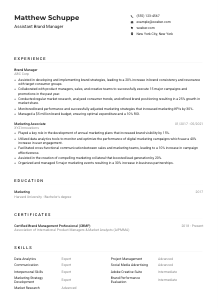
List your positions in reverse chronological order and give extra attention to roles closest to brand management, campaign leadership, or go-to-market execution. If your title was adjacent, such as Assistant Brand Marketing Manager or Marketing Manager, use the bullet points to show the brand strategy, performance analysis, and cross-functional ownership that connect you to this level of work.
Generic lines such as "responsible for campaigns" do not tell a hiring team much. Stronger bullets show what you planned, what you changed, and what happened as a result. The sample resume does this well with outcomes tied to brand awareness, market share, sales lift, ROI, and campaign performance improvements.
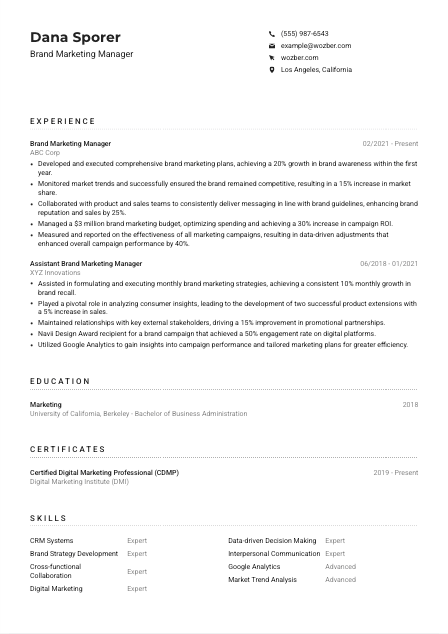
Brand marketing is measured through results, so include numbers wherever they are real and relevant. Metrics might include awareness growth, acquisition volume, engagement rate, conversion lift, return on ad spend, campaign ROI, market share, retention, or budget efficiency. For example, managing a $3 million budget and increasing campaign ROI by 30% tells a much stronger story than simply saying you oversaw spend.
Prioritize experience that shows brand positioning, channel execution, consumer insight, reporting cadence, agency or stakeholder management, and collaboration with product or sales. Older or less relevant roles can stay brief unless they add useful evidence. The goal is a work history that makes your brand leadership and marketing judgment easy to recognize.
A Brand Marketing Manager resume should read like a track record of market-facing decisions and measured outcomes. If your experience section shows how you built campaigns, guided messaging, and improved performance with data, it is doing the heavy lifting it needs to do.
Education is usually a supporting section for mid-level and senior brand marketing candidates, but it still matters because many openings set a degree requirement. Keep it clean, accurate, and clearly aligned with the field the employer requested.
If the posting asks for a bachelor's degree in Marketing, Business, or a related field, make sure that connection is obvious. In the example, a Bachelor of Business Administration in Marketing aligns directly with the requirement and should be presented in that exact, easy-to-read form.
List the degree, field of study, school name, and graduation year. Brand marketing resumes benefit from clean structure, and there is usually no need to overdesign this section unless you are early in your career and education is one of your strongest assets.
If your degree title is broad, include the concentration or specialization when it helps. Business Administration, Communications, Consumer Psychology, or similar fields can all be relevant when paired with a marketing focus that supports brand strategy, audience insight, or campaign planning.
Early-career candidates can include coursework, capstone projects, or student-led campaign work if it strengthens their case. For experienced Brand Marketing Managers, those details are usually optional unless they directly relate to brand research, market analysis, product launches, or another core part of the target role.
If you have completed recent training in analytics, digital marketing, CRM strategy, consumer insights, or brand management, it can reinforce that your marketing knowledge is current. Keep the education section focused, then let certifications carry the more recent professional development.
This section does not need much space, but it should remove doubt quickly. A clearly listed degree in a relevant field supports the baseline requirements and keeps attention on the bigger differentiators in your experience and results.
Certifications can strengthen a Brand Marketing Manager resume when they point to current tools, channels, or strategic capabilities. They are especially useful when the role values analytics, digital performance, CRM knowledge, or continued growth in a fast-moving marketing environment.
Start with the job description. If a certification is named, include it exactly and make sure the wording matches. In this example, no certification is required, so the section becomes a chance to support your profile with relevant marketing credentials rather than a box to tick.
Pick credentials that connect to brand strategy, campaign execution, analytics, digital channels, or customer lifecycle marketing. A certification such as "Certified Digital Marketing Professional (CDMP)" fits naturally because it supports the mix of campaign planning, performance analysis, and channel fluency many brand roles now expect.
Add the year earned, and if the certification remains active, note that clearly. Recency matters in areas tied to measurement platforms, digital media, CRM workflows, and changing consumer behavior, where stale credentials carry less weight.
Brand marketing changes with audience behavior, attribution models, media mix, and platform reporting. Ongoing learning in analytics, consumer research, lifecycle marketing, or brand storytelling can help you stay current and give your resume more depth, especially when paired with strong campaign outcomes in your experience section.
Certifications will not replace proven brand results, but they can strengthen your profile when they reflect tools, methods, or strategic areas that matter in the role. Choose the ones that support how you actually work as a marketer.
A Brand Marketing Manager skills section should do more than list broad marketing buzzwords. It should show the mix of strategic, analytical, and collaborative capabilities needed to launch campaigns, maintain consistent brand messaging, and improve performance through data.
Use the job description as a practical filter. Here, the employer points to analytical strength, marketing software, Google Analytics, CRM systems, and strong communication. Those are clear signals about the tools and working style the resume should surface, assuming they reflect your actual background.
Build the list around skills that connect directly to the work: brand strategy development, campaign performance measurement, market trend analysis, cross-functional collaboration, CRM systems, digital marketing, and communication. The sample resume also includes data-driven decision making and sales funnel optimization, which help show commercial thinking beyond brand awareness alone.
Do not crowd this section with every platform or soft skill you have ever used. Lead with the capabilities most likely to matter in brand planning, campaign analysis, budget optimization, stakeholder communication, and customer acquisition. A concise list of relevant strengths is more credible than a long inventory with no clear hierarchy.
When this section is tailored well, it quickly confirms that you speak the language of brand marketing and understand the tools behind performance. Keep it aligned with the role's real demands, then let your experience section prove the depth behind those skills.
Brand marketing depends on communication, but language skills only matter on the resume when they are relevant to the role, audience, or market. Present them clearly and keep the emphasis proportional to the job's actual needs.
If the posting specifies language ability, list it clearly at the top of this section. Here, fluent English is a stated requirement, so showing English prominently with an accurate proficiency level helps confirm you meet a basic communication standard for campaign planning, stakeholder collaboration, and written brand messaging.
Additional languages can be valuable when the brand serves multilingual audiences, regional markets, or global customers. For example, Spanish may be especially relevant in some consumer markets, but include it because it is genuinely useful to your background and target audience, not as filler.
Choose clear labels such as Native, Fluent, Advanced, Intermediate, or Basic. Brand roles often involve nuanced messaging, presentations, and written copy review, so overstating your proficiency can create problems later in interviews or on the job.
If the role involves international expansion, multilingual customer segments, or regional campaign adaptation, language capability becomes more strategic. If not, keep the section short and factual while still meeting any stated requirement.
For most Brand Marketing Manager roles, language details play a supporting role. Lead with required English fluency, then include additional languages when they genuinely add market or communication value.
Your summary should quickly establish the level of brand work you have handled and the kind of results you produce. For this role, that usually means a short statement combining years of experience, brand and campaign scope, analytical fluency, and a few concrete performance outcomes.
Before writing the summary, identify the few responsibilities that define the role. In this case, those include growing brand awareness, driving customer acquisition, managing performance with data, and working across teams. Build your opening around that combination rather than writing a generic marketing introduction.
Your first line should state who you are professionally and how much experience you bring. A phrase such as "Brand Marketing Manager with 8+ years of experience" works because it is direct and immediately places you in the right lane for the reader.
Use the next sentence to mention outcomes or strengths tied to the role, such as improving brand awareness, increasing market share, lifting ROI, or optimizing campaigns through Google Analytics and CRM insight. The sample summary works because it connects analytical ability to specific business results instead of staying at the level of personality traits.
Aim for a short paragraph that can be scanned in seconds. Skip generic adjectives and use space for real differentiators such as campaign execution, budget ownership, competitive analysis, cross-functional collaboration, or measurable growth. A summary that is concise and concrete gives the rest of the resume a stronger opening.
A well-written summary tells the reader what kind of brand marketer you are before they reach the first job entry. Keep it focused on scope, tools, and results so the hiring team can immediately place you in the level of work the role requires.
A Brand Marketing Manager resume works best when it connects campaign planning, brand stewardship, and performance measurement in a clear, consistent story. Each section should support that picture, from the header that confirms practical requirements to the experience bullets that show awareness growth, budget control, cross-functional execution, and data-led optimization.
Wozber can help you build an ATS-compliant resume with role-aligned language, cleaner structure, and faster tailoring through its resume tools and ATS resume scanner. The final result should make one thing easy to judge: whether you can lead brand marketing work that strengthens market position and drives measurable growth.




