



Use Wozber and land your dream job
Create Resume
No registration required
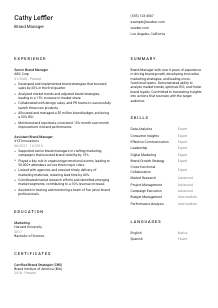
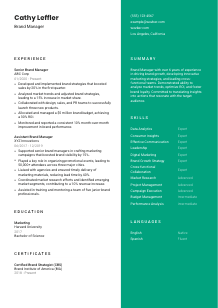
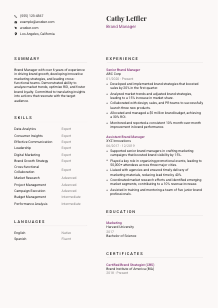
Crafting campaigns, but your resume isn't trending? Check out this Brand Manager resume example, created with Wozber free resume builder. It shows how to strategically present your branding expertise to match job expectations, ensuring your career trajectory is as impactful as your brand stories!
Brand management sits at the intersection of commercial growth and market perception. Hiring teams look for candidates who can shape positioning, guide campaigns, read consumer behavior, and adjust strategy when performance data shifts. Your resume needs to make that commercial judgment visible, not just list marketing activity.
A targeted Brand Manager resume quickly clarifies whether your work influenced launches, market share, ROI, or brand performance, which matters both to recruiters and to ATS screening. Wozber's free resume builder helps you organize that experience into an ATS-friendly resume format, so the hiring team can immediately see how your background lines up with the brand growth work they need.
Brand managers are expected to present information clearly, consistently, and with good judgment. Your personal details section should reflect that same standard. Keep it clean, professional, and aligned with the practical requirements of the opening.
Use your full name in a clear, readable format at the top of the page. For a Brand Manager, this section should feel polished and deliberate, much like a brand header. Avoid decorative formatting that distracts from the rest of the resume.
Place "Brand Manager" directly under your name when that matches the role you are applying for. This creates immediate alignment with the posting and helps position your background correctly, especially if your recent title was something adjacent such as Senior Brand Manager or Assistant Brand Manager.
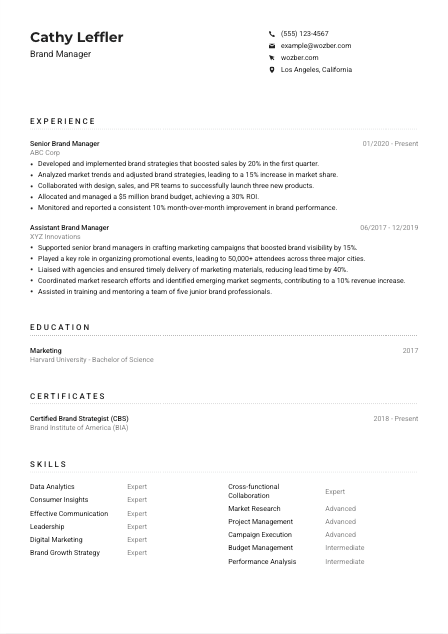
If the employer specifies a location, show that clearly in your personal details. In the example here, listing Los Angeles, California directly supports a stated requirement and removes avoidable questions about availability or local market presence. For other roles, include city and state when location is relevant to the hiring process.
Include LinkedIn or a personal website if it strengthens your candidacy. For brand managers, this can be useful when it supports your resume with campaign work, portfolio context, speaking appearances, or a stronger view of your career progression. Keep the profile current and consistent with the resume language.
This section should make you easy to contact and easy to place. Clean details, the right title, and any required location information help the reader move straight to your brand experience.




For Brand Manager hiring, experience carries the most weight because it shows whether you have already influenced growth, launches, positioning, and budget decisions in a live market. Focus less on broad marketing responsibility and more on the outcomes you drove, the teams you worked through, and the commercial results attached to your decisions.
Start by identifying the work that appears repeatedly in the posting. In this case, the emphasis is on brand strategy, campaign execution, market analysis, cross-functional collaboration, budget ownership, and performance monitoring. Those priorities should shape which accomplishments you surface first and how you phrase them.
List roles in reverse chronological order with company name, title, and dates. That structure helps the reader see whether you have grown from supporting brand activity to owning strategy, launches, budgets, or team coordination. A progression from Assistant Brand Manager to Senior Brand Manager, as shown in the example, naturally supports a move into a Brand Manager opening.
Each bullet should show what you changed in the business. For brand management, that often means sales lift, share growth, product launches, campaign performance, improved visibility, stronger consumer engagement, or faster go-to-market execution. One strong example from the sample resume is "Developed and implemented brand strategies that boosted sales by 20% in the first quarter," because it ties strategic work to a commercial result.
Numbers help hiring teams understand scale and impact. Prioritize measures that matter in this field, such as market share, revenue growth, ROI, budget size, launch count, campaign reach, event attendance, or month-over-month brand performance. The sample does this well with figures like a $5 million budget, 30% ROI, and three product launches, which immediately show scope and business value.
Choose experience that reinforces your ability to lead brand growth. If an older role does not connect to market research, campaign execution, positioning, budget management, or cross-functional delivery, reduce it or remove it. The goal is a focused record of work that shows you can translate insights into brand performance.
Your experience section should show that you can move a brand forward with strategy, analysis, and execution. When the bullets connect your decisions to sales, market share, launch results, or ROI, the Brand Manager case becomes much stronger.
Education is usually a supporting section for experienced Brand Managers, but it still matters because many roles ask for a degree in marketing, business, or a related field. Present it clearly so the reader can confirm the academic baseline without hunting for it.
When a posting asks for a bachelor's degree in Marketing, Business, or a related field, make sure your education section states that clearly. In the example, "Bachelor of Science" in "Marketing" aligns neatly with the requirement and removes ambiguity.
List degree, field of study, school, and graduation year in a simple order. Hiring teams do not need extra narrative here. They need to confirm quickly that you have the academic background expected for strategy, market analysis, and commercial planning work.
If your degree directly supports the role, make that easy to read. A marketing degree signals grounding in consumer behavior, segmentation, positioning, and campaign planning, all of which feed into brand management decisions.
Most mid-level and senior candidates can keep this section brief. If you are earlier in your career or moving into brand work from another marketing discipline, relevant coursework, case competitions, or capstone projects in brand strategy, market research, or analytics can strengthen the story.
Honors, leadership roles, or relevant extracurriculars are worth mentioning when they add context, especially for newer professionals. Keep the additions closely tied to marketing, business, research, or leadership rather than listing unrelated campus activity.
Your education section should quickly validate the academic foundation behind your marketing and brand work. Keep it concise, relevant, and easy to scan.
Certifications are not always required for Brand Manager roles, but the right ones can strengthen your profile, especially when they reinforce strategy, analytics, digital channels, or structured project delivery. Use this section to show focused professional development, not to build a long inventory.
Prioritize credentials that connect to brand strategy, digital marketing, consumer insights, analytics, or project management. These areas support the kind of campaign planning and performance analysis that often sits at the core of brand roles.
A short, relevant list is stronger than a crowded one. If you hold a credential such as the sample's Certified Brand Strategist, it supports your positioning well because it directly reflects branding expertise rather than a broad, generic training course.
Add the issue date, validity period, or renewal range where appropriate. In fast-moving marketing environments, recent learning in analytics, media, or consumer research can matter, and dates help the employer place that knowledge in context.
Brand management changes with channel behavior, audience data, and measurement practices. Continuing education in areas like attribution, digital performance, consumer insight methods, or AI-supported marketing workflows can help your resume reflect an up-to-date operating style.
Use certifications to reinforce the parts of brand management where added expertise matters most. A small, relevant selection can strengthen your profile without distracting from your results.
The skills section should mirror how brand managers actually work. That means balancing analytical ability with commercial judgment, campaign execution, stakeholder management, and brand stewardship. It also plays an important role in ATS optimization when your wording matches the language used in the posting.
Start with the capabilities the employer explicitly calls out. Here, that includes data analytics, market research, consumer insights, communication, leadership, and project management. If you have them, use the same wording so both the reader and the ATS can connect your background to the role quickly.
Brand managers rarely work in isolation. Your skill mix should reflect both the strategic side of the job and the cross-functional reality of it. Pair capabilities such as data analytics, budget management, and performance analysis with collaboration, communication, and leadership skills that support work with design, sales, PR, and agencies.
Do not turn this into a master list of everything you can do. Prioritize the skills that matter most for guiding campaigns, reading market movement, allocating spend, and growing a brand. The example skill set works because it stays close to the role, highlighting items such as Brand Growth Strategy, Consumer Insights, Campaign Execution, and Market Research.
Your skills should support the same story told in your experience section. When the language lines up with the posting and reflects real brand work, the resume reads as more targeted and more credible.
Brand managers spend a large part of the job aligning teams, presenting ideas, shaping messaging, and communicating with internal and external partners. If a posting names language ability, treat it as a clear requirement rather than a minor detail.
Read the posting carefully for specific language expectations. In this job description, effective English communication is required, so your resume should show that clearly rather than assuming it will be inferred.
List English first when it is mandatory for the role, along with an honest proficiency level such as Native or Fluent. For a Brand Manager, this matters because strategy documents, presentations, stakeholder meetings, and campaign reviews all depend on precise communication.
Additional languages can be valuable when the brand serves multilingual audiences, works across regions, or relies on varied consumer segments. Spanish, for example, can be a meaningful asset in some markets, but it should remain a supplement to the core requirements of the role.
Use clear labels such as Native, Fluent, Intermediate, or Basic. That helps set realistic expectations for meetings, writing, presentations, and partner communication.
If another language has supported research, campaign localization, or audience engagement in your past work, that value can come through elsewhere in the resume as well. Here, the languages section should stay concise and factual while still showing communication range.
Language skills can add practical value in brand management, especially when communication and audience nuance are central to the work. Keep the section honest, relevant, and aligned with the posting.
Your summary should give the reader a quick sense of your level, your lane within brand management, and the kind of business results you tend to drive. Keep it compact, but make sure it reflects the strategic and commercial side of the role rather than sounding like a generic marketing profile.
Start with your title or area of specialization plus years of experience. For example, a line such as "Brand Manager with 6+ years of experience in brand growth and campaign strategy" immediately places you in the field and gives the reader a frame for the rest of the resume.
Pull in two or three core strengths that match the posting closely. In this case, that might include brand strategy, consumer insights, market analysis, cross-functional leadership, and budget management. The sample summary works because it references brand growth, strategy development, and leading teams without drifting into vague claims.
Aim for a short paragraph of three to five lines. Use the space to show how you operate and what results you influence, whether that is improving ROI, launching products, expanding market share, or strengthening brand loyalty.
Your summary should set up the evidence that follows in the experience section. If you mention growth, analytics, or leadership here, the rest of the resume should back that up with campaign results, budget scope, launch activity, and market performance metrics.
A well-written summary helps frame you as a Brand Manager who can connect insight, execution, and commercial results. That makes the rest of the resume easier to read in the right context.
A Brand Manager resume works best when every section supports the same core message: you understand the market, you can turn insight into strategy, and your decisions produce measurable business results. That is what hiring teams want to see in campaign execution, budget ownership, launch work, and brand performance reporting.
Use Wozber to tighten that message into an ATS-compliant resume with clear role alignment, stronger wording, and practical ATS optimization. When the final version makes your growth impact, strategic range, and cross-functional leadership easy to spot, you are ready to apply with confidence.