



Use Wozber and land your dream job
Create Resume
No registration required
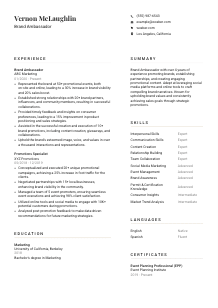
Representing top brands, but your resume is blending in? Showcase your charisma with this Brand Ambassador resume example, made with Wozber free resume builder. Learn how to highlight your promotional prowess to match job expectations, elevating your career as high as the brands you champion!
Brand ambassador work is public-facing and highly visible. Employers look for people who can represent a brand consistently in live interactions, online promotions, partner conversations, and community settings without drifting from the brand's voice or values. Your resume needs to show that you can do more than appear at events. It should make clear that you can attract attention, build trust, and turn engagement into measurable brand lift, leads, or sales.
A tailored resume changes how quickly that value comes across. When your event work, social media activity, partnership building, and customer feedback are phrased in the same language as the posting, hiring teams can connect your background to the promotion calendar they need to run. Wozber's free resume builder helps shape that into an ATS-compliant resume that highlights the right keywords and responsibilities, so your experience reads like someone ready to represent the brand well from day one.
Brand ambassadors are often hired for customer-facing assignments, local events, and community partnerships, so your contact details need to feel current, professional, and easy to act on. Keep this section clean and practical.
Use your full name in the largest text on the resume. For a role built on presence and recognition, your header should be easy to scan right away, much like clear signage at an event booth.
Place "Brand Ambassador" directly under your name if that is the role you are pursuing. This removes ambiguity, especially if your previous titles include related work such as Promotions Specialist, Event Marketer, or Community Outreach Coordinator.
Include your phone number and a professional email address you check often. If you add a website or LinkedIn profile, make sure it supports your brand-facing work with event history, campaign content, partnerships, or promotional results rather than a generic online presence.
For roles tied to on-site activations or local market work, location matters. In this example, listing Los Angeles, California directly supports the employer's requirement and signals that you can realistically cover local promotions without relocation questions.
A portfolio, LinkedIn profile, or personal site can help if it shows social content, event photos, campaign collaboration, or audience engagement work. Keep it polished and aligned with the image you would represent in front of customers, partners, and influencers.
This header should answer the practical questions fast: who you are, how to reach you, and whether you are positioned for the market the role serves. That gives the hiring team a clean start before they evaluate your promotional experience.




For brand ambassador hiring, experience is where employers look for proof of audience engagement, event execution, community relationships, and commercial results. Generic bullets about being outgoing or passionate do not help much here. Specific campaign activity does.
Read the job description closely and identify the activities that define success. For this role, that includes representing the brand at on-site and online events, generating leads, maintaining partner relationships, supporting promotions, and sharing consumer insights back to the brand team. Those priorities should shape what you emphasize in each job entry.
Under every position, show the parts of your work that involved public representation, campaign support, event presence, community engagement, or influencer and partner coordination. Even if your title was broader, your bullets should make the promotional side of the work unmistakable.
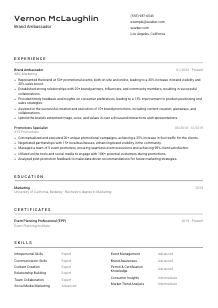
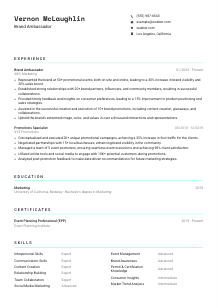
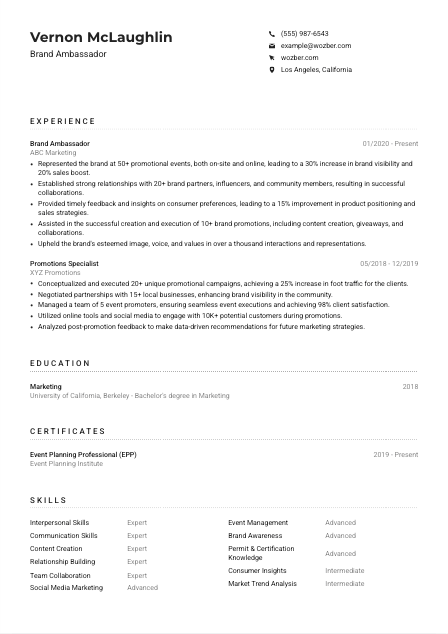
Brand ambassador work is easier to trust when it is quantified. Event counts, audience reach, sales lift, partner growth, lead volume, foot traffic, or social engagement all help. The sample resume does this well with figures such as 50+ promotional events, a 30% increase in brand visibility, and a 20% sales boost.
Choose bullets that show how you supported brand awareness and audience response. Strong examples include launching giveaways, coordinating collaborations, gathering customer feedback, or improving product positioning after promotions. If a task does not connect to brand representation, customer engagement, or campaign performance, it probably belongs off the page.
Start bullets with verbs that reflect action in this field, such as "represented," "activated," "engaged," "coordinated," "negotiated," or "analyzed." Then finish the thought with a result. In brand-facing roles, energy matters, but hiring teams still want to see what your actions changed in visibility, sales, partnerships, or customer response.
By the end of this section, a reader should be able to picture you working an event, managing partner interactions, supporting promotions, and reporting audience feedback that the brand can actually use. That is the standard this section needs to meet.
Education usually supports the application rather than carrying it, but it still matters when the employer has named a degree requirement. Keep this section straightforward and relevant to marketing, communications, or adjacent fields connected to promotion work.
If the posting asks for a bachelor's degree in Marketing, Communications, or a related field, make sure that information is easy to find. In the sample resume, a Bachelor's degree in Marketing aligns directly with the requirement, so it deserves a simple, prominent listing.
List your degree, school, field of study, and graduation year or date range. Hiring teams reviewing many resumes do not need extra formatting tricks here. They need to confirm academic qualification quickly and move back to your brand promotion experience.
If your degree connects directly to consumer behavior, communications, media, event marketing, or digital promotion, that helps frame your background. Keep it concise, but do not hide a field of study that clearly supports audience engagement and brand messaging.
If you do not yet have much campaign or event experience, include a few relevant academic details such as brand strategy projects, marketing campaigns, campus promotions, or social media work. Those details can help fill the gap between education and practical promotional work.
Student organizations, event committees, media clubs, or leadership roles can help if they show public engagement, campaign planning, or community outreach. Skip generic extras and keep only the items that support the way brand ambassadors are actually hired.
Education should quickly show that you meet the academic baseline and, when relevant, that you built early experience in communication, promotion, or audience-facing work. Save the extra detail for what strengthens that message.
Certifications are optional in many brand ambassador applications, but they can add useful depth when they support event execution, social media promotion, or market-facing communication. Relevance matters more than volume.
If the posting does not require a specific certification, choose the ones that support the role's actual responsibilities. Event planning, social media, digital marketing, community engagement, or promotional compliance can all strengthen a brand ambassador profile. The sample resume's Event Planning Professional and Certified Social Media Specialist are good examples of that alignment.
Order certifications by relevance, not by prestige alone. A certificate tied to event marketing or social content will usually help more than a broad course that has little connection to public-facing promotions or brand partnerships.
Certification dates show whether your training is current, especially in fast-moving areas like social platforms, content formats, or event operations. Recent or still-active credentials can support the impression that your methods are up to date.
Some brand promotion work involves permits, venue rules, or local activation requirements. If you have training or certification related to event compliance, sampling regulations, or promotional operations, include it when it reflects real experience and fits the employer's market.
This section should show focused professional development, not a random course list. Include certifications that make you more credible in events, promotions, content, or market-facing brand work.
The skills section should reflect how brand ambassadors actually operate: in front of customers, across event teams, through social channels, and alongside partners. Keep the mix practical and tied to execution.
Start with the skills named or clearly implied in the posting. Here, interpersonal communication, social media use, relationship building, content support, and consumer insight stand out. Those are stronger choices than vague traits that could appear on any resume.
If the posting says "brand promotion," "promotional events," or "community members," use those exact ideas where they genuinely match your background. This helps both ATS matching and human review, especially for jobs where the line between sales, events, and marketing can blur.
A useful brand ambassador skills section often combines communication skills with operational ones such as event management, social media marketing, content creation, market trend analysis, or partner coordination. The sample resume handles this well by mixing audience-facing strengths with promotion and analytics skills.
Your skills should show that you can engage people, support campaigns, and work within a brand's messaging standards. Keep the list focused enough that a hiring manager can immediately connect it to event promotion and audience growth.
Language ability can matter more in brand ambassador work than in many marketing roles because the job often involves live conversation, community outreach, and direct customer interaction. List languages with clear proficiency levels.
If the employer specifies English proficiency, list English prominently and state your level clearly. In this posting, high proficiency in English is a stated requirement, so it should be impossible to miss.
Start with the language most important to the job, then list any additional languages in descending order of proficiency. This keeps the section easy to scan and useful for roles involving diverse audiences or regional community engagement.
Additional languages can strengthen your application when the brand serves multilingual communities, events, or partner networks. For example, Spanish can be valuable in many customer-facing markets because it expands who you can engage naturally during promotions.
Terms like Native, Fluent, Advanced, or Conversational are helpful when used accurately. In a role built on real-time interaction, overstating language ability can create problems quickly during interviews or live events.
List only languages you could actually use in customer conversations, online engagement, or partner communication. The point is practical reach, not a longer resume.
This section should show whether you can communicate clearly in the markets and settings the brand cares about. For a public-facing role, that has direct value.
A brand ambassador summary should quickly establish your market-facing experience, the kind of promotions you have handled, and the results you tend to drive. Keep it tight, but make it specific enough to separate you from general marketing candidates.
Before writing the summary, identify what kind of brand ambassador position you are targeting. Some lean heavily on events, some on community partnerships, and others on social content or product sampling. Your first lines should reflect the mix you have actually done well.
Lead with a direct statement such as "Brand Ambassador with 4+ years of experience in live promotions, partner engagement, and social media campaigns." That immediately places you in the right lane and gives the reader usable context.
Choose highlights that match the posting, such as event representation, lead generation, partnership building, consumer insight gathering, or content support. The sample summary works because it ties years of experience to promoting brands, creating engaging content, and achieving sales goals.
Aim for three to five lines. Avoid broad claims about passion or personality unless they are backed by actual promotional outcomes, audience growth, campaign execution, or brand consistency across many interactions.
After these opening lines, the reader should already understand your promotional focus, your level of experience, and the kind of brand-facing results you bring. That context makes the rest of the resume easier to trust.
A brand ambassador resume works best when it shows visible promotion work, credible audience engagement, and a steady ability to represent the brand well in public. When your resume includes event metrics, partnership examples, social promotion skills, and feedback-driven improvements, hiring teams can picture you in the field rather than guessing from generic marketing language.
Use Wozber's free resume builder to organize that experience into an ATS-friendly resume format, tailor your wording to the posting, and strengthen ATS optimization with role-matched terminology. The final result should make one thing easy to judge: you can step into events, community interactions, and online promotions ready to protect the brand voice and grow attention around it.




