



Use Wozber and land your dream job
Create Resume
No registration required
Crafting campaigns, but stumped by your resume? Check out this Marketing Specialist resume example, created with Wozber free resume builder. It shows how to align your strategy smarts with job requirements, positioning your marketing career for maximum impact!
Marketing Specialist hiring moves quickly once a resume shows how you plan, launch, and measure campaigns. Hiring teams want to see proof that you can connect channel work to business results, whether that means stronger lead flow, higher engagement, better conversion rates, or cleaner reporting on ROI. Your resume should make that operating rhythm visible from the start.
When the wording reflects the target role, reviewers can separate broad marketing experience from hands-on campaign ownership much faster. Wozber's free resume builder helps you align your language with the posting, keep an ATS-compliant resume structure, and surface the tools, channels, and results that matter first for a Marketing Specialist opening.
Marketing is a communication job, and that starts with how you present your own information. This section should look current, professional, and easy to scan, while also covering practical filters the employer may use early, such as location and title alignment.
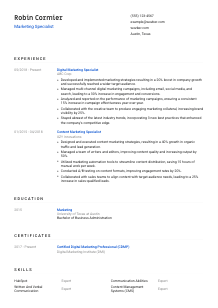
Use your full name in a clean, prominent style so it anchors the page immediately. For a Marketing Specialist resume, the presentation should feel polished and modern, much like campaign copy or brand collateral that gets to the point without visual clutter.
Place "Marketing Specialist" directly under your name if that is the role you are targeting. This helps frame the rest of the resume around campaign management, content execution, analytics, and channel coordination instead of leaving the reader to guess whether your background is broader brand marketing, communications, or sales support.
List a reliable phone number and a professional email address, and check them carefully. In a role built on communication and campaign follow-through, basic contact accuracy matters. If you include a website or portfolio, make sure it leads to relevant work such as campaign samples, content, case studies, or measurable marketing outcomes.
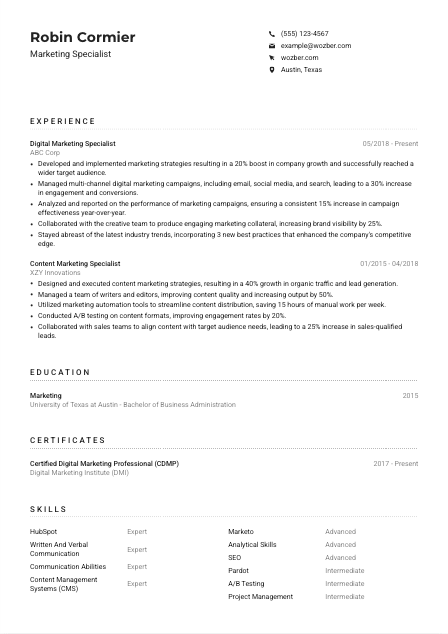
If a posting specifies an on-site or location-based requirement, show that detail clearly in your header. Here, listing Austin, Texas directly supports the employer's stated requirement and removes an avoidable question early in the review process.
A LinkedIn profile can strengthen your application when it reflects the same roles, dates, and achievements shown on the resume. For marketers, it can also reinforce your professional focus through content, recommendations, campaign examples, or platform expertise, as long as it is current and consistent.
This section should do its job quietly and well. Accurate contact details, the right target title, and any required location information let the reviewer move straight to your campaign experience instead of pausing over avoidable gaps.




This is where Marketing Specialist resumes are usually won or lost. Hiring teams look past general claims quickly and focus on execution: which channels you managed, what strategy you shaped, how you measured results, and whether your work moved growth, engagement, pipeline, or brand visibility.
Start by marking the responsibilities and tools that define the opening. For this role, that includes strategy development, digital campaign management across email, social, and search, performance reporting, collaboration with creative teams, and familiarity with marketing automation platforms. Those priorities should guide which bullets you keep and how you phrase them.
List your most recent position first, then work backward. For each role, include the company, title, and dates, then make the bullets do the real work. If your background includes adjacent titles such as Digital Marketing Specialist or Content Marketing Specialist, keep the framing clear so the reader can see the progression into broader campaign ownership.
Replace routine task language with accomplishment-driven bullets that show what changed because of your work. The sample resume handles this well with statements like managing multi-channel campaigns that increased engagement and conversions by 30%. That kind of bullet shows channel scope, ownership, and business effect in one line.
Use metrics that fit marketing work naturally: conversion rate, engagement, lead volume, organic traffic, campaign effectiveness, brand visibility, qualified leads, time saved through automation, or revenue contribution where available. Numbers give context to your decisions. A bullet about improving campaign effectiveness by 15% year over year says much more than "analyzed campaign performance."
Emphasize work that matches the channel mix and collaboration style of the job you want. If the opening leans heavily on digital execution and reporting, push email, paid search, social, automation, A/B testing, and creative collaboration higher than unrelated communications work. In the sample, experience with strategy, content, automation, analytics, and cross-functional work all supports that direction.
A hiring manager should be able to scan this section and understand your channel mix, your level of ownership, and the results you delivered. When each bullet ties action to measurable marketing outcomes, your experience starts to look immediately usable.
For many Marketing Specialist roles, education is a qualification check before it becomes a differentiator. Keep it straightforward, but make sure it clearly supports the academic background the employer asked for, especially when the posting names marketing, business, or a related field.
If the job asks for a bachelor's degree in Marketing, Business, or a related discipline, present that match clearly. A degree such as Bachelor of Business Administration in Marketing lines up well because it connects both business grounding and marketing focus without extra explanation.
List the school, degree, field of study, and graduation year in a consistent format. This section does not need heavy detail for most mid-level marketing applications unless a specific academic credential is central to the role.
If your degree title is broad, use the field of study to clarify relevance. That is especially useful when your academic background supports work in campaign planning, consumer behavior, analytics, communications, or business strategy. The sample does this effectively by pairing a business degree with a marketing concentration.
Relevant coursework, academic projects, or extracurricular leadership can help if you are earlier in your career or moving into a more specialized marketing track. Otherwise, keep the emphasis on experience and results, since that is where most Marketing Specialist hiring decisions are made.
If you have completed post-degree marketing training, workshops, or platform learning, decide whether it belongs here or in Certifications based on visibility. Formal degrees should stay clean and easy to read, while more recent professional learning often works better in a dedicated credentials section.
This section should confirm that you meet the academic baseline without slowing down the reader. When the degree, field, and school are easy to find, attention can move back to campaign performance and platform experience.
Certifications are useful in marketing when they add current, practical credibility. They work best when they reinforce skills the role depends on, such as digital strategy, platform knowledge, analytics, automation, or campaign management.
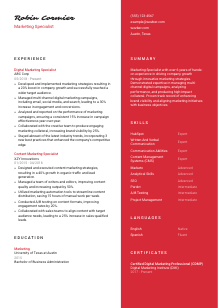
If the job description does not require a certification, include only ones that sharpen your fit. A credential such as Certified Digital Marketing Professional supports a resume aimed at digital campaign planning, content execution, and performance analysis, all of which matter in many Marketing Specialist roles.
Prioritize certifications tied to the work you want to do. Marketing automation, paid media, analytics, SEO, email marketing, content strategy, and CRM-related credentials tend to carry more weight than generic professional development courses when the role centers on campaign execution and measurement.
Dates help employers understand how current the credential is, especially in a field where platforms, privacy rules, attribution models, and channel tactics shift regularly. A recent or actively maintained certification can support your case when the role expects up-to-date digital knowledge.
Marketing changes fast, so recent learning matters. If you continue building skills in automation tools, analytics platforms, or campaign optimization, your certifications can show that you stay current with the methods and systems modern teams actually use.
A short, targeted certificate section can reinforce platform fluency and commitment to staying current. Keep it focused on credentials that support better campaign execution, stronger analysis, or deeper digital marketing expertise.
Marketing Specialist skills need to do two jobs at once. They should show the systems you can use and the marketing judgment you can apply. The right mix usually includes campaign tools, analytics capability, content or channel expertise, and communication skills that support cross-team execution.
Look for both explicit tools and implied working strengths. In this posting, the clear requirements include marketing automation platforms such as HubSpot, Marketo, or Pardot, plus analytical ability and strong written and verbal communication. Those are not filler keywords. They point to how the team runs campaigns and evaluates performance.
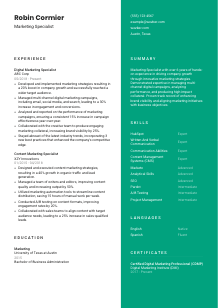
Mirror the employer's language where it reflects your actual background. If you have experience with HubSpot, Marketo, email workflows, SEO, CMS platforms, A/B testing, or reporting, list those directly. The sample skills section works because it covers automation tools, analytics, SEO, communication, and project management without drifting into unrelated strengths.
Put the most relevant skills first, with hard skills leading when the role is tool-heavy or execution-focused. For a Marketing Specialist, that often means automation platforms, campaign analysis, channel expertise, testing, and content systems before broader traits. Keep the list selective enough that every item supports the kind of marketing work the job calls for.
Your skills should read like a practical match for the team's campaign stack and workflow. When the list reflects the posting and stays anchored in real experience, it helps both ATS screening and human review.
Language ability matters in marketing when it affects audience reach, content quality, stakeholder communication, or market coverage. Even when multilingual ability is not central to the role, meeting a stated language requirement should be straightforward and easy to spot.
If the posting specifies English proficiency, make that visible first. For this role, listing English clearly as Native or Fluent addresses an explicit requirement and supports the communication demands of campaign writing, reporting, and cross-functional collaboration.
After the required language, include other languages that could support customer segmentation, regional campaigns, or broader audience communication. If a second language helps with content adaptation or market reach, it can add useful context without taking over the section.
Choose standard labels such as Native, Fluent, Intermediate, or Basic. Marketing work often involves writing, presenting, or coordinating with partners, so vague descriptions are less helpful than direct proficiency levels.
Additional language ability can be especially useful for brands serving multilingual communities, international markets, or diverse customer bases. It is a secondary advantage in many Marketing Specialist roles, but in the right setting it can support campaign localization and stronger message relevance.
If language learning is part of your ongoing development, that can be worth mentioning once proficiency becomes usable in professional settings. For marketers, stronger language ability can expand content reach, customer insight, and cross-market collaboration.
This section does not need to be long. It needs to make required proficiency easy to confirm and show any additional language strengths that could widen your effectiveness with audiences or teams.
Your summary should give a quick, credible read on the kind of marketer you are. For Marketing Specialist roles, that usually means years of experience, channel scope, analytical strength, and the kinds of business outcomes you have helped drive. Keep it tight, but make every sentence work.
Use the posting to decide what belongs in your opening lines. Here, strategy development, digital campaigns, performance analysis, collaboration, and automation tools all matter, so your summary should touch the areas where your background overlaps most strongly.
Start with a direct line that establishes your level. A phrase like "Marketing Specialist with over 6 years of experience" works because it quickly sets scope and seniority, then leaves room to define your channel and performance strengths.
Focus on the kinds of campaigns, tools, and outcomes that match the target role. The sample summary does this well by mentioning multi-channel digital campaigns, performance analysis, collateral production, and company growth. That gives the reader a compact picture of both execution and impact.
Aim for three to five sentences. That is enough space to cover your experience level, specialty areas, and one or two concrete strengths without repeating bullets from the experience section. If a line does not clarify your campaign ownership, analytical ability, or business contribution, cut it.
When this section is written well, the reader knows within seconds whether your background fits the role's campaign mix and performance demands. Keep it specific, measured, and closely tied to the marketing work you want next.
A Marketing Specialist resume should show how you turn strategy into channel execution and then into measurable results. If your sections consistently reflect campaign ownership, platform fluency, collaboration with creative teams, and clear reporting on performance, hiring managers can understand your value quickly.
Use Wozber to tighten the wording, improve ATS optimization, and shape your experience into an ATS-friendly resume format that matches the role you are targeting. The final resume should make one thing easy to judge: whether you can step in and run effective marketing campaigns with confidence.




