



Use Wozber and land your dream job
Create Resume
No registration required
Drafting catchy campaigns, but your resume is getting sent to the spam folder? Check out this Email Marketing Manager resume example, built with Wozber free resume builder. Learn how to match your messaging skills to job criteria, ensuring your career journey lands in the inbox of success!
Email marketing managers are hired to do more than send campaigns on schedule. They are expected to grow engagement, protect deliverability, and turn subscriber behavior into better segmentation, testing plans, and revenue-producing email programs. Your resume needs to show that you can manage the full lifecycle, from strategy and copy direction to performance analysis and list health.
Hiring teams move quickly when a resume makes your channel expertise easy to recognize in both human review and ATS screening. Wozber's free resume builder helps you align your language with the posting in an ATS-friendly resume format, so strengths like A/B testing, automation platform experience, and measurable lift in open or click-through rates surface early and clearly.
For an Email Marketing Manager, the top of the resume should read like a clean campaign header. It needs to establish who you are, what role you target, and whether you match practical filters such as location and contact accessibility without wasting space.
Use your full name as the most prominent text on the page. This is basic resume structure, but it matters when your document is scanned, saved, or reviewed alongside campaign specialists, lifecycle marketers, and CRM candidates. An ATS-friendly layout from Wozber keeps that identification clean and easy to parse.
Place "Email Marketing Manager" directly below your name when that is the job you are pursuing. This helps frame the rest of the resume around channel ownership, campaign execution, segmentation, and optimization work rather than broader digital marketing duties. If your current title is adjacent, such as CRM Manager or Lifecycle Marketing Manager, use the target title only when your experience genuinely supports it.
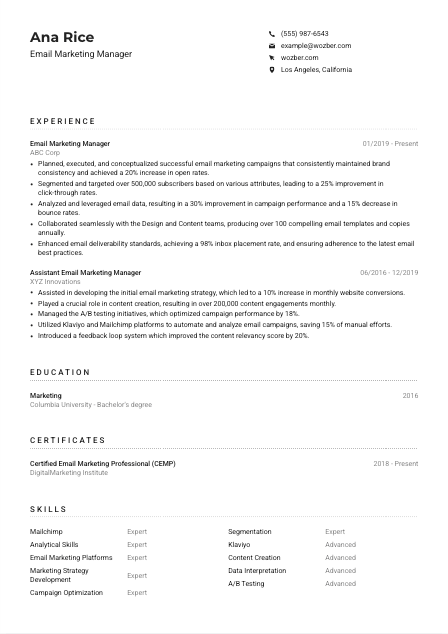
List a reliable phone number and a professional email address, then add your city and state when location matters. In the example, "Los Angeles, California" supports a stated requirement, which is useful for that application. Treat location this way when a posting names an on-site or local preference, not as a rule for every email marketing role.
If you include a website, portfolio, or LinkedIn profile, make sure it supports your email marketing narrative. A hiring manager may look for campaign examples, lifecycle strategy context, or broader retention marketing achievements. Only link profiles that are current and consistent with the metrics and responsibilities on your resume.
Do not add age, marital status, photo, or other details unrelated to campaign performance or professional qualifications. In this field, space is better used for platform expertise, subscriber growth, testing results, or cross-functional collaboration with design and content teams.
Your header should quickly confirm identity, target role, and any practical requirement such as location, while keeping the page clean for the metrics and channel expertise that matter next.




This is the section where Email Marketing Manager resumes either become credible or stay generic. Hiring teams want to see what kinds of campaigns you owned, how you segmented audiences, what tools you used, and whether your decisions improved open rates, click-through rates, conversions, deliverability, or list quality.
Before rewriting bullets, identify the operating priorities in the role. Here, those include strategy development, segmentation, content creation, A/B testing, analytics, automation platforms, and deliverability. Those themes should show up across your experience section in the language of actual work, not as a pasted keyword list.
For every position, list your job title, company, and dates in a consistent format, starting with the most recent role. This matters for ATS parsing and for fast human review. An Email Marketing Manager resume often gets compared with candidates from CRM, content, and growth teams, so clean structure helps your direct email ownership stand out.
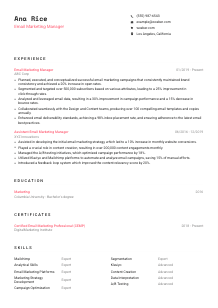
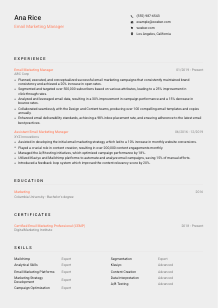
Focus your bullets on the work that proves you can run the email program end to end. Strong bullets show campaign planning, audience segmentation, template or copy collaboration, testing, automation, and post-send analysis. The example does this well with points about planning campaigns, segmenting more than 500,000 subscribers, and partnering with Design and Content on over 100 templates annually.
Quantify results with measures that are native to email marketing. Open rate lift, click-through rate gains, inbox placement, bounce reduction, conversion impact, and manual time saved through automation all tell a clearer story than generic claims about success. The sample resume shows the right pattern with a 20% increase in open rates, 25% improvement in click-through rates, and 98% inbox placement rate.
Keep the section centered on responsibilities and outcomes that match the role. General marketing tasks belong only if they directly support email performance, retention strategy, or subscriber engagement. If a bullet does not show campaign execution, testing, analytics, automation, compliance, or collaboration that improved the email program, replace it with one that does.
By the end of your experience section, a hiring manager should be able to picture the scale of your email program, the tools and workflows you used, and the business results your campaigns produced. Wozber's ATS resume scanner can help you check that those priorities are clearly reflected in each role.
Education matters here because many postings still ask for a marketing, business, or related degree, but it usually plays a supporting role behind campaign results and platform experience. Keep this section direct and relevant.
If the posting asks for a bachelor's degree, make sure that information is easy to find. In the example, a Bachelor's degree in Marketing directly matches the requirement. When your degree is in a related field, list it clearly and let the rest of the resume show how your experience bridges into email strategy and performance work.
List your degree, school, field of study, and graduation year or date range if needed. This section does not need extra design treatment. Clean formatting helps both ATS systems and hiring teams confirm the requirement quickly.
If your academic background genuinely connects to the role, a field such as Marketing, Business, Communications, or Analytics can reinforce your foundation in audience behavior, messaging, and business performance. Keep that connection brief. Your campaign outcomes should still carry more weight than coursework.
Specialized courses are useful when they strengthen your case, especially early in your career. Classes in digital marketing, consumer insights, analytics, or marketing automation can support your profile, but only include them if they add information not already proven through work experience.
Honors, scholarships, or leadership activities can help if you are relatively early in your career or if they directly relate to marketing execution, analysis, or communications. For experienced email marketers, keep this section lean unless the distinction carries real professional relevance.
This section should confirm that you meet the degree requirement and then get out of the way. For an Email Marketing Manager, the hiring decision is usually driven by campaign ownership, analytical judgment, and channel results.
Certifications are useful in email marketing when they reinforce hands-on expertise with automation tools, channel strategy, or deliverability practices. They are rarely the main reason someone gets hired, but they can sharpen your profile when the posting mentions them as a plus.
Prioritize certificates tied to email marketing, lifecycle marketing, CRM, automation platforms, or related analytics work. The example's "Certified Email Marketing Professional (CEMP)" is a strong fit because it supports the core responsibilities named in the posting.
A short list of highly relevant certifications is more convincing than a long list of loosely related badges. If the role centers on segmentation, automation, testing, and performance analysis, choose certifications that deepen those themes rather than broad marketing credentials with little connection to email execution.
Include dates when they help show recency, especially for tools, compliance standards, or automation practices that evolve over time. Current credentials can reinforce that you stay up to date with changes in deliverability, privacy expectations, and platform capabilities.
If you continue to train, focus on areas that affect day-to-day email performance, such as personalization, journey automation, testing methodology, reporting, or platform-specific workflows. That kind of learning supports the resume far more than generic professional development entries.
Certifications work best when they back up the experience section rather than compete with it. In this role, they should reinforce your command of email strategy, automation, and optimization.
An Email Marketing Manager skills section should look like the toolkit behind a working channel, not a grab bag of marketing terms. Focus on the capabilities that drive campaign execution, segmentation quality, testing discipline, reporting, and collaboration with design and content partners.
Start with the requirements in the job ad, then check that each skill is supported somewhere else on the resume. Here, that means segmentation, A/B testing, content creation, analytics, strategy development, and proficiency with platforms such as Mailchimp or Klaviyo. ATS alignment matters, but the wording should still reflect real experience.
List the tools and the operational abilities that make those tools valuable. Platform names like Mailchimp and Klaviyo are useful, but so are skills like lifecycle strategy, audience segmentation, campaign optimization, deliverability, data interpretation, and cross-functional collaboration. Together they show both software fluency and channel judgment.
Keep the list selective enough that every item supports the target role. A compact set of skills is easier to scan and usually stronger in ATS review than a long, diluted inventory. The sample resume handles this well by mixing platform knowledge with core email functions such as segmentation, campaign optimization, content creation, and A/B testing.
Your skills section should make it obvious that you can operate the email channel, interpret performance data, and improve campaigns through testing and segmentation, not simply participate in a broader marketing team.
Language skills matter in email marketing when they support copy quality, stakeholder communication, or audience reach across markets. If a posting names a required language, include it clearly. If it does not, keep this section brief unless multilingual work is part of your campaign experience.
When the posting specifies fluent English, list English prominently and use an accurate proficiency label. This is especially important for roles involving campaign copy review, testing variations, brand voice control, and collaboration across content and design functions.
Place the required or primary working language first, then add additional languages in descending order of usefulness or proficiency. In the example, English appears first, followed by Spanish, which can be a practical advantage for audience segmentation or multilingual campaign support when relevant.
Terms such as "Native," "Fluent," "Advanced," or "Conversational" work well when they reflect your actual ability. For a role that may involve copy review or nuanced messaging, overstating language skills can quickly become obvious.
Additional languages can strengthen your profile if the company serves multilingual subscriber bases, international markets, or regional customer segments. If that connection is weak, keep the section simple rather than trying to create value where it does not exist.
For some email marketing roles, language ability is useful because it supports localization, market-specific segmentation, or collaboration with regional teams. If that applies to your background, reflect it in experience bullets as well, not only in the language section.
Language skills should clarify your working capability, especially when English fluency is required. If other languages support audience reach or campaign localization, they can add useful depth to your profile.
The summary should quickly tell a hiring manager whether you have the experience to run an email program with strategy, testing discipline, and measurable results. Skip generic self-description and use those lines to establish scale, strengths, and the kind of performance you have delivered.
Read the posting closely, then pull out the themes that shape the job. In this case, that includes end-to-end campaign execution, segmentation, content collaboration, A/B testing, analytics, and platform proficiency. Those are the building blocks of a summary that feels specific to email marketing rather than general digital marketing.
Start with your title and years of experience in a way that immediately positions you for the role, such as "Email Marketing Manager with 5+ years of experience." That opening works because it establishes channel focus and seniority without wasting words.
Choose strengths that match the job and show how you work. Strategic segmentation, lifecycle or campaign planning, content development, testing, automation, and performance analysis are all strong options when they are grounded in outcomes. The sample summary does this well by combining segmentation and engagement improvement with data-led decision making.
Aim for a short paragraph of about three to five lines. That is enough space to establish your specialty, mention platform or channel strengths, and hint at results such as engagement growth, conversion improvement, or stronger email performance without repeating the entire experience section.
After reading these opening lines, a hiring manager should already understand your channel focus, your level of ownership, and the kinds of email results you are used to producing. That sets up the rest of the resume to confirm the details.
A well-tailored Email Marketing Manager resume makes three things easy to see fast: you know the platforms, you know how to improve campaign performance, and you can turn subscriber data into smarter segmentation and testing decisions.
Use Wozber to tighten the wording, check ATS optimization, and present your experience in an ATS-compliant resume that reflects the actual priorities of the role. The finished resume should make your readiness to run a high-performing email channel clear from the first screen.




