



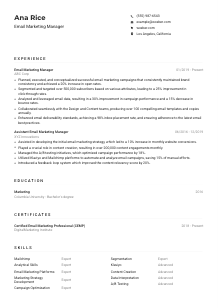
Use Wozber and land your dream job
Create Resume
No registration required
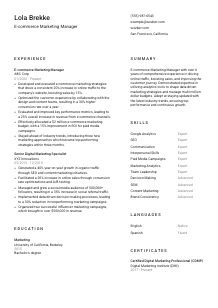
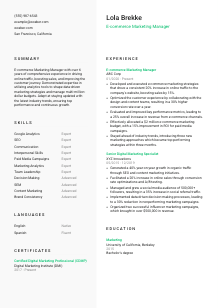
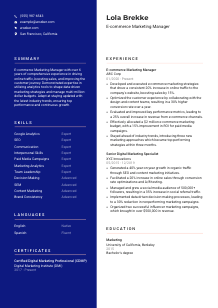
Driving online sales, but your resume isn't adding to cart? Browse this E-commerce Marketing Manager resume example, created with Wozber free resume builder. Learn how to put your digital marketing expertise to work for the job criteria, making sure your professional journey gets as many clicks as that must-have item in the shopping cart!
E-commerce marketing managers are hired to move revenue through digital channels, not simply to run campaigns. A resume for this role needs to show how you grow qualified traffic, improve conversion, manage paid spend, and turn analytics into better channel decisions across the customer journey.
When that track record is tailored to the target role, hiring teams can quickly see whether your experience lines up with the traffic, performance, and budget ownership they need. Wozber's free resume builder helps you shape that story in an ATS-friendly resume format, so the right terms, metrics, and channel experience are easy to scan and your online growth impact is easy to judge.
For an E-commerce Marketing Manager, the top of the resume should establish role alignment fast. Keep this section clean and practical so the employer immediately sees your title, contact details, and any logistical match that matters for the opening.
Place your full name at the top in a clear, readable format. It should be the most visible text on the page so the resume feels easy to reference during interviews, email follow-up, and ATS review.
Add "E-commerce Marketing Manager" directly under your name when that reflects the role you are pursuing. Matching the target title helps frame the rest of the resume around e-commerce growth, digital channel strategy, and conversion performance from the first line.
List a professional email address and a phone number you actually answer. Accuracy matters here. If a hiring manager wants to discuss your paid media results, SEO background, or analytics ownership, they need a frictionless way to reach you.
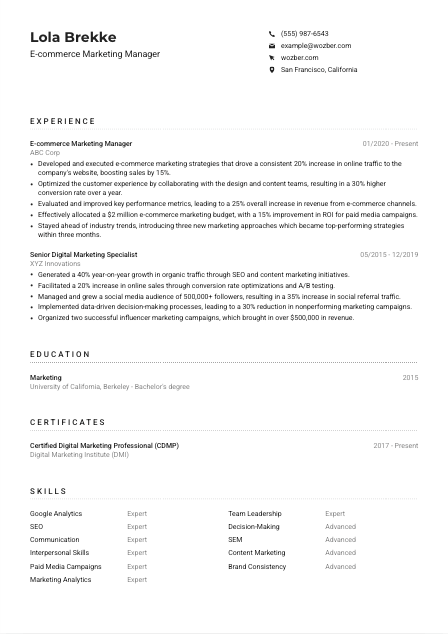
If the job has a location requirement, include your city and state clearly. In the example, San Francisco, California supports a stated requirement, which removes an avoidable screening question early in the process.
Include LinkedIn or a professional website if it strengthens your application. For this profession, that can be useful when it reinforces campaign leadership, brand portfolio work, channel expertise, or career progression. Make sure the content matches your resume wording and dates.
This section should confirm who you are, which role you are targeting, and whether there are any logistical barriers. Once that is clear, the reader can focus on your traffic growth, conversion wins, and budget management.




This is the section hiring teams read most closely for an E-commerce Marketing Manager. They want to see how you influenced online traffic, conversion rate, revenue, paid media efficiency, and customer experience, not just which marketing tasks sat on your desk.
Start by identifying the operational themes in the posting. Here, the priorities include e-commerce strategy, customer experience optimization, performance analysis, budget allocation, and current knowledge of SEO, SEM, and content marketing. Those themes should shape which achievements you surface first.
Use reverse chronological order and make the progression visible. For this profession, that often means moving from channel execution into broader ownership of strategy, reporting, spend, and cross-functional coordination with design, content, or merchandising teams.
Each bullet should show what changed because of your work. Strong E-commerce Marketing Manager bullets tie actions to business results such as traffic growth, higher conversion rate, lower wasted spend, stronger ROI, or higher e-commerce revenue. The sample does this well with results like a 20% traffic increase and a 15% sales lift tied to strategy execution.
Quantify with metrics that matter in e-commerce marketing. Good examples include organic traffic growth, paid media ROI, conversion rate improvement, revenue lift, CAC efficiency, AOV movement, or budget size. A line about managing a $2 million budget with a 15% ROI improvement tells far more than saying you "handled campaigns successfully."
Keep the emphasis on work that matches e-commerce growth leadership. If a bullet does not show channel strategy, analytics, customer journey optimization, or measurable commercial performance, trim it or rewrite it. The goal is a tighter story about digital growth management, not a full archive of every marketing task you have done.
By the end of this section, a reader should understand your scale, your channels, and your results. Your experience should make it easy to picture you owning traffic strategy, budget decisions, and performance improvement in an e-commerce environment.
Education usually sits behind experience for this level of role, but it still matters because many openings ask for a degree in marketing, business, or a related field. Present it clearly and let it confirm the formal background behind your channel and analytics work.
If you hold a Bachelor's degree in Marketing, Business, or a related area, list it clearly because many E-commerce Marketing Manager postings ask for that baseline. In the example, a Bachelor's degree in Marketing aligns directly with the requirement.
Include degree, field of study, school, and graduation year or date in a consistent format. Hiring teams are usually checking for qualification match here, not looking for a detailed academic narrative.
When the opening names a preferred field, use the exact field wording that applies to your degree. That helps both ATS parsing and human review, especially when the job specifies marketing or business-related education.
If you are earlier in your career, you can include coursework or academic projects tied to digital marketing, consumer behavior, analytics, SEO, or e-commerce strategy. For experienced candidates, keep this brief unless the work is unusually relevant.
Honors, research, or extracurricular leadership can stay if they reinforce a marketing profile, but do not let them crowd out stronger professional evidence. At this stage, education should support your commercial marketing story, not compete with it.
Your education section should confirm that you meet the stated academic requirement and move on. Clear formatting and relevant field details are enough when your experience already carries the heavier proof of performance.
Certifications matter most when they sharpen your positioning in performance marketing, analytics, or e-commerce strategy. They are especially useful when they show recent platform knowledge or continued development in a field that changes quickly.
List certifications that strengthen your case for managing e-commerce growth, digital channels, analytics, or paid acquisition. General certificates carry less value than those connected to campaign strategy, measurement, or platform fluency.
When a role leans on analytics, SEO, SEM, or digital marketing leadership, choose certifications that reinforce those capabilities. The CDMP credential in the example supports broader digital marketing expertise in a relevant way.
Add issue dates or active periods for certifications that signal current knowledge. In digital marketing, recency can matter because tools, privacy changes, attribution practices, and platform best practices evolve quickly.
Use this section to show that your knowledge stays current as search, paid media, content distribution, and e-commerce platforms shift. A short, relevant certification list can strengthen your profile when it reflects where the market is moving.
A few well-chosen certifications can reinforce your credibility in analytics and digital growth. Keep the list relevant, current, and clearly tied to the kind of marketing performance the role expects.
For an E-commerce Marketing Manager, the skills section should reflect how you drive growth and measure performance. Think in terms of channel execution, analysis, optimization, and collaboration rather than broad marketing buzzwords.
Review the job ad for explicit tools and capability areas. In this case, Google Analytics, SEO, SEM, content marketing, communication, and data-driven decision-making all deserve attention because they are named or strongly implied.
List skills that also appear in your experience bullets. If you claim SEO, analytics, paid media, or customer experience optimization, there should be evidence elsewhere on the resume such as traffic growth, revenue lift, or campaign ROI improvement.
Aim for a clean set of high-value skills instead of an oversized inventory. For this role, a balanced list may include analytics tools, acquisition channels, optimization methods, and collaboration strengths. The example combines technical and business-facing skills, from Google Analytics and SEM to team leadership and brand consistency, which suits a management-level profile.
This section should read like a summary of your working toolkit. If the listed skills line up with your achievements, the employer gets a much clearer picture of how you drive e-commerce performance day to day.
Language ability is not the main decision point for most E-commerce Marketing Manager roles, but it can matter when the posting names a requirement or when the business serves multilingual markets. Keep this section straightforward and honest.
If the posting specifies a language, list it clearly. Here, English is required, so it should appear first with an accurate proficiency level that leaves no doubt about your communication ability.
Order languages by business relevance, not personal preference. For a role requiring strong English communication, placing English at the top helps the employer confirm a basic qualification immediately.
Additional languages can be valuable when the brand serves diverse audiences, runs international campaigns, or works with regional partners. Spanish, for example, may be useful in certain customer segments or cross-market campaigns, even when not required.
Choose realistic levels such as Native, Fluent, Advanced, or Conversational. Marketing leaders are often expected to present, write, and collaborate across teams, so overstating your level can become obvious quickly.
If multilingual ability has practical relevance, let the rest of your resume support that story through market exposure, audience strategy, localization work, or cross-border campaign experience. Do not force the point if language is not central to your background.
This section should answer a practical question, not create one. List required language ability first, then include other languages that genuinely add value to your e-commerce marketing profile.
The summary needs to quickly position you as someone who can drive e-commerce results. For this role, that usually means connecting years of experience with a record of traffic growth, conversion improvement, channel strategy, analytics, and budget ownership in a few compact lines.
Before writing, identify the few themes that matter most in the posting. Here, those include online traffic growth, performance analysis, customer experience improvement, channel strategy, and budget management.
Start with a direct description of who you are professionally. For example, mention your years in e-commerce or digital marketing and your focus on performance-driven online growth so the reader immediately understands your lane.
Include the strengths that matter most for the role, such as using analytics to improve marketing decisions, leading SEO and paid media efforts, or managing meaningful budgets. The sample summary works because it ties experience to traffic, sales, customer journey improvement, and multi-million-dollar budget responsibility.
Aim for 3 to 5 lines with no filler. Every sentence should help explain how you contribute to e-commerce revenue, efficiency, or customer acquisition. Save the detail for your experience section and keep the summary focused on your value proposition.
A well-written summary gives hiring teams the right lens for reading everything that follows. It should position you as a marketer who understands channels, numbers, and commercial outcomes from the start.
Once each section reflects the job's channel mix, performance expectations, and required qualifications, your resume becomes much easier to evaluate for an E-commerce Marketing Manager opening. That includes clear evidence of traffic growth, conversion work, analytics fluency, and budget ownership.
Use Wozber's free resume builder and ATS resume scanner to tighten phrasing, align job-specific terminology, and strengthen ATS optimization across the page. The final result should make one thing easy to judge: you can lead e-commerce marketing activity that drives measurable online growth.




