



Use Wozber and land your dream job
Create Resume
No registration required
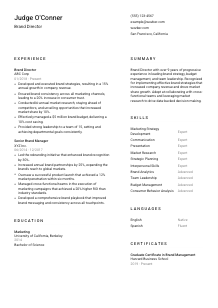
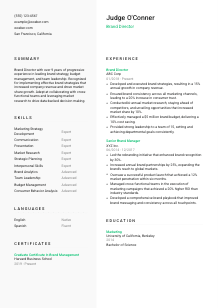
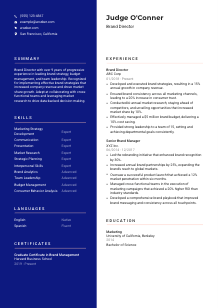
Masterminding brands, but your resume lacks that commanding presence? Check out this Brand Director resume example, created with Wozber free resume builder. It shows how to align your strategic brilliance with job expectations, positioning your brand career at the helm of success!
Brand Director hiring usually turns on one question quickly: can you connect brand strategy to commercial results? Titles alone do not answer that. Your resume needs to show how you shaped positioning, protected consistency across channels, used market insight, and led teams or budgets in ways that moved revenue, share, trust, or launch performance.
A tailored resume also helps separate senior brand marketers from true brand leaders. When the language matches the posting's priorities, an ATS-compliant resume is more likely to surface the right mix of strategy, analytics, and leadership experience. Wozber's free resume builder makes that tailoring easier to structure, so hiring teams can see faster whether you have the scope to lead brand growth.
For a Brand Director, the top of the resume should read cleanly and confidently. This section is simple, but it still carries practical hiring signals: whether you present yourself at the right level, whether contact details are usable, and whether you meet any location or communication requirements attached to the role.
Use your full name as the most visible text on the page. Skip decorative styling and keep the format polished. Brand leadership is tied to judgment and presentation quality, so even this first line should feel considered and professional.
If you are applying for a Brand Director position, state "Brand Director" beneath your name. That instantly frames your background at the right level and helps both recruiters and ATS systems place you in the correct leadership lane instead of reading you as a general marketing candidate.
List a working phone number and a professional email address, ideally in a straightforward format such as firstname.lastname@email.com. Brand directors spend a lot of time in cross-functional communication, presentations, and stakeholder discussions, so sloppy contact details create the wrong first impression.
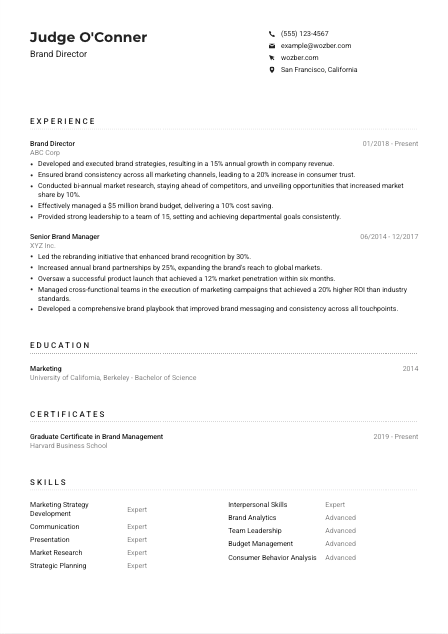
Only include location details that matter to the employer's requirements. In this example, San Francisco, California directly supports a stated location preference, so showing it in the header removes an immediate logistical question. If you are relocating, make that clear rather than leaving the employer to guess.
Include a LinkedIn profile or personal site if it expands on your leadership story with campaign work, brand launches, speaking, press coverage, or portfolio-style case studies. For a Brand Director, an external link should reinforce strategic credibility, not just repeat the resume.
This header does not need personality lines or extra filler. It should present you as reachable, appropriately positioned, and aligned with any immediate requirements before the reader reaches your brand strategy work.




This is the section that carries the most weight for a Brand Director. Hiring teams look for scope, business impact, cross-functional influence, and signs that you can translate brand thinking into growth, consistency, research-backed decisions, and effective team leadership.
Read the posting for the work that defines success in the role, then mirror that language where it honestly fits your background. Here, the priorities are clear: develop brand strategy, maintain consistency across channels, use research and analytics, manage budget, and lead a team. Those should appear in your bullet points through outcomes, not copied phrases alone.
Start with your most recent role and show title, company, and dates in a format that is easy to scan. For senior brand candidates, chronology also tells a leadership story. A progression from Brand Manager to Senior Brand Manager to Brand Director, for example, helps show increasing ownership over positioning, campaigns, budget, and team direction.
Your bullets should show what you owned and what changed because of your work. Strong Brand Director experience usually includes repositioning, go-to-market leadership, campaign alignment, research-driven changes, budget allocation, and team management. The example resume does this well by tying brand strategy to 15% annual revenue growth and market research to a 10% market share increase.
Use numbers that reflect how brand work is measured: revenue growth, market share, trust or recognition lift, campaign ROI, partnership growth, budget savings, launch penetration, or team size. Metrics make strategic work easier to evaluate. A line such as managing a $5 million budget with a 10% cost saving gives much more useful context than saying you "oversaw budget planning."
As you move toward director-level roles, prioritize experience that shows strategy, influence, and leadership. Older bullets that focus on execution without ownership can stay if they support your progression, but they should not dominate. Keep the spotlight on work that shows you can guide brand direction across functions and deliver growth.
The experience section should leave no doubt about scale. By the end of it, the employer should understand what brands, teams, budgets, and commercial outcomes you have already led.
Education matters here because the posting asks for a bachelor's degree in Marketing, Business, or a related field. For a Brand Director, this section is usually straightforward, but it should still confirm the academic base behind your brand, marketing, and business decision-making.
If you hold a bachelor's degree in Marketing, Business, or a related discipline, list it clearly. This is one of the easier screening criteria to satisfy, and making it visible helps remove friction early in the review process.
Present the institution, degree, field of study, and graduation date in a consistent structure. Senior candidates do not need to overwork this section. Clarity is enough, especially when your experience carries the bigger story.
If your degree title closely matches the posting, use the full wording. "Bachelor of Science in Marketing" aligns naturally with a Brand Director opening asking for a marketing-related degree and makes the connection immediate.
Extra detail is optional. Include coursework, thesis topics, honors, or student leadership only if they directly reinforce brand strategy, consumer behavior, market research, or business planning, and only if they still add value at your career stage.
Additional study can be useful when it deepens your positioning as a senior marketer or brand leader. In the example, a Graduate Certificate in Brand Management adds a relevant layer because it supports the resume's emphasis on strategic brand leadership.
For most Brand Directors, this section confirms academic fit rather than carrying the application. State the degree cleanly, add relevant advanced learning, and let your experience do the heavier lifting.
Certifications are rarely the deciding factor for a Brand Director, but the right ones can strengthen your profile. They work best when they add depth in areas such as brand strategy, leadership, analytics, consumer insight, or executive marketing education.
Prioritize credentials that connect to strategic brand management, research, leadership, or commercial decision-making. If a certificate does not support how Brand Directors are hired, leave it off. Relevance matters more than volume.
One well-chosen certification often does more than a long list of lightweight courses. A credential like a Graduate Certificate in Brand Management supports the kind of strategy and brand architecture work employers expect at director level.
Dates help show whether a credential is current, recent, or part of ongoing development. That matters more for fast-moving areas like analytics, digital brand management, and leadership development than for older, less role-specific coursework.
Brand leadership depends on staying current with consumer behavior, channel shifts, measurement frameworks, and competitive movement. Relevant certifications can quietly reinforce that you are still developing your approach, not relying only on past wins.
This section should back up your resume's main story, not distract from it. Keep only the credentials that strengthen your case as someone trusted to direct brand decisions at a high level.
A Brand Director skills section should look selective and role-specific. Employers want to see the mix of strategic, analytical, and leadership capabilities that support brand growth, research-informed decisions, and consistent execution across teams and channels.
Start with the capabilities the role emphasizes, then keep only the ones you can support elsewhere in the resume. In this case, that includes brand strategy, brand analytics, market research, budget management, communication, presentation, and team leadership. These are stronger than broad terms like "creative" or "hardworking."
Brand Directors need more than creative instinct. Your list should reflect strategic planning, consumer insight, analytics, budget ownership, cross-functional collaboration, and executive communication. The example resume handles this balance well by combining skills like Marketing Strategy Development and Brand Analytics with Presentation and Interpersonal Skills.
Do not turn the skills section into a dumping ground. Choose the abilities most relevant to senior brand leadership and remove tools or traits that are too basic, outdated, or off-target. A tighter list helps the employer quickly recognize the kind of judgment and operating range the role requires.
When this section is done well, it reinforces the story told in your experience bullets. The reader should see a candidate who can shape strategy, interpret the market, guide teams, and protect brand consistency across the business.
Language skills matter when the role requires a specific level of communication or when the brand operates across markets. For a Brand Director, this section is usually short, but it can still clarify your ability to lead presentations, align teams, and communicate with partners or audiences effectively.
If the posting calls for strong English, state your English proficiency clearly. That is especially relevant in leadership roles where presentations, strategy decks, messaging reviews, and executive communication are routine parts of the job.
List the languages you know from highest to lower proficiency so the most relevant capability is visible first. This keeps the section practical and easy to scan.
Extra languages can add value when the brand serves multilingual audiences, global partners, or international teams. They are not mandatory for every Brand Director role, but they can strengthen your profile where consumer reach and cultural fluency matter.
Terms like Native, Fluent, Advanced, Intermediate, and Basic are easier to interpret than vague descriptions. Honest labeling matters, especially for roles where public-facing communication and stakeholder interaction are part of daily work.
Do not oversell language ability if it is not central to the role. For this opening, strong English is the key requirement. Additional languages such as Spanish can be a useful bonus, but they should remain secondary to your brand strategy and leadership qualifications.
For Brand Directors, language skills are most helpful when they support leadership communication or broader market reach. Present them simply and let their relevance speak for itself.
The summary is where you establish your level in a few lines. For a Brand Director, it should quickly connect years of experience with the kind of strategic ownership, market judgment, and business results the employer is trying to hire.
Before writing, identify the two or three themes that matter most in the posting. Here, that means brand strategy, leadership, analytics-informed decision-making, and growth. Those ideas should shape the summary more than generic claims about passion or creativity.
Start with a concise line that establishes career level and field, such as more than 9 years in brand management and brand leadership. That gives immediate context and helps distinguish you from earlier-career marketers.
Use one or two concrete outcomes that show your range. In the example, revenue growth, market share gains, and experience leading cross-functional teams make the summary more persuasive because they connect brand work to commercial performance.
Aim for three to five lines that read smoothly and avoid repeating the exact bullets from your experience section. The summary should frame the rest of the resume by showing what kind of brand leader you are, what you have led, and what results tend to follow your work.
A useful Brand Director summary gives the reader a quick picture of your scope and your impact. It should make your resume feel immediately relevant before they reach the detailed experience section.
A Brand Director resume should make three things easy to see: the scale of brand strategy you have led, the business results tied to that work, and the teams or budgets you have directed. When those points are clear, your application reads as leadership material rather than general marketing experience.
Wozber's free resume builder helps you shape that story in an ATS-friendly resume format, and its ATS resume scanner can help you align wording with the posting's priorities. The finished resume should make it easy for a hiring team to recognize that you can lead brand growth with strategic discipline.




