



Use Wozber and land your dream job
Create Resume
No registration required
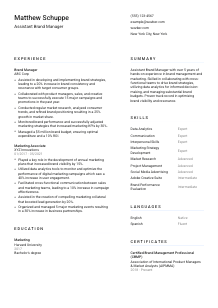
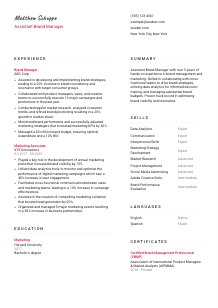
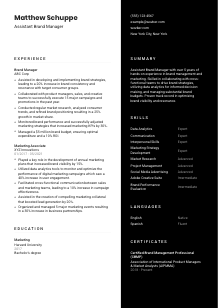
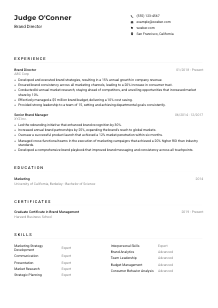
Shaping brand stories, but your resume isn't trending? Check out this Assistant Brand Manager resume example, created with Wozber free resume builder. It shows how to package your market insights and creativity to match the job criteria, propelling your career narrative to brand ambassador level!
Assistant Brand Manager hiring usually turns on whether your resume shows you can connect brand thinking to execution. Teams want someone who can support positioning work, coordinate campaigns across product, sales, and creative partners, read market feedback, and keep an eye on performance without losing sight of budget discipline.
When those capabilities are spelled out in the same language used by the employer, your resume is easier to rank in an ATS and easier to read as a practical brand-management profile instead of a general marketing one. Wozber's free resume builder helps you shape that alignment into an ATS-compliant resume, so hiring teams can quickly see your experience with brand strategy, KPI tracking, consumer research, and cross-functional campaign delivery.
This section is simple, but it still affects how smoothly your application moves forward. For an Assistant Brand Manager role, your header should make it easy to contact you, confirm you meet location expectations when stated, and see right away that your profile is aligned with brand management rather than a broad marketing catch-all.
Use your full name as the most prominent text on the page. Keep the styling clean and professional. Brand roles often sit close to stakeholder-facing work, so even the top of the resume should reflect good judgment and polish.
Place a clear role title directly below your name, such as "Assistant Brand Manager," when that is the position you are pursuing. This helps frame the rest of your background around brand strategy, campaign coordination, and performance analysis rather than leaving recruiters to interpret a broader title on their own.
List a reliable phone number and a professional email address, ideally in a straightforward format such as firstname.lastname@email.com. If your work involves presenting campaign updates or collaborating across teams, small details like a polished email address support the professional impression you want to make.
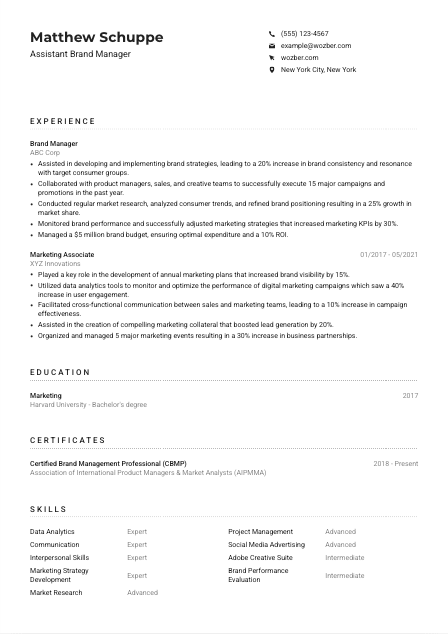
If the posting specifies a city, include your city and state so there is no question about availability. Here, listing New York City, New York directly answers a stated requirement. If you are relocating, say so plainly rather than leaving the employer to guess.
Include LinkedIn or a personal website only if it supports your candidacy. For brand and marketing applicants, that might mean a profile with campaign results, portfolio-style project highlights, presentations, or a consistent work history. Make sure dates, titles, and achievements match your resume.
Your personal details do not need personality flourishes. They need to confirm identity, role focus, contact access, and any stated location requirement so the reader can move straight to your brand and marketing experience.




For Assistant Brand Manager roles, the experience section carries the most weight. Hiring teams look for proof that you have supported brand strategy, coordinated launches or promotions, worked with cross-functional teams, used research to shape decisions, and tracked performance in terms that matter to the business.
Read the posting and isolate the recurring work, not just the obvious keywords. In this case, the recurring themes are brand strategy support, campaign execution, consumer and market analysis, KPI reporting, and budget awareness. Those themes should guide which bullets you keep, rewrite, or cut.
List positions in reverse chronological order and make sure the most relevant brand or marketing work is easy to spot. Titles like Brand Manager or Marketing Associate can both support an Assistant Brand Manager application if the bullets clearly show positioning work, campaign coordination, research, and measurable brand outcomes.
Do not stop at task descriptions. Show what changed because of your work. The sample resume does this well by tying brand strategy support to a 20% increase in brand consistency and linking market research to a 25% growth in market share. Those are the kinds of outcomes that make brand-management experience feel concrete.
Numbers are especially persuasive here when they reflect how brand performance is actually managed. Include metrics such as campaign volume, market share movement, engagement lift, KPI improvement, budget size, ROI, lead generation, or partner growth. A bullet about managing a $5 million budget with a 10% ROI says far more than simply stating that you handled brand spending.
Prioritize bullets that show brand relevance over general marketing activity. If you have broader experience, rewrite it through the lens of the job you want. For example, "worked on campaigns" becomes stronger when you specify that you collaborated with product, sales, and creative teams to deliver promotions and improve campaign effectiveness.
By the end of this section, the reader should be able to picture you helping manage positioning, campaigns, reporting, and budget decisions. That is the level of practical brand contribution your bullets need to make visible.
Education matters most here as a qualification check and as context for your marketing foundation. Once you have a few years of relevant experience, this section should stay concise, but it still needs to confirm that your academic background supports work in branding, marketing, consumer insight, or business strategy.
If the job asks for a Bachelor's degree in Marketing, Business, or a related field, make sure that information is easy to find. A Bachelor's degree in Marketing, as shown in the example, directly supports the employer's requirement and does not need extra explanation.
List your degree, field of study, school, and graduation year in a consistent format. Hiring teams usually scan this section quickly, so clarity matters more than decorative detail.
When your degree is closely tied to brand management, give the field of study clear visibility. Marketing, business, communications, and similar disciplines all help establish familiarity with positioning, consumer behavior, and campaign planning.
If you are earlier in your career or your degree is less directly related, selected coursework can help bridge the gap. Choose classes tied to brand strategy, market research, consumer behavior, advertising, analytics, or marketing communications rather than filling space with a long list of modules.
Honors, leadership roles, or student marketing projects can be useful if they support your target role. A case competition, brand campaign project, or leadership position in a marketing club is worth more here than generic campus involvement.
For most Assistant Brand Manager candidates, this section works best when it quickly confirms the right academic background and then gets out of the way. Let it support your brand and marketing story without overloading the page.
Certifications are rarely the deciding factor for an Assistant Brand Manager role, but they can strengthen your profile when they reinforce your knowledge of branding, marketing, analytics, or related strategy work. They are especially useful when the posting mentions them as a plus, as it does here.
Start with the job description. If certifications are listed as preferred rather than required, treat them as support material that sharpens your profile rather than as the center of your application.
Choose credentials that connect clearly to the work, such as brand management, digital marketing, analytics, consumer insight, or product marketing. The example's "Certified Brand Management Professional" fits because it reinforces the exact area of responsibility the role covers.
Marketing tools, channels, and measurement practices evolve quickly, so dates can help show that your learning is recent or still active. If the certification is ongoing or current, say so in a clear format.
If your background is light on direct brand-management titles, a strong certification can help close that gap. Consider ongoing development in areas like market research, brand strategy, campaign analytics, or digital media measurement, especially if those are recurring themes in your target roles.
The best certifications add another layer of relevance to your resume. They work when they support the same brand, research, and marketing strengths already visible in your experience.
Assistant Brand Manager skills should reflect how the work gets done. That means balancing analytical ability with communication, campaign coordination, market understanding, and the practical tools or methods you use to turn brand plans into measurable results.
Look beyond the explicit list. Here, data analytics, market research, communication, presentation, and interpersonal skills are named directly, while collaboration, KPI reporting, budgeting, and brand positioning are implied by the responsibilities. Your skills section should cover both groups when they reflect real experience.
Use the same wording the employer uses when it is accurate. Terms like "market research," "data analytics," "brand strategy," and "brand performance" help connect your resume to the role in both ATS screening and human review. The sample resume handles this well by pairing technical and business-facing skills instead of listing only generic marketing strengths.
Put the most role-critical capabilities first. For this kind of opening, that usually means market research, data analytics, brand strategy development, KPI analysis, communication, and cross-functional collaboration before less central tools or software. Keep the list focused enough that each skill supports the case you are making.
If a hiring manager scans only this section, they should still recognize a candidate who understands brand positioning, campaign performance, stakeholder collaboration, and data-informed marketing decisions.
Language ability matters in brand roles because messaging, presentations, and cross-team communication are part of the everyday work. Even when the role is not globally focused, the ability to communicate clearly in the required language is a baseline expectation.
If the posting states English proficiency as critical, list English clearly with an accurate proficiency level. This removes doubt about your ability to handle presentations, reporting, agency communication, and internal collaboration.
Put the most important language first, especially when one is explicitly required. That makes the section easier to scan and keeps the hiring signal immediate.
Other languages can strengthen your profile when they relate to consumer segments, regional campaigns, or cross-market collaboration. In the example, Spanish adds useful range without distracting from English as the required priority.
Choose terms such as "native," "fluent," "advanced," or "intermediate" carefully. Brand work often involves live communication, so overstating proficiency can become obvious in interviews or presentation tasks.
If a language has direct commercial relevance, that can be worth noting elsewhere in your resume through experience bullets or project scope. For example, bilingual communication can support multicultural campaigns, community outreach, or collaboration with regional teams.
This section should confirm communication capability, especially in English, and highlight any added language range that could support audience insight or broader market work.
Your summary should quickly establish what kind of marketing professional you are and why your background fits assistant-level brand management work. It is most effective when it blends experience level, brand-relevant strengths, and one or two measurable outcomes without reading like a string of buzzwords.
Start from the main demands of the job, such as supporting brand strategy, using market and consumer data, collaborating across teams, and tracking performance. Those themes should shape the first lines of your summary more than broad claims about passion or creativity.
Lead with your years of experience and the area you work in. A line such as "Assistant Brand Manager with 5+ years in brand management and marketing" is stronger than a vague personal statement because it immediately anchors your profile in the field.
Include one or two results that reflect the work employers care about. The example summary points to brand visibility, brand resonance, budget management, and data-informed decision-making. You can strengthen that pattern even further by mentioning outcomes like market share growth, KPI improvement, or campaign performance gains.
Aim for a short paragraph that gives a clear hiring picture in a few lines. Avoid stuffing in every skill you have. A focused summary that names your brand-management scope, analytical approach, and strongest outcomes will do more work than a longer generic introduction.
When this section is doing its job, the rest of the resume feels consistent before the reader reaches your first bullet. It should position you as someone ready to support brand growth with research, execution, and measured marketing performance.
An effective Assistant Brand Manager resume makes a clear business case. It should show that you can support brand strategy, work across teams, interpret market data, report on KPIs, and manage resources with commercial awareness.
Use Wozber's free resume builder to shape that experience into an ATS-friendly resume template, then refine the language with ATS optimization and an ATS resume scanner so your strongest brand-management qualifications are easy to find. The final result should make your readiness for brand execution and performance-focused marketing easy to judge.




