




Use Wozber and land your dream job
Create Resume
No registration required
Driving online partnerships, but your resume isn't reaping clicks? Check out this Affiliate Marketing Manager resume example, created with Wozber free resume builder. Learn how to showcase your conversion-kickstarting strategies to match job playbooks, ensuring your career affiliateiates with success!
Affiliate marketing work gets judged quickly by one thing: whether you can grow partner-driven revenue without losing margin. Hiring teams want to see that you can recruit and manage affiliates, improve offer performance, read campaign data well, and work across SEO, product, and creative teams when the channel needs adjustment. Your resume should make that commercial ownership visible early.
When the wording on your resume reflects how affiliate programs are actually run, the distinction between general digital marketing experience and true affiliate program leadership becomes much clearer. Wozber's free resume builder helps shape that language into an ATS-compliant resume by aligning your titles, achievements, and keywords with the job description, so your background reads as someone ready to manage partner portfolios, optimize profitability, and grow the channel.
This section does simple but important work. For an Affiliate Marketing Manager, it should confirm who you are, how to reach you, and whether you meet practical requirements such as location, while keeping the focus on your professional brand.
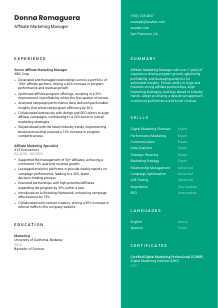
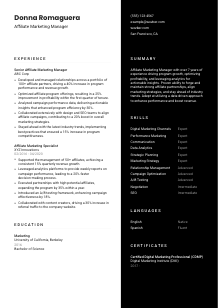
Put your name at the top in a clear, readable format, then place your target title directly underneath. If you are applying for an Affiliate Marketing Manager role, use that exact title when it matches your background. It immediately frames your resume around affiliate program ownership, partner management, and performance growth rather than broad marketing support work.
List a phone number you answer and a professional email address that will not distract from your application. For a role that depends on partner communication, negotiation, and relationship management, even small presentation details matter. Make it easy for recruiters or hiring managers to contact you without confusion.
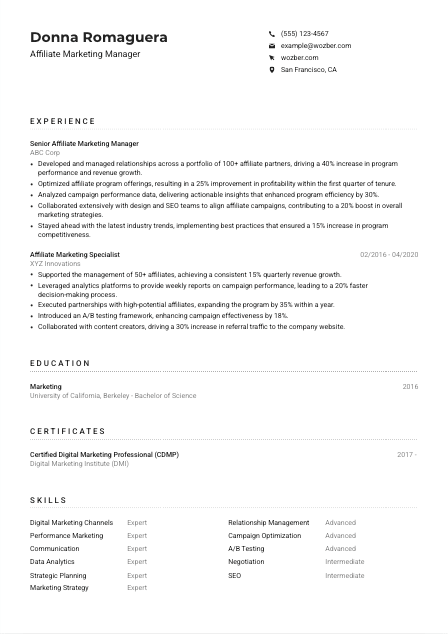
If a job asks for a local candidate or someone willing to relocate, include that clearly in your contact block. In the example, listing "San Francisco, CA" directly supports a stated requirement. Do this when it is relevant to the posting, especially if location affects start timing or eligibility.
Include LinkedIn and, if useful, a professional website or portfolio page that expands on your marketing work. For affiliate marketing, that might mean a profile that supports your experience with partnership growth, performance reporting, channel strategy, or cross-functional campaigns. Make sure the dates, titles, and achievements match your resume closely.
Do not include age, marital status, gender, photo, or other personal identifiers unless a local market specifically requires them. Affiliate hiring decisions should stay centered on your record of scaling programs, handling partner relationships, and improving conversion or revenue metrics.
Your personal details should remove friction, not add noise. A clear title, accurate contact information, and any required location detail help the hiring team move straight to what matters most, your ability to run and grow an affiliate program.




This is the section most hiring managers will study first. Affiliate Marketing Manager resumes stand out when experience shows ownership of partner portfolios, program optimization, reporting cadence, and measurable revenue or profitability gains, not just general campaign activity.
Read the posting and mark the phrases tied to channel ownership. For this role, that includes managing affiliate relationships, maximizing performance, refining program offerings, analyzing campaign data, and collaborating with product, design, and SEO. Use those themes to decide which bullets stay, which get rewritten, and which results deserve the top spots.
For every job, include your title, company, and dates in a format that is easy to scan. Then make the first one or two bullets establish scale. In affiliate marketing, scope can mean number of partners managed, size of the program, reporting responsibility, markets covered, or the cross-functional teams you worked with. The sample does this well by opening with management of 100+ affiliate partners.
Affiliate marketing is measured through revenue growth, profitability, conversion efficiency, partner performance, traffic quality, and program expansion. Your bullets should reflect that. "Drove a 40% increase in program performance and revenue growth" or "improved profitability by 25%" gives the reader a direct business result. If you have metrics for CPA, ROAS, referral traffic, partner retention, or testing wins, use them.
A hiring manager does not need every marketing task you have ever handled. Prioritize bullets that show affiliate recruiting, partner development, payout or offer optimization, campaign analysis, commission strategy, testing, and collaboration with adjacent teams. If you also worked on broader digital marketing, keep only the parts that strengthen your affiliate case, such as SEO coordination or landing page testing.
Start bullets with verbs that reflect decision-making and execution: "developed," "negotiated," "optimized," "analyzed," "expanded," "launched," or "collaborated." That language matters for affiliate roles because the job often sits between relationship management and performance accountability. The sample resume's phrasing works because each bullet makes the candidate sound responsible for growth, not merely present during it.
Your experience section should make it easy to see how you managed affiliates, improved program economics, and translated data into action. If a reader can quickly trace partner scope, optimization work, and business outcomes, this section is doing its job.
Education usually is not the deciding factor for an experienced Affiliate Marketing Manager, but it still needs to be accurate and aligned. Many postings ask for a bachelor's degree in marketing, business, or a related field, so this section should confirm that requirement without taking up too much space.
When a posting names a degree, mirror that information clearly in your education section. If you hold a bachelor's degree in Marketing, Business, Communications, or a related area, list it in full. In the example, "Bachelor of Science" in "Marketing" matches the requirement cleanly.
Present your degree, field of study, school, and graduation year in a consistent order. Recruiters often scan this section in seconds. Clean structure helps them confirm qualifications and move on to the performance-based sections where your affiliate experience carries more weight.
If your degree directly supports the role, say so through the field name instead of leaving it vague. "Marketing" is stronger than an abbreviated or unclear label because it connects naturally to channel strategy, analytics, and campaign optimization. Only add extra detail when it strengthens that connection.
Early-career candidates can include relevant coursework, marketing competitions, analytics projects, or student leadership if those experiences support affiliate or performance marketing skills. Once you have several years of experience managing campaigns and partnerships, these details usually become optional.
Academic honors, scholarships, or standout projects can help if they reinforce analytical ability, business judgment, or marketing execution. Keep them brief. For this profession, practical achievements in channel growth and performance data will matter more than a long list of campus distinctions.
Education should confirm your academic foundation without competing with your experience. If the degree is relevant, clearly labeled, and easy to find, the section has done what it needs to do.
Certifications can strengthen your case when they deepen your credibility in digital marketing, analytics, or channel strategy. They are especially useful when they show current knowledge in a field where platforms, attribution models, and best practices shift fast.
List certificates that connect to affiliate marketing, performance marketing, digital analytics, paid media, SEO, or broader growth strategy. The goal is to reinforce skills used in the role, not to fill space. A credential such as "Certified Digital Marketing Professional (CDMP)" works because it supports the channel and analytics focus of the job.
If you have several certifications, lead with those that best support partner growth, campaign analysis, or digital channel management. Hiring teams care more about relevant training in analytics platforms, conversion strategy, or digital marketing than about unrelated credentials with recognizable brand names.
Add completion or active dates when they show that your knowledge is current. In affiliate marketing, recency can matter because reporting tools, compliance expectations, and optimization tactics evolve. Dates also help distinguish an active credential from training completed years ago and never revisited.
If your certification list is light, this is a practical area to strengthen. Courses in GA4, attribution, SEO, CRO, partnership strategy, or performance reporting can all support an Affiliate Marketing Manager profile. Ongoing learning matters because the role sits at the intersection of channel economics, data, and relationship management.
Certifications should support the story your experience already tells. Choose the ones that make your digital marketing, analytics, and optimization background easier to trust at a glance.
The skills section should read like the toolkit behind your results. For affiliate roles, that means a mix of channel knowledge, analytical ability, commercial judgment, and partner-facing communication, arranged around what the target job actually asks for.
Start with the job description and note the repeated capabilities. Here, that includes digital marketing channels, analytics platforms, performance metrics, relationship management, negotiation, and collaboration across teams. Use the employer's wording where it truthfully reflects your background so both recruiters and ATS filters can recognize the match.
Lead with the abilities most central to affiliate program ownership. Skills such as performance marketing, data analytics, campaign optimization, relationship management, and strategic planning should appear before more general marketing strengths. In the example, SEO is listed, which makes sense because the role also involves cross-functional work with SEO teams, but it should not overshadow affiliate-specific strengths.
Group your skills in a way that makes sense to a marketing hiring team. One practical approach is to balance technical and commercial skills, such as analytics, A/B testing, and digital channels alongside communication, negotiation, and partner management. This mirrors how the job is performed, where numbers and relationships both drive results.
Your skills section should reinforce what your experience already proves. When the list reflects affiliate management, campaign analysis, optimization, and partner communication, it strengthens the overall case without feeling generic.
Language ability may or may not be a major factor in affiliate hiring, depending on the partner base and markets covered. Still, when a posting names English proficiency or the role involves international affiliates, this section can add useful context.
If the job specifically asks for English proficiency, list English at the top of the section with an accurate level. That directly addresses the requirement and matters for a role built on communication, negotiation, reporting, and relationship management.
Additional languages can be valuable when affiliate programs operate across regions or rely on diverse publisher relationships. If you can speak with partners, review localized materials, or support expansion into new markets, mention those languages clearly. In the example, Spanish adds breadth without distracting from the core requirement.
Choose straightforward ratings such as "Native," "Fluent," "Advanced," "Intermediate," or "Basic." Avoid overstating your ability. In affiliate marketing, a language claim should reflect what you can actually do, whether that is negotiating with partners, writing outreach, or participating in campaign reviews.
If the target company works with affiliates in multiple countries, language skills become more commercially relevant. They can support partner recruitment, smoother communication, and faster troubleshooting across time zones and markets. If the role is domestic, keep the section concise and factual.
List languages when they support the way you work, not just as personal trivia. For this profession, language ability can strengthen partner communication, market expansion, and affiliate relationship building, which makes it worth including when relevant.
For Affiliate Marketing Manager roles, language skills are most useful when they connect to partner communication or expansion into additional markets. Keep the section accurate, brief, and tied to business value.
Your summary should quickly tell the reader what kind of affiliate marketer you are and what outcomes you are known for. In a few lines, it should connect your years of experience with the revenue, profitability, and program management strengths that matter for the role.
Start with your title and years of experience, then define your focus clearly. For example, an Affiliate Marketing Manager with 7+ years in affiliate and performance marketing tells the reader right away that you are not coming from an unrelated generalist path. This is where you establish channel relevance fast.
Follow with two or three role-specific strengths such as growing affiliate revenue, optimizing program profitability, analyzing campaign performance, or building high-value partner relationships. The sample summary does this effectively by connecting growth, profitability, and analytics in a way that mirrors the job description.
Aim for three to five lines. Every phrase should add useful information about program scale, results, or expertise. Avoid vague claims about being passionate or dynamic unless you pair them with something concrete, such as portfolio growth, testing wins, or cross-functional campaign execution.
A short summary can still show how you operate. If your strength is data-driven optimization, strategic partner management, or close collaboration with SEO and design teams, state that directly. That gives the employer a clearer picture of how you lead affiliate performance, not just what title you hold.
A well-written summary should make the reader expect strong affiliate results before they even reach your experience section. Keep it specific enough to anchor your profile around revenue growth, partner management, and program optimization.
Once your resume clearly shows partner portfolio management, revenue growth, program optimization, and data-led decision making, it will read much more like an Affiliate Marketing Manager application and much less like a general digital marketing resume.
Use Wozber's free resume builder to shape that experience into an ATS-friendly resume format, and use its ATS resume scanner to check whether the language of your resume matches the requirements of the role you want.
The final version should make one thing easy to judge: you can build affiliate relationships, improve program performance, and grow revenue with discipline.




