



Use Wozber and land your dream job
Create Resume
No registration required
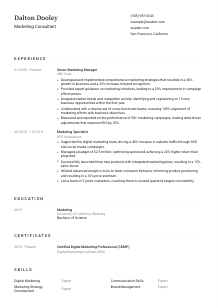
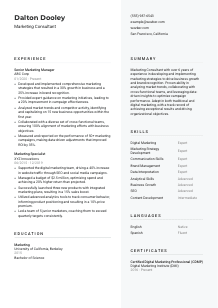
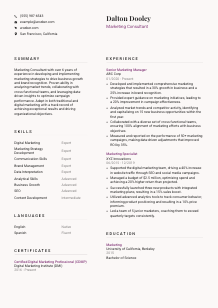
Creating campaigns, but your resume feels unbranded? Check out this Marketing Consultant resume example, created with Wozber free resume builder. It shows how to position your strategic insights to match job demands, paving the way for your career to hit those customer conversion records!
Marketing consultants are hired to turn market insight into action. A resume for this role needs to show how you shaped strategy, improved campaign performance, guided stakeholders, and translated data from channels like SEO, paid media, content, email, or brand work into business growth. Broad claims about being "results-driven" do not carry much weight here. Specific outcomes, marketing scope, and decision-making do.
Screening often comes down to whether your background clearly matches the employer's mix of strategy, channel knowledge, and reporting depth. Wozber's free resume builder helps you shape that match into an ATS-compliant resume, so terms from the job description and your actual accomplishments line up cleanly. That makes it easier for a hiring team to see whether you can lead campaigns, advise cross-functional partners, and improve results with data.
This section is simple, but it still sets expectations. For a Marketing Consultant, it should immediately confirm who you are, what role you do, and whether basic hiring requirements like location and contact availability are already covered.
Place your name at the top in a slightly larger font than the rest of the page. Keep it clean and professional. Marketing work depends on clear presentation, and that standard starts with the resume header.
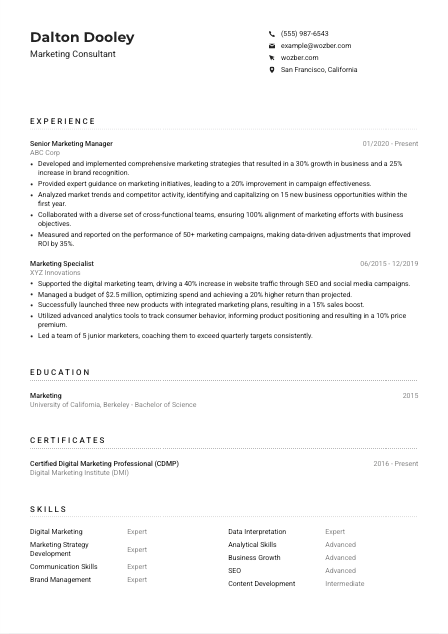
Add "Marketing Consultant" directly under your name if that is the role you are applying for. This keeps your positioning clear, especially if your recent titles were broader, such as Senior Marketing Manager or Marketing Specialist. It helps the reader connect your background to consulting-focused work right away.
Include a reliable phone number and a professional email address. If you use a portfolio site, LinkedIn profile, or personal website, make sure it supports your marketing work with campaign examples, brand projects, thought leadership, or measurable results rather than acting as a placeholder.
Some marketing roles are flexible, but others are tied to a market, client base, or office. Here, the posting specifically asks for someone located in San Francisco, CA, so listing San Francisco, California in your header removes an obvious screening barrier early.
A digital link earns space when it deepens your case. For a marketing consultant, that could mean a LinkedIn profile with consistent career history, a website with campaign case studies, or a portfolio showing brand strategy, content planning, demand generation, or analytics work. Keep it current and aligned with the resume.
Your header should answer the practical questions first: who you are, what marketing role you are targeting, and how to reach you. When those basics are clean, the rest of the resume can focus on strategy, execution, and results.




This is the section that usually decides whether a marketing consultant moves forward. Hiring teams want to see how you built strategy, advised teams, managed campaigns across channels, and improved outcomes with market analysis and performance reporting.
Before rewriting bullets, identify the work patterns behind the posting. Here, the employer wants someone who can develop marketing strategy, guide campaigns and content, analyze competitors and trends, collaborate across functions, and report performance. Those themes should shape the examples you choose from your own background.
List roles in reverse chronological order with title, company, and dates. That basic structure matters because consulting hires are often judged on progression from execution into strategy, leadership, and advisory work. In the sample resume, the move from Marketing Specialist to Senior Marketing Manager helps support that progression naturally.
Each bullet should show what you owned, what you changed, and what happened next. For marketing work, that often means campaign performance, pipeline or revenue contribution, brand lift, audience growth, efficiency gains, or market opportunities identified. A bullet like "developed and implemented comprehensive marketing strategies that resulted in 30% business growth" works because it links strategy to a business result.
Numbers matter most when they reflect how marketing is actually measured. Include ROI, conversion lift, website traffic growth, campaign volume, lead quality, budget size, engagement improvement, share of voice, or brand recognition when those metrics are part of your real work. The sample resume does this well with figures like 50+ campaigns managed and a 35% ROI improvement.
A marketing consultant is expected to recommend, influence, and optimize, not just execute tasks. Prioritize bullets that show strategic planning, cross-functional partnership, market analysis, and recommendations that changed performance. If a bullet does not support the employer's need for channel knowledge, analytical judgment, or business-facing communication, cut it or rewrite it.
By the end of this section, a reader should be able to tell what scale of marketing work you handled, which channels and initiatives you influenced, and what business results followed from your decisions. That is the standard this role is usually screened against.
Education is rarely the deciding factor for an experienced marketing consultant, but it still needs to confirm that you meet the stated academic requirement and that your foundation fits the work.
The posting asks for a bachelor's degree in Marketing, Business, or a related field. If you have one of those degrees, state it clearly without abbreviations that make the credential harder to read. A Bachelor of Science in Marketing is an exact match and should be easy to spot.
List degree, field of study, school, and graduation year. Hiring teams do not need extra formatting here. They need to confirm the requirement quickly and move on to your strategic and analytical experience.
When your degree aligns closely with the role, it reinforces your professional story. In the provided resume, a marketing degree from UC Berkeley strengthens the case for someone moving into a consultant-level role grounded in formal marketing training.
Most candidates with 5+ years of experience can skip coursework unless it directly supports a specialized area such as brand analytics, consumer behavior, digital media planning, or market research. Use it sparingly and only when it sharpens your relevance.
Honors, leadership roles, or major projects can help if they connect to marketing strategy, communications, or analytics, especially earlier in your career. Once your professional achievements are stronger, keep this section lean so the resume stays focused on campaign and business impact.
For this role, education should confirm that you meet the baseline and support your marketing foundation. It does not need to compete with your experience section for attention.
Certifications can strengthen a marketing consultant resume when they point to current channel expertise, analytics knowledge, or continued development in a fast-changing field.
This posting does not require a certification, so use the section to reinforce relevant depth rather than to fill space. Credentials tied to digital marketing, analytics, content strategy, CRM platforms, paid media, or brand management are usually the most useful for this kind of work.
Put the certification that best supports your consulting scope first. A credential such as Certified Digital Marketing Professional fits well because it backs up experience across channels and helps validate expertise in digital planning and execution.
Certification dates show whether your training is current, which matters in marketing where platforms, attribution models, privacy rules, and channel practices change quickly. If the certification is active or renewed, note that clearly.
Ongoing learning matters in marketing because strategy quality depends on current channel knowledge and measurement discipline. Certifications in GA4, paid search, content marketing, lifecycle marketing, or marketing automation can strengthen your profile when they match the work you actually do.
Relevant credentials add weight when they support your channel knowledge and analytical range. Keep the section focused on certifications that make your recommendations and campaign judgment more credible.
The skills section should read like the operating toolkit of a marketing consultant. That means a focused mix of strategy, channel knowledge, analysis, and communication, not a long inventory of every platform or buzzword you have touched.
Start with the job description and identify both direct and implied skills. Here, that includes marketing strategy, digital marketing, brand management, data interpretation, communication, campaign planning, content development, and cross-functional collaboration. Use your real experience to decide which of those belong on the page.
Consulting resumes need more than execution tools. Include capabilities that show you can diagnose problems and guide action, such as marketing strategy development, performance analysis, market research, brand positioning, and stakeholder communication. The sample resume balances these well with skills like Digital Marketing, Brand Management, and Data Interpretation.
Group or order skills so the strongest and most role-relevant ones appear first. Do not overcrowd the section with low-value software names or vague traits. A shorter list built around strategic planning, analytics, channel execution, and communication will say more than a cluttered one.
A hiring manager should be able to scan this section and understand the kind of marketing problems you can solve. When the skills list matches the strategy, channels, and analysis in your experience section, your profile feels much more convincing.
Language skills are a supporting detail for most marketing consultant resumes, but they can matter when the role calls for client communication, cross-market work, or audience knowledge.
The posting states that the candidate must communicate effectively in English. List English first and use an honest proficiency level such as Native or Fluent. That addresses a stated requirement without overexplaining it.
Additional languages are useful when they relate to audience segments, regional campaigns, client communication, or multicultural brand work. Spanish, for example, can strengthen a profile if you have worked on bilingual campaigns or market expansion efforts.
Use clear labels such as Native, Fluent, Advanced, or Intermediate. Marketing consultants are often expected to present, write, and advise, so inflated language ratings can create problems later if the role includes client-facing communication.
If another language has helped you research markets, localize messaging, manage regional stakeholders, or support international campaigns, that context belongs elsewhere in the resume as well. The language section should stay concise, but it can support a broader story about audience reach.
For most marketing consultant roles, languages are a secondary section. They become more valuable when they connect to client communication, audience understanding, or cross-market campaign work.
Your summary needs to establish your marketing scope fast. In a few lines, show the level you operate at, the kinds of outcomes you influence, and the mix of strategy, channel knowledge, and analysis you bring.
Read the job description first and decide what the opening lines need to emphasize. For this position, the clearest themes are strategy development, digital and traditional channel knowledge, data-driven recommendations, cross-functional collaboration, and business growth. Those should shape the summary more than generic personal descriptors.
State your title or professional identity, years of experience, and area of strength in one direct sentence. A summary that opens with 6+ years in marketing strategy and performance-focused campaign leadership sets a stronger tone than a vague claim about passion or creativity.
Choose two or three strengths that connect directly to the role, such as growth strategy, brand development, market analysis, campaign optimization, or stakeholder guidance. The sample summary works because it ties experience to business growth, brand recognition, and data-driven performance improvement rather than listing traits.
Aim for three to five lines. That is enough space to establish your seniority, marketing scope, and measurable orientation without repeating the experience section. Every phrase should earn its place by clarifying what kind of consultant you are.
A strong summary tells the reader, in seconds, whether your background matches the level and marketing scope of the role. Keep it direct, specific, and grounded in the kind of results you have actually delivered.
A marketing consultant resume should make three things easy to judge: the strategic problems you can solve, the channels and campaigns you know how to improve, and the business results tied to your recommendations. When each section supports that story, the application reads with much more authority.
Use Wozber to tighten the language, align your content with the posting, and check ATS optimization before you apply. The final version should feel less like a generic marketing profile and more like a clear case for why you can guide growth, sharpen campaigns, and report on performance with confidence.




