



Use Wozber and land your dream job
Create Resume
No registration required
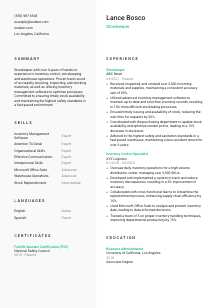
Preserving inventory order, but your resume seems disarrayed? Organize your talent with this Storekeeper resume example, created with Wozber free resume builder. Learn how to stockpile your warehousing expertise to match job specifications, ensuring your career is always on the right shelf!
Storekeeping work is judged in daily operations long before it shows up on a resume. Materials have to be received correctly, stock has to be available when requested, counts have to hold up during physical inventory, and safety procedures have to be followed without shortcuts. Your resume should make that operational reliability visible, not just list warehouse duties.
A tailored Storekeeper resume quickly shows whether you can manage stock accurately, work with inventory systems, and support smooth replenishment without creating delays or discrepancies. Wozber's free resume builder helps shape that experience into an ATS-compliant resume by aligning your wording with the posting and keeping the structure easy to scan, so hiring teams can immediately see where you have handled receiving, recordkeeping, and stock control well.
For a Storekeeper role, the personal details section does one practical job first. It should confirm who you are, how to reach you, and whether you meet straightforward screening requirements before the reader gets into inventory experience or warehouse performance.
Use your full name as the most visible text on the page. Keep it clean and professional so the resume starts with clarity, especially when a hiring team is reviewing multiple warehouse and inventory candidates in a short batch.
Place "Storekeeper" directly under your name if that matches the role you are targeting. This immediately positions your background around stock handling, inventory records, issuing materials, and warehouse support rather than leaving the employer to guess which operations role you want.
List a phone number you answer reliably and a professional email address. In fast-moving hiring cycles for warehouse and storekeeping roles, outdated contact details can delay interviews or shift opportunities to another candidate.
If the employer specifies a location requirement, show it clearly in your header. In the example posting, Los Angeles, California is listed as a must, so including that detail removes an immediate screening question about availability or relocation.
A LinkedIn profile or professional website can help if it reinforces your work history, certifications, or warehouse operations background. Leave it out if it is incomplete, outdated, or unrelated to inventory control and materials handling.
Skip details such as age, marital status, or other personal identifiers unless a local process explicitly requires them. For a Storekeeper resume, space is better used on stock accuracy, equipment credentials, software proficiency, and relevant experience.
Your header should answer the practical basics in seconds: your identity, your contact information, and any location requirement tied to the job. Once that is clear, the resume can stay focused on inventory accuracy, stock availability, and warehouse discipline.




Storekeeper experience is strongest when it shows control over physical goods and inventory records at the same time. Hiring teams look for evidence that you can receive materials, inspect them, keep stock organized, issue items on time, and coordinate with purchasing or operations without introducing avoidable errors.
Before writing bullets, isolate the work that matters most in the target role. For Storekeeper jobs, that usually includes receiving incoming supplies, maintaining accurate inventory data, handling stock requests, supporting reorder decisions, and following warehouse safety procedures. These should become the backbone of your experience section instead of generic logistics language.
Start with your most recent position and include job title, employer, and employment dates for every role. This lets the reader follow your progression through inventory control, warehouse operations, or materials management work without having to reconstruct your timeline.
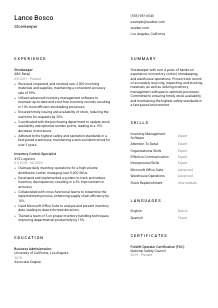
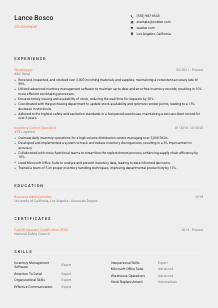
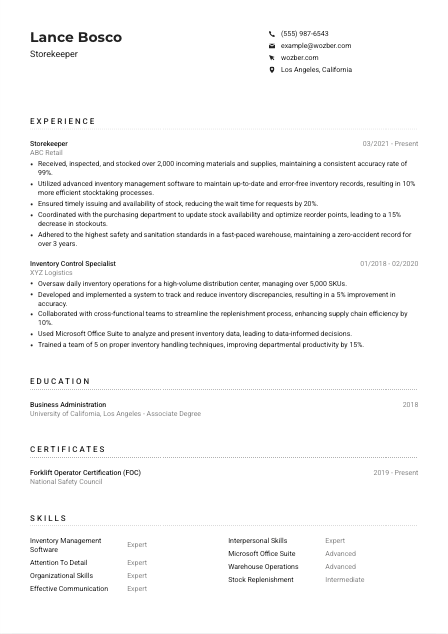
Focus each bullet on work that matters in a storeroom or warehouse environment. Good examples include inspecting deliveries, resolving discrepancies, keeping inventory records current, fulfilling stock requests, or coordinating reorder points with purchasing. The sample resume handles this well by tying day-to-day duties directly to receiving, issuing stock, and stock availability rather than using vague operations language.
Numbers carry real weight in inventory work because they show scale and control. Include metrics such as number of materials received, SKU count, inventory accuracy, stockout reduction, request turnaround time, or safety record. In the example, figures like 2,000 incoming items, 99% accuracy, and a 15% drop in stockouts give the hiring team a clearer picture of performance than a generic claim about being detail-oriented.
Prioritize experience that supports inventory handling, warehouse organization, data accuracy, replenishment, and compliance with safety procedures. If you have broader logistics or retail operations experience, keep the parts that connect directly to stock control and materials movement, and trim duties that do not strengthen your case for the role.
Your experience section should show that stock moved through your hands and records without chaos. If the reader can see reliable receiving, accurate counts, timely issuing, and measurable improvements in availability or accuracy, this section is doing its job.
For most Storekeeper roles, education is a qualifying detail rather than the main selling point. It should confirm that you meet the posted baseline and, when relevant, add context that supports inventory work, business operations, or warehouse administration.
Start by matching the stated baseline. Many Storekeeper postings ask for a high school diploma or equivalent, sometimes paired with hands-on inventory experience. If you hold additional education, list it clearly, but make sure the required level is easy to identify at a glance.
Use a clean structure that includes degree or diploma, institution, and graduation information if available. Straightforward formatting works best here because this section is usually scanned quickly after experience and skills.
If your studies relate to business administration, supply chain basics, accounting, or warehouse processes, that connection is worth making. The example resume lists an Associate Degree in Business Administration, which can support storekeeping work by signaling familiarity with recordkeeping, purchasing flow, and operational organization.
Coursework is optional, but it can help early-career candidates or anyone whose education includes subjects tied to inventory systems, spreadsheets, operations, or logistics. Keep it brief and practical rather than turning the section into a course catalog.
Honors, projects, or extracurricular activities belong here only when they connect to responsibility, data handling, process improvement, or operational coordination. If they do not add value to storekeeping work, keep the section lean and let experience carry the weight.
Education should confirm that you meet the role's baseline and support the rest of the resume without competing with your inventory experience. A short, relevant entry is usually enough unless your academic background directly strengthens your work in stock control or operations.
Certifications matter most when they support safe, efficient work in storage and warehouse environments. For Storekeeper roles, the strongest ones usually relate to equipment use, material handling, safety practice, or systems knowledge that improves day-to-day reliability.
List certificates that relate directly to warehouse operations, inventory handling, safety compliance, or equipment use. This is where a forklift credential, OSHA-related training, or other handling and safety certification can strengthen your resume far more than a generic course completion.
Lead with certifications that help an employer picture you working safely and productively in their storage environment. The sample resume's Forklift Operator Certification is a strong example because it connects directly to material movement and warehouse operations, even though it is not listed as a universal requirement in every Storekeeper posting.
Show when the certificate was earned and, if applicable, whether it is still active. In warehouse roles, current credentials matter because they affect compliance, equipment access, and confidence in your readiness to start work quickly.
If you are actively working in storekeeping or inventory control, continue adding certifications that support safety, equipment handling, inventory systems, or warehouse process improvement. A current certificate list shows you are maintaining practical capability, not letting operational knowledge go stale.
Certificates can strengthen your resume when they point to safer handling, broader warehouse capability, or faster onboarding. Keep the list current and relevant, and it becomes another practical reason to trust you with stock, equipment, and inventory processes.
A Storekeeper skills section should reflect the actual mix of the job. That usually means inventory software, stock control, warehouse organization, communication with purchasing or requestors, and the attention to detail needed to keep counts accurate and materials available.
Pull the required skills from the job description and match them against your own background. In this posting, that includes inventory management software, Microsoft Office Suite, attention to detail, organization, communication, and safety awareness. Use the same language when it truthfully reflects your experience so both the recruiter and the ATS can connect your background to the role.
Put the most job-relevant abilities first. For Storekeeper positions, that often means inventory management systems, stock replenishment, warehouse operations, receiving and inspection, and data accuracy. In the sample resume, software proficiency, warehouse operations, and stock replenishment all support the core responsibilities listed in the posting.
Avoid padding this section with every general trait you have ever used. A shorter list with role-linked skills is stronger than a long one full of vague strengths. Aim for a mix of technical tools and dependable work habits that directly support receiving, record maintenance, issuing stock, and safe material handling.
This section should quickly confirm that you can work in both the physical and administrative sides of inventory control. If the reader can see system proficiency, stock-handling capability, and disciplined warehouse habits, your skills list is pulling its weight.
Language ability matters in storekeeping when instructions, stock requests, safety procedures, and record updates need to be understood correctly the first time. In many warehouse settings, clear English communication is essential for receiving, issuing, and coordinating inventory without avoidable mistakes.
Check the posting for any stated language requirement and list that language first if you meet it. Here, English proficiency is explicitly required, so it should appear clearly in your languages section rather than being left implied.
Use simple proficiency labels so the employer knows whether you can handle daily communication, documentation, and coordination. This matters in storekeeping because inventory requests, delivery discrepancies, and safety instructions all depend on precise understanding.
Extra languages can be valuable in warehouses, retail backrooms, and distribution environments where teams, drivers, vendors, or requestors may be multilingual. The example resume includes Spanish, which can be useful in many operations settings, though it should be treated as an added advantage rather than a universal requirement.
Do not overstate fluency. If you will need to read inventory notes, communicate about stock issues, or understand safety procedures on the job, your listed level should match what you can actually do in a working environment.
If another language helps you communicate with coworkers, suppliers, or customers, include it. If it does not add practical value to the role, there is no need to force it into the resume. Keep the section tied to workplace communication, not personal trivia.
Language details should make it easier to picture you handling instructions, updates, and day-to-day coordination accurately. For Storekeeper roles, that means clear communication around stock, safety, and requests, with any added language skill serving as a practical bonus.
The resume summary is where you frame your background in a few lines before the reader reaches your full work history. For a Storekeeper, it should quickly establish your experience level, your command of inventory processes, and the kind of operational results you can deliver.
Start with the core of the role, not a generic statement about being hardworking. Mention experience in inventory control, receiving, stock organization, issuing materials, warehouse operations, or similar functions that define storekeeping work.
Your first line should identify you as a Storekeeper or closely related inventory professional and state your years of experience. The sample summary does this well by immediately positioning the candidate around more than 4 years in storekeeping, inventory control, and warehouse operations.
Follow with specifics that match the posting, such as maintaining accurate records, working with inventory software, reducing stock delays, improving stocktaking efficiency, or upholding safety standards. This gives the reader a fast operational snapshot before they move into the experience section.
Aim for a compact paragraph, usually three to five lines. A summary should not repeat the whole resume. It should establish your inventory background, your strongest relevant capabilities, and the level of responsibility you can handle.
A good summary should make your direction obvious within seconds: you know how to manage stock accurately, keep inventory records dependable, and support warehouse operations without losing control of detail. That is the impression this section needs to leave.
You now have a practical framework for building a Storekeeper resume that reflects how the job is actually reviewed. Focus on the parts of your background that show accurate receiving, dependable inventory records, timely stock issuing, software use, and safe warehouse habits.
Use Wozber to organize that experience into an ATS-friendly resume format, strengthen wording with role-specific terminology, and check alignment with an ATS resume scanner before you apply. The finished resume should make it easy to see that you can keep inventory under control, support daily operations, and step into the role with confidence.