



Use Wozber and land your dream job
Create Resume
No registration required
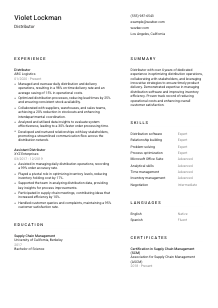
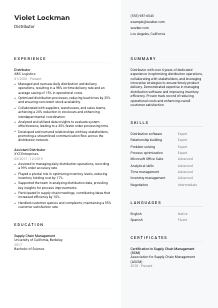
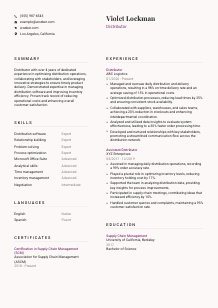
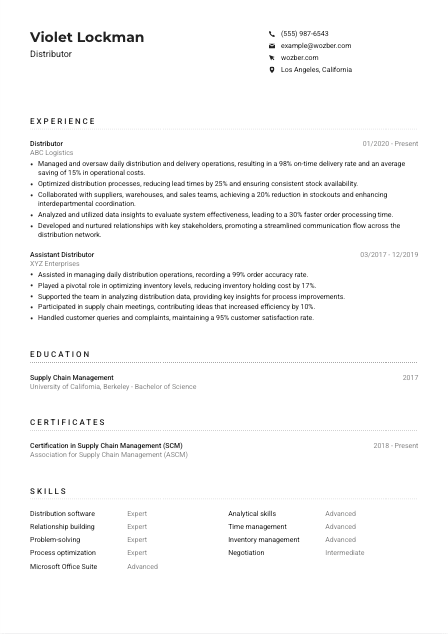
Bringing goods to the table, but your resume seems lost in transit? Check out this Distributor resume example, created with Wozber free resume builder. Learn how to put your logistics expertise and supplier savvy in line with job requirements, ensuring your career trajectory arrives right on schedule!
Distribution work is judged in motion. Hiring teams want to see whether you can keep deliveries on schedule, control costs, maintain stock flow, and solve operational issues before they disrupt customers or warehouse teams. Your resume should make that operational command visible through concrete scope, process improvements, and service results.
When distributor resumes are tailored well, the first read quickly separates hands-on distribution operators from broader logistics candidates whose experience is less direct. Wozber's free resume builder helps you match the job's language in an ATS-friendly resume format, so terms like distribution operations, delivery performance, stock levels, and process optimization are easy to surface where they matter most.
This section does more than provide contact information. For distributor roles, it also confirms practical basics early, especially title alignment and location when the employer wants someone already based in a specific market.
Use your full name in a clear, prominent format at the top of the page. Keep the styling simple and professional so the eye lands on it immediately. In operations-focused hiring, clean presentation matters because it sets the tone for how the rest of your resume will be read.
Place the job title "Distributor" directly under your name when that is the role you are pursuing. This creates an immediate connection between your background and the opening, especially when the employer is scanning quickly for distribution-specific applicants rather than general logistics support profiles.
List a reliable phone number and a professional email address that uses your real name. Accuracy matters here. If a hiring manager wants to move quickly after seeing strong delivery metrics or inventory results, your contact details should not slow anything down. Add a website or LinkedIn profile only if it supports your professional record and matches the resume.
If the posting requires a candidate to be based in a certain area, include your city and state clearly. Here, Los Angeles, California is part of the stated requirement, so placing it in the header removes doubt immediately. That kind of detail is situational, not universal, but when a role includes local distribution oversight or in-market coordination, it matters.
Add LinkedIn or a professional site if it reinforces your background in distribution, logistics, inventory, or supply chain work. Make sure the content matches your resume, including titles, dates, and measurable outcomes such as on-time delivery rates, cost reductions, or warehouse coordination responsibilities.
A well-built personal details section gives the employer the essentials without making them search. For a distributor role, that means clear contact information, the right job title, and location when it is part of the hiring criteria.




This is the section hiring teams read most closely for distributor roles. They want to see how you handled daily movement of goods, worked across suppliers and warehouses, and improved service, cost, or inventory performance over time.
Read the posting and mark the operational themes that appear repeatedly. In this case, the employer needs someone who can oversee daily distribution and delivery activity, optimize processes, analyze data, and coordinate with suppliers, warehouses, and sales teams. Those themes should show up in your experience section through real examples, not broad claims.
List each position in reverse chronological order with job title, company name, and dates. For distribution hiring, titles matter because they help show whether you led operations directly or supported them in a junior capacity. A progression such as Assistant Distributor to Distributor, as shown in the example, quickly signals growth in responsibility.
Distributor resumes get stronger when bullets show what changed because of your work. Instead of saying you managed deliveries, show the service level you maintained, the lead time you cut, or the stockout rate you improved. The sample does this well with results like a 98% on-time delivery rate, 15% operational cost savings, and 25% shorter lead times.
Use numbers that belong naturally to distribution work. Strong examples include order accuracy, delivery performance, processing time, inventory holding cost, stock availability, customer satisfaction, and coordination improvements across the network. Metrics like a 30% faster order processing time or a 20% reduction in stockouts tell hiring teams how you influence throughput and reliability.
Trim out tasks that do not strengthen your case for the target role. Prioritize bullets tied to routing, inventory flow, supplier coordination, warehouse communication, delivery performance, cost optimization, and customer outcomes. If you handled complaints, frame that work in terms of service levels or satisfaction, as the example does with a 95% customer satisfaction rate.
Your experience section should leave little doubt that you can run distribution activity, improve process efficiency, and work across the supply chain without losing control of service levels. The clearest proof is specific work paired with measurable operational results.
For distributor positions, education usually acts as a qualification check rather than the main selling point. Still, when the role asks for a bachelor's degree in Business, Supply Chain Management, or a related field, your education section needs to confirm that requirement quickly and clearly.
If your degree matches the posting, make that easy to see. A bachelor's degree in Business, Supply Chain Management, or a related field directly supports the requirement here, so list it in a straightforward way. The example does this effectively with a Bachelor of Science in Supply Chain Management.
List your degree, field of study, school, and graduation year in a clean sequence. That is usually all an employer needs to confirm your academic background. Avoid crowding this section with extra text unless your coursework or honors directly strengthens your case for distribution work.
When your major aligns with the role, use the exact wording. Supply Chain Management, Logistics, Operations, or Business are all stronger when named directly rather than left implied. This helps both human readers and ATS screening connect your education to the position faster.
Most experienced distributors do not need course lists, but it can help if you are earlier in your career or changing from an adjacent field. Include subjects such as inventory management, logistics analytics, procurement, transportation systems, or operations planning only if they support the target role in a meaningful way.
Honors, relevant projects, or student leadership can be worth adding if they reinforce analytical ability, planning discipline, or supply chain interest. Keep them brief. Once you have several years of hands-on distribution experience, academic extras should not distract from your operational record.
Education should answer the employer's degree requirement in seconds. If your field of study connects directly to supply chain or business operations, make that connection obvious and move the focus back to your work history.
Certifications matter most when they strengthen a distribution profile with current supply chain knowledge or operational depth. They are especially useful when the employer mentions SCM credentials as a plus, as this posting does.
If the role mentions supply chain certification, list that credential clearly and use the exact language where appropriate. Here, an SCM certification aligns directly with the employer's preference. That kind of match helps your resume move from acceptable to notably well-tailored.
Choose certificates tied to distribution, logistics, warehouse operations, procurement, transportation, or supply chain planning. One respected credential is more persuasive than a long list of unrelated training. The example's Supply Chain Management certification from ASCM works because it supports the job's operational and analytical focus.
Add the year earned, and if relevant, show that the certification remains active. In a field shaped by changing systems, service expectations, and process standards, current credentials carry more weight than old ones with no context.
If you are working toward a new credential or regularly updating your training in forecasting, inventory planning, compliance, or data analysis, include that selectively. Employers hiring distributors often value people who improve process knowledge over time, especially when the role involves optimization and cross-functional coordination.
A well-chosen certification strengthens your case when it connects directly to supply chain execution, distribution planning, or process improvement. Keep the section focused, current, and closely tied to the work you want to do next.
A distributor's skills section should read like the toolset behind reliable movement of goods and steady service performance. It needs to cover systems, analysis, coordination, and execution without turning into a generic list of business traits.
Start with the posting and pull out skills tied to day-to-day performance. Here that includes distribution software, Microsoft Office Suite, analytical ability, negotiation, and time management. If those reflect your real experience, use that language directly so the match is visible in both ATS screening and human review.
Lead with the capabilities that support delivery accuracy, stock control, process efficiency, and stakeholder coordination. For distributor roles, that often means inventory management, process optimization, logistics analysis, relationship management, order tracking, reporting, and system use. The sample skill list works because it stays close to the actual responsibilities of the role.
Use a concise format instead of full sentences. Grouping hard skills and core working skills can help if you have a broad background, but avoid padding the list. Every item should connect to how distribution performance is measured, whether through timeliness, cost control, order accuracy, or customer satisfaction.
Your skills section should reinforce the operational story told elsewhere in the resume. If your experience shows delivery performance, stock optimization, and process improvement, the listed skills should make those outcomes feel credible and consistent.
Distribution work often involves constant coordination across suppliers, warehouse teams, carriers, and sales contacts. Language skills matter when they support clear communication, documentation, and relationship management, especially in fast-moving service environments.
If the job asks for strong English language competence, list English prominently with an accurate proficiency level such as Native or Fluent. This is a direct requirement in the posting, so make it easy to confirm without forcing the reader to infer it from the rest of the resume.
Additional languages can strengthen a distribution profile when they help with supplier communication, customer service, or regional coordination. In a market like Los Angeles, Spanish can be especially useful, but include any language only if you can genuinely use it in a professional setting.
Use clear labels such as Native, Fluent, Intermediate, or Basic. Overstating language ability can create problems quickly in operations roles where instructions, issue resolution, and stakeholder communication need to be handled accurately.
If multilingual communication has helped you coordinate deliveries, handle customer issues, or work with diverse warehouse or supplier teams, let that support your application. The language section itself should stay brief, but your experience bullets can show where communication skills affected service quality.
Do not overbuild the languages section unless the position clearly involves multilingual operations. For many distributor roles, English proficiency is the key requirement and any additional language is an advantage rather than a deciding factor.
For distributor roles, language skills matter most when they help you communicate clearly across the delivery network. Lead with required English proficiency, then add other languages that genuinely support the job.
The summary should quickly establish your level, your operational focus, and the kind of results you deliver. For distributor roles, that usually means a short paragraph that combines years of experience with distribution scope, systems knowledge, and measurable improvements in service or efficiency.
Build your summary around the core of the role, not around generic strengths. If the job centers on daily distribution oversight, process optimization, data analysis, and stakeholder coordination, your opening lines should reflect those areas in clear, direct language.
Open with your title and a credible experience range, such as "Distributor with 4+ years of experience" or similar wording that matches your background. This helps the reader place you quickly and gives context for the responsibilities and results that follow.
Use two or three details that show what you do well in practice. Good examples for this field include improving delivery performance, reducing operational costs, maintaining stock availability, working with distribution software, or speeding up order processing. The sample summary succeeds because it links experience to optimization, stakeholder coordination, and customer satisfaction.
Aim for three to five lines with no filler. This section works best when it functions as a compact operating profile, not a full career history. Leave the detailed proof for the experience section and use the summary to establish your direction and value quickly.
A focused summary helps the employer understand right away whether you belong in a distribution seat that owns delivery performance, inventory flow, and process improvement. Keep it specific enough to set the tone for the rest of the resume.
A distributor resume should make one thing easy to understand fast: you can keep product moving efficiently while balancing cost, accuracy, and customer expectations. If your sections consistently show delivery oversight, stock coordination, data-backed improvement, and communication across the network, you are presenting the right profile.
Use Wozber's free resume builder to organize that story in an ATS-friendly resume template, then refine it with the ATS resume scanner so your wording lines up with the posting's operational language. The final version should make your distribution experience, system fluency, and performance results easy to judge at a glance.




