



Use Wozber and land your dream job
Create Resume
No registration required
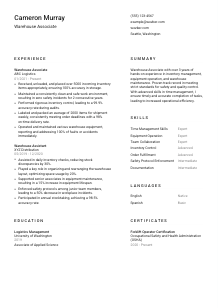
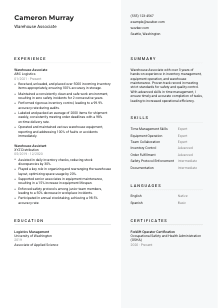
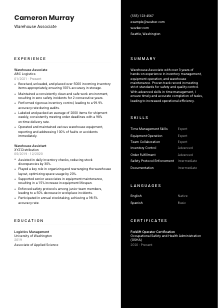
Keeping stock, but your resume is out of inventory? Check out this Warehouse Associate resume example, created with Wozber free resume builder. Learn how to present your logistics skills and teamwork talents to match job specs, ensuring your career journey is always on the right pallet!
Warehouse work gets judged in motion. Hiring teams want to see that you can keep inventory flowing, handle equipment safely, stay accurate under pace, and keep the floor organized enough for shipping, receiving, and audits to run without disruption. Your resume should make those operating habits visible, not hide them behind generic lines about being hardworking or reliable.
Small wording choices change how quickly your background reads as warehouse-ready. When your resume uses the same language as the posting, from inventory control and shipment prep to forklift operation, Wozber's free resume builder helps shape that experience into an ATS-compliant resume that is easy to parse and easy to connect to day-to-day warehouse work. That matters when recruiters are separating general labor applicants from people who already know how to keep receiving, storage, and order fulfillment on track.
For a Warehouse Associate resume, the header should remove friction. Contact details, title, and location are basic fields, but they also confirm whether you match practical requirements such as local availability, professional communication, and role alignment. Keep this section clean and direct so the reader can move straight into your warehouse experience.
Use your full name in a larger, readable font so it is easy to find at a glance. Warehouse hiring often moves quickly, and a clean header helps your resume look organized from the first line, which already reflects the kind of orderliness the job requires.
Place "Warehouse Associate" directly under your name if that is the role you are pursuing. This immediately connects your resume to the opening and avoids making the reviewer guess whether your background is in warehouse operations, shipping, receiving, or a broader labor role.
List a current phone number and a professional email address you check regularly. In a role where missed calls can mean missed interview slots or shift discussions, accuracy matters here as much as it does on a pick list or shipment label.
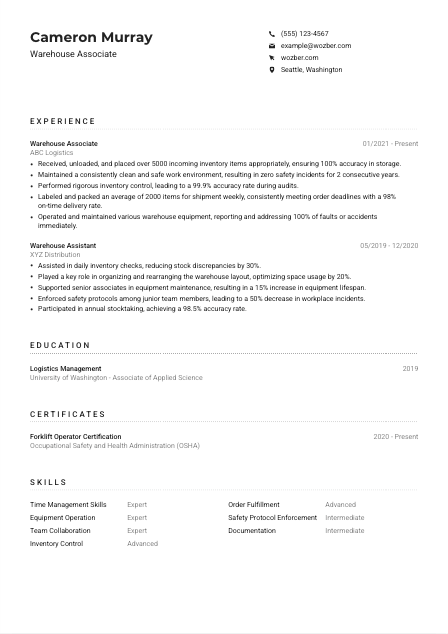
If the employer requires local availability or relocation, include your city and state. In the example, listing Seattle, Washington answers that requirement immediately. Treat this as tailoring to the posting, not as a universal rule for every warehouse application.
A LinkedIn profile or professional website can help if it is current and consistent with your resume. For warehouse roles, this is useful when it reinforces work history, certifications, or logistics training. Skip it if it adds nothing or contains outdated information.
This section should confirm who you are, what job you are targeting, and whether you meet practical screening requirements. When it is accurate and easy to scan, the hiring team can get straight to the warehouse skills and results that matter most.




This section carries the most weight for Warehouse Associate hiring. Employers want proof that you can receive stock, store it correctly, support accurate inventory counts, prepare shipments, and work safely with equipment under daily volume. Focus on what moved through your hands, how accurately you handled it, and what operational results followed.
Pull the main duties from the job description and make sure your bullets reflect that same work when it matches your background. If the posting emphasizes receiving inventory, packing shipments, inventory control, and equipment operation, those actions should appear clearly in your experience instead of being buried under generic warehouse language.
List your roles in reverse chronological order with job title, employer, and dates. For warehouse hiring, titles such as Warehouse Associate, Warehouse Assistant, Material Handler, or Shipping and Receiving Associate quickly frame your level of hands-on experience and how recently you worked in a similar environment.
Replace task-only bullets with outcome-based statements. "Performed inventory control" says very little. "Maintained a 99.9% accuracy rate during audits through daily inventory checks and organized storage" tells the reader how well you handled a core warehouse responsibility. The example resume does this well across receiving, packing, and safety work.
Metrics are especially useful in this field because they show pace and reliability. Count items received, weekly shipment volume, audit accuracy, on-time order rates, safety records, or space optimization improvements. The sample bullets use figures like 5000 incoming items and 2000 weekly shipments, which give real scale to otherwise common tasks.
Keep bullets that support the target role directly. Receiving accuracy, zero safety incidents, stock discrepancy reduction, equipment maintenance support, and order deadline performance all belong here. Less relevant work can be shortened or removed so your recent warehouse strengths stay visible.
A hiring manager should be able to read this section and understand your operating range right away: what equipment you used, what inventory volume you handled, how accurate you were, and whether you worked safely. That is the level of detail that moves a warehouse resume forward.
Education usually plays a supporting role for Warehouse Associate positions, but it can still strengthen your resume when it connects to logistics, operations, safety, or supply chain work. Keep the section straightforward and use it to reinforce practical knowledge, not to fill space.
If the posting does not require a specific degree, list your highest completed credential first. For many warehouse roles, a diploma, associate degree, or job-related training is enough. In the example, an Associate of Applied Science in Logistics Management adds useful context because it relates directly to warehouse flow and inventory handling.
Include school name, degree, field of study, and graduation year or date. Warehouse resumes benefit from clear structure, and this section should be quick to scan without extra description unless the coursework is especially relevant.
When your studies connect to warehousing, logistics, supply chain, or inventory systems, make that visible. A logistics-focused program can support your hands-on experience by showing familiarity with storage processes, movement of goods, and basic distribution concepts.
If you completed coursework or training tied to warehouse work, such as safety procedures, material handling, or equipment use, include it when it adds hiring value. If you already have a dedicated Certifications section, keep this mention brief to avoid duplication.
Awards, activities, or leadership experience belong here only if they connect to the role. Team-based projects, logistics clubs, or safety-focused training can help. Generic school activities usually do not influence warehouse hiring and can be left out.
This section works best when it supports the practical side of your application. A concise education entry can reinforce logistics knowledge or training, but your warehouse results and equipment experience should remain the main story.
Certifications can carry real weight in warehouse hiring because they speak to safety, compliance, and equipment readiness. If a posting mentions forklift operation or similar requirements, this section can quickly separate you from candidates who would need training before starting.
Check whether the employer asks for a specific license or certification. Here, forklift certification is a clear example. If you hold it, include it prominently so the reviewer can confirm you meet that requirement without searching through your experience bullets.
Prioritize credentials that support warehouse operations, equipment use, safety, shipping, or inventory handling. A forklift certification is directly relevant. Unrelated courses or general certificates can dilute the section and distract from practical qualifications.
List the issue date and renewal period if the certification is active or recently updated. That helps the employer understand whether you are currently cleared to operate equipment or follow a specific safety standard. The example's OSHA forklift certification does this clearly.
Warehouse procedures, safety requirements, and equipment standards can change. Keeping certifications active shows that you take safe operation seriously and can step into a structured warehouse environment with less ramp-up time.
For warehouse roles, relevant certifications are practical proof. They show you can work safely, operate required equipment, and meet compliance expectations from day one, especially when the posting names those requirements directly.
A Warehouse Associate skills section should read like the actual work. That means equipment operation, inventory accuracy, order handling, safety awareness, and pace management, not a broad list of generic strengths. Pick skills that match the floor, the dock, and the shipment schedule.
Read the posting closely and note both explicit requirements and recurring tasks. In this case, equipment use, time management, organization, inventory control, packing, labeling, and safe handling all belong in the skill set if they reflect your real background.
Every skill listed should connect to your experience, certification, or summary. If you claim inventory control, your work history should show audit accuracy or stock checks. If you list equipment operation, include forklift, pallet jack, or similar equipment where appropriate.
Keep the list focused and easy to read. You can group hard skills such as inventory control, order fulfillment, documentation, and equipment operation alongside softer but relevant strengths like time management and team collaboration. The example resume balances both types well without overloading the section.
This section should sound like someone who already knows warehouse routines, equipment, and performance expectations. When your listed skills line up with your bullets and the posting, the resume reads as credible and job-ready.
Warehouse work depends on clear instructions, safe communication, and accurate documentation. Language skills matter most when they affect training, team coordination, shipping paperwork, or customer-facing handoffs. Keep this section honest and useful.
If the employer specifies English proficiency, include it clearly. In the provided description, English is a stated requirement, so it should appear on the resume with an accurate proficiency level.
List the most relevant language at the top with your level, such as Native, Fluent, or Professional. That makes it easy for the employer to confirm you can understand instructions, safety guidance, and documentation used in the warehouse.
Extra languages can be helpful in busy warehouse environments, especially when teams are multilingual or when shipping and receiving involve varied partners. Spanish, for example, may support team communication in some operations, even when it is not required.
Use realistic levels rather than overstating fluency. If you can handle basic workplace conversation but not detailed instructions, say so. In safety-sensitive settings, precision matters more than optimism.
Do not overemphasize languages if they are not central to the job. Include them when they support communication or the posting requests them, but let your warehouse experience, safety record, and operational skills remain the focus.
For a Warehouse Associate resume, language details should clarify communication ability, not decorate the page. Lead with the required language, add others when useful, and keep the emphasis on safe, accurate work.
The summary is your quick operating profile. For a Warehouse Associate, it should tell the reader how much warehouse experience you have, what kind of work you handle well, and which results or strengths make you dependable on the floor. Keep it short, specific, and tied to the job.
Look at the posting and decide which points deserve space in the first lines of the resume. For warehouse work, that often means inventory handling, shipment preparation, equipment operation, safety, and accuracy under daily volume.
Start with a direct professional label and a truthful level of experience. A line such as "Warehouse Associate with over 3 years of hands-on experience" works because it establishes role relevance immediately and matches what recruiters scan for first.
Mention the capabilities that matter most for the target opening, such as inventory control, equipment use, order fulfillment, safety compliance, or audit accuracy. The example summary works because it ties experience to safety standards, quality control, and operational efficiency instead of relying on vague traits.
Aim for three to five lines. This section should not repeat your full work history. It should give a quick read on your warehouse background and make the employer want to see the supporting details in your experience section.
A well-written summary tells the employer, in a few seconds, whether you have handled the kind of warehouse pace, equipment, and accuracy standards they need. Keep it grounded in real work, and let the rest of the resume prove it.
A Warehouse Associate resume works best when it shows the flow of the job clearly: receiving stock, storing it correctly, keeping counts accurate, preparing shipments on time, and following safety procedures every shift. If those points are visible in your title, bullets, skills, and summary, hiring teams can quickly understand where you add value.
Wozber's free resume builder can help you structure that story in an ATS-friendly resume format, and Wozber's ATS resume scanner can help you align your wording with the posting's actual requirements. The final result should make one thing easy to judge: you can step into warehouse operations and contribute with accuracy, pace, and safe equipment handling.




