



Use Wozber and land your dream job
Create Resume
No registration required
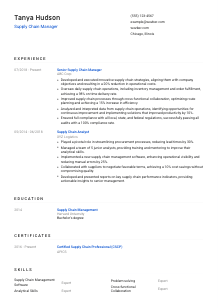
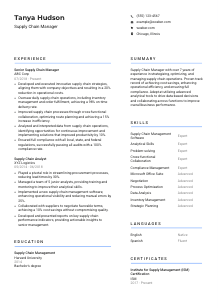
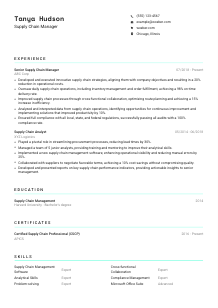
Masterminding logistics, but your resume seems off-route? Plot your exploits on this Supply Chain Manager resume example, built with Wozber free resume builder. Learn how to align your strategic orchestrations with job benchmarks, ensuring your career never gets caught in transit!
Supply Chain Managers are hired to keep goods, data, and decisions moving without waste. A resume for this field needs to show how you balance inventory, transportation, supplier coordination, fulfillment, cost control, and compliance while supporting broader business targets.
When the resume is tailored to the posting, the first read becomes much clearer. Hiring teams can quickly connect your background to planning, logistics, and process improvement work instead of sorting through generic operations experience. Wozber's free resume builder helps you shape that alignment into an ATS-compliant resume, so the right terms, metrics, and systems experience are easy to read and easy to match to the role.
This section is simple, but it still affects how smoothly your application moves forward. For a Supply Chain Manager, it should confirm who you are, how to reach you, and whether you already meet any practical requirement such as location.
Use your full name in a larger, clean font at the top of the page. Keep it more prominent than the rest of the contact details so the document looks organized from the first glance, much like a well-run reporting dashboard.
Place "Supply Chain Manager" under your name if that is the role you are targeting. This helps frame your background around supply chain strategy, logistics oversight, inventory control, and cross-functional operations instead of reading as a broad operations profile.
List a reliable phone number and a professional email address. Double-check both. If a hiring manager wants to discuss your experience with order fulfillment, transportation performance, or supplier negotiations, there should be no friction in reaching you.
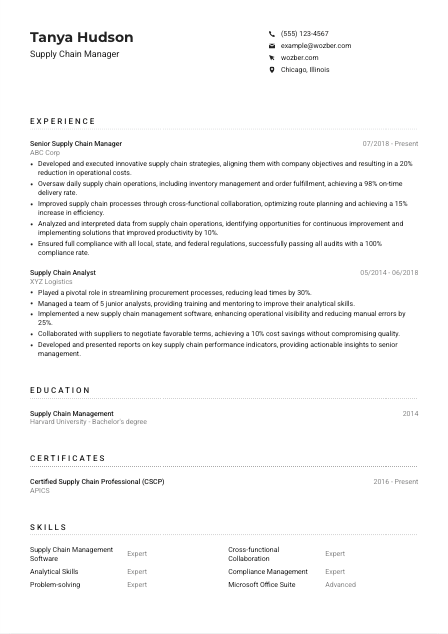
If the job requires you to be in a certain market, address that directly in this section. In the example, listing "Chicago, Illinois" immediately answers a stated requirement. If you are relocating, make that clear in a brief, honest way rather than leaving the employer to guess.
Include LinkedIn or another relevant professional profile if it reinforces your resume with consistent titles, career progression, and supply chain achievements. Keep it current. A profile that expands on KPIs, systems, and team scope can strengthen the first impression.
Personal details should remove questions, not create them. When this section is clean and complete, the reader can move straight to your supply chain experience, systems knowledge, and business impact.




This is the section where employers look for proof that you can run and improve a supply chain. Focus on scope, measurable outcomes, and the operational levers you actually managed, from inventory and fulfillment to carrier performance, supplier terms, and compliance.
Read the job description for the operating priorities behind the wording. Here, the recurring themes are strategy, daily operations, cost control, data analysis, cross-functional work, and regulatory compliance. Use those priorities to decide which achievements deserve space and which older bullets can be cut.
List your positions in reverse chronological order with job title, company, and dates. For Supply Chain Manager hiring, recent experience usually carries the most weight because it reflects current ownership of planning cycles, fulfillment performance, transportation oversight, and reporting responsibility.
Each bullet should show what you improved, controlled, reduced, or delivered. The example does this well by tying work to outcomes such as a 20% reduction in operational costs, a 98% on-time delivery rate, and 100% audit compliance. Those are the kinds of results that make supply chain leadership concrete.
Quantify with metrics that matter in this profession: lead time, cost savings, inventory accuracy, service level, on-time delivery, efficiency gains, error reduction, audit results, or productivity improvements. A bullet about route optimization or procurement is far stronger when it shows the percentage saved or the time reduced.
Prioritize experience that supports the target position. If you have older work that does not connect to logistics, procurement, planning, warehousing, or operations analysis, shorten it or remove it. The reader should come away with a clear picture of your ability to run supply chain operations and improve performance across teams and vendors.
Your experience section should read like a record of operational decisions and business results. If each role shows ownership, metrics, and progression, the employer can quickly picture you managing service, cost, and compliance in a live supply chain environment.
Supply chain hiring often starts with practical experience, but education still matters because it confirms formal grounding in logistics, operations, procurement, business planning, and analytics. Present it clearly and connect it to the role when relevant.
If the posting asks for a bachelor's degree in Supply Chain Management, Business, or a related field, make sure that credential is easy to spot. In the example, a bachelor's degree in Supply Chain Management directly supports the requirement and reinforces subject-matter depth.
List degree, school, field of study, and graduation year in a consistent structure. Hiring teams should be able to scan it quickly without searching for missing pieces, especially when they are reviewing multiple resumes for operations and logistics leadership roles.
If your degree is directly tied to supply chain, logistics, business, industrial engineering, or operations, state the field clearly. That detail matters because it points to formal exposure to forecasting, inventory models, procurement processes, and supply network planning.
Most experienced candidates do not need a course list, but it can help if the coursework supports the role in a specific way. Topics such as logistics management, operations research, demand planning, procurement, or data analysis can be worth mentioning early in your career.
Relevant projects, student organizations, or capstone work can strengthen this section if they show practical interest in supply chain problems. Keep it concise and focused on work that relates to planning, sourcing, transportation, warehousing, or process improvement.
Education does not need to be long, but it should clearly support the level of responsibility you want. A well-framed education section reinforces that your operational experience sits on a solid academic base.
Certifications carry real weight in supply chain because they point to recognized knowledge in planning, sourcing, operations, and continuous improvement. They are especially useful when a posting names preferred credentials or when you want to reinforce leadership-level expertise.
When a posting mentions CSCP or ISM, move those credentials into clear view if you hold them. In the example, both are listed, which directly supports the employer's preference and signals current professional commitment in supply chain and procurement practice.
Do not crowd this section with unrelated programs. Choose credentials that strengthen your case for supply chain leadership, logistics oversight, procurement knowledge, compliance awareness, or process improvement capability.
If a certification is active, renewed, or ongoing, list the dates in a straightforward way. That helps employers see that your knowledge is current, which matters in a field shaped by shifting regulations, systems, and sourcing conditions.
If you are pursuing a relevant certification, you can note that as long as it is accurate. In supply chain, ongoing learning can support your candidacy when it reflects real investment in areas such as strategic sourcing, planning, analytics, or global operations.
A certification section works best when every entry adds weight to your operational profile. Well-chosen credentials help position you as someone who understands both day-to-day execution and the broader structure of modern supply chain management.
The skills section should reflect how supply chain work is actually done. That means a mix of systems knowledge, analysis, planning, vendor and stakeholder management, and the practical execution skills that keep service levels and costs under control.
Mark the capabilities named in the posting and the ones implied by the responsibilities. Here, that includes supply chain management software, Microsoft Office, analytics, problem-solving, negotiation, inventory oversight, transportation coordination, and cross-functional process improvement.
List the tools and abilities you can support with experience. The example includes supply chain management software, data analysis, compliance management, process optimization, inventory management, and negotiation, which maps well to the work described. Keep the language honest and job-relevant.
Organize the section so hiring teams can spot your strengths fast. You might combine technical tools, operational capabilities, and leadership skills, or keep one concise list if the resume is already dense. Either way, emphasize the capabilities that support strategy execution, cost reduction, service performance, and operational control.
Every skill on the page should connect to work you have done in planning, logistics, procurement, analytics, or operations management. When the section mirrors the language of the role and the content of your experience, it becomes much more persuasive.
Supply chain work depends on clear communication across vendors, internal teams, carriers, warehouses, and leadership. Language skills matter when they support reporting, negotiations, issue resolution, and coordination across regions or business units.
If the posting requires English speaking and listening proficiency, list English clearly with an accurate level. That is especially important for roles involving vendor calls, cross-functional meetings, audit communication, and operational reporting.
If you work with international suppliers, cross-border logistics, or multilingual plant and warehouse teams, additional languages can be highly relevant. Put the most professionally useful languages first rather than treating this section as a personal detail.
Even when not required, another language can still support your candidacy if it helps with supplier relationships, market coverage, or coordination across regions. In the example, Spanish adds practical value for many supply chain environments.
Use levels that reflect how you actually communicate, such as Native, Fluent, Advanced, Intermediate, or Basic. Supply chain work often depends on accuracy in conversations about schedules, quantities, quality issues, and service exceptions, so overstatement can backfire.
If the target job is heavily domestic, keep this section brief. If the role touches global sourcing, distribution, or international supplier management, language capability can become a stronger differentiator and deserves clearer emphasis.
List languages when they help explain how you work across teams, partners, and markets. For supply chain roles, that practical communication value is what makes this section worth keeping.
The summary sits near the top of the resume, so it needs to establish your level quickly. For a Supply Chain Manager, that means combining years of experience with the operating areas you lead and the kinds of outcomes you produce.
Start from the job's core needs. In this case, the employer wants someone who can align supply chain strategy with business goals, run daily operations, analyze performance data, collaborate across functions, and maintain compliance. Those themes should shape your opening lines.
Open with a direct introduction such as "Supply Chain Manager with 7+ years of experience" if that is accurate. This immediately places you at the right level and helps distinguish you from candidates whose background is limited to analyst or coordinator work.
Include two or three strengths or outcomes that matter in supply chain leadership, such as cost reduction, efficiency gains, on-time delivery performance, process optimization, systems implementation, or regulatory compliance. The example summary works because it stays focused on savings, efficiency, and data-driven decisions.
Aim for a compact paragraph, not a biography. In three to five lines, the reader should understand your scope, your main strengths, and the business results you are known for. Save detailed examples for the experience section where numbers can do more work.
A well-written summary gives the hiring team an immediate sense of your supply chain range and management level. Once that frame is in place, the rest of the resume can deepen it with metrics, systems, and examples of operational control.
A Supply Chain Manager resume should make one thing easy to see: you can connect strategy to execution and improve the movement of goods, information, and cost across the operation. When your sections align around measurable results, systems fluency, cross-functional coordination, and compliance, the document starts to read like a leadership profile rather than a list of tasks.
Use Wozber's free resume builder, ATS-friendly resume template, and ATS resume scanner to sharpen that alignment and strengthen ATS optimization. The final result should make it easy for an employer to see how you manage performance, solve operational problems, and lead a supply chain with control.




