




Use Wozber and land your dream job
Create Resume
No registration required
Steering shipments, but your resume seems adrift? Anchor it with this Shipping Coordinator resume example, created with Wozber free resume builder. Learn how to present your logistics experience to match job demands, sailing your career through smooth waters.

Shipping coordination lives in the details. A missed customs document, a bad carrier handoff, or an inaccurate stock count can delay delivery, raise costs, and disrupt the warehouse schedule. Your resume needs to show that you can keep freight moving, maintain accurate records, and stay steady when multiple suppliers, carriers, and internal teams are pulling on the same timeline.
Resume screening for this role often narrows quickly to candidates whose background clearly matches day-to-day shipping operations. Using Wozber's free resume builder to tailor your wording and strengthen ATS optimization helps surface the right terms, from shipment tracking to stock reconciliation, so hiring teams can quickly see that your experience fits live logistics work rather than general operations support.
For a Shipping Coordinator, the contact section does more than identify you. It should immediately support the basics an employer checks first, including role alignment, professional communication, and any location requirement named in the posting.
Use your full name in a clean, readable font that is slightly larger than the body text. This section does not need design flair. It needs clarity, especially in ATS-friendly resume format, where straightforward presentation works better than decorative styling.
Place the exact role title, such as "Shipping Coordinator," directly below your name when it matches your background. That small line helps frame the rest of the resume correctly, especially when your past titles vary between shipping associate, logistics coordinator, or dispatch support.
Recruiters and operations managers should be able to reach you without friction. Use a reliable phone number and a professional email address, then double-check both for errors before sending the application.
If the employer asks for someone based in Seattle or willing to relocate, make that easy to see in your contact details. The sample resume handles this well by listing Seattle, Washington, which removes an avoidable question early in the review.
Include a LinkedIn profile or professional website if it supports your logistics background. Make sure it matches your resume on job titles, dates, and certifications. For shipping roles, consistency matters because hiring teams often compare details across systems before moving candidates forward.
This section should confirm that you are reachable, professionally presented, and aligned with the basic requirements of the opening. Keep it clean, accurate, and easy to scan.




Shipping Coordinator hiring usually turns on operational proof. Employers want to see that you have handled shipment flow, carrier communication, documentation, and inventory tasks in real settings, not that you have held a vaguely related office role.
Before rewriting your experience, mark the responsibilities that drive the role. For this kind of position, that usually includes tracking shipments, coordinating with suppliers and carriers, handling customs paperwork, managing stock accuracy, improving shipping procedures, and sometimes supervising shipping staff. Those points should shape which bullets you keep and which you cut.
List your most recent role first, then work backward with job title, company name, and employment dates. This format helps reviewers quickly understand your progression from support work into broader coordination, vendor contact, process ownership, or team oversight.
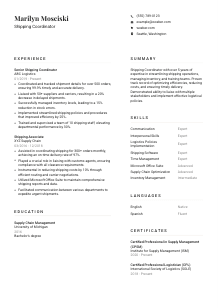
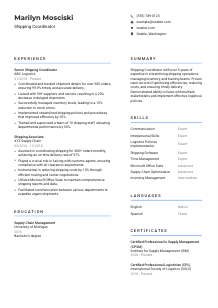
Each role should show what you actually managed and what improved because of your work. Good Shipping Coordinator bullets often mention order volume, on-time delivery, customs compliance, inventory counts, routing decisions, or staff supervision. The sample resume gives a strong model with lines such as coordinating over 500 orders and maintaining 99.9% timely and accurate delivery.
Quantified results matter here because shipping performance is measurable. Include metrics such as order volume, on-time rate, delayed shipment reduction, stock error reduction, cost savings, cycle time improvements, or team size. In the example, a 20% decrease in delayed shipments and a 15% reduction in stock errors make the candidate's impact much easier to trust.
Prioritize experience that connects directly to shipping, inventory, warehousing, transportation, freight coordination, or supply chain support. If you include adjacent roles, rewrite the bullets to emphasize transferable work such as documentation control, vendor communication, scheduling, or process compliance rather than unrelated duties.
A hiring team should be able to read this section and picture you handling live shipments, solving delivery issues, and keeping records accurate under daily pressure. Focus on scope, results, and the logistics work you owned.
Education will not outweigh relevant shipping experience, but it still matters when the posting asks for a specific degree. In logistics hiring, this section often confirms foundational training in supply chain concepts, inventory flow, transportation, and operations planning.
If the role asks for a bachelor's degree in Supply Chain Management, Logistics, or a related field, state your degree in direct terms. When your background lines up closely, as it does in the example with a bachelor's degree in Supply Chain Management, make that visible without extra wording.
List the degree, field of study, school name, and graduation year in a clean structure. This helps recruiters and ATS systems pick up the qualification quickly, especially when education is part of the initial screening criteria.
For this profession, the field of study often matters as much as the degree level. If your coursework focused on logistics, transportation, procurement, or warehouse operations, make sure the field is easy to spot rather than buried after the institution name.
Relevant courses can help early-career candidates or career changers. Include them if they support the role with topics like inventory management, international trade, supply planning, or transportation systems. If you already have several years of direct shipping experience, this detail is usually optional.
Honors, projects, or student logistics organizations can add value when they connect to shipping operations or supply chain work. As your professional experience grows, keep only the academic details that still support the role you are targeting.
This section should confirm that you meet the stated education requirement and have a solid foundation in logistics-related work. Present it clearly and let relevance do the work.
Certifications can carry real weight in shipping and supply chain roles, especially when a posting names them directly. They show continued development in procurement, logistics standards, and operational decision-making beyond day-to-day experience.
When a job description specifically names credentials such as CPSM or CPL, move those to the top if you hold them. This role does exactly that, so matching the wording helps your resume line up with both ATS filters and human review.
List certifications that support shipping coordination, inventory control, transportation, procurement, customs knowledge, or supply chain operations. Put the most relevant ones first rather than arranging them by prestige alone.
Add the earned date or indicate that the certification is current when relevant. The sample resume handles this clearly by showing ongoing status for both CPSM and CPL, which signals that the credentials are active and up to date.
If you are moving toward broader logistics leadership, continue adding certifications that match that growth. Shipping policies, compliance, inventory systems, and supply management are all areas where updated credentials can sharpen your profile.
Relevant credentials can strengthen your case, especially when several applicants have similar hands-on experience. Keep this section focused on certifications that support shipping execution and supply chain judgment.
The skills section should reflect how shipping work actually gets done. Employers are looking for a mix of operational tools, process knowledge, and communication skills that support accurate, on-time movement of goods.
Review the job description for named tools and implied capabilities. Here, shipping software and Microsoft Office Suite are explicit requirements, while shipment tracking, stock reconciliation, policy implementation, and staff coordination are built into the responsibilities. Your skills list should cover both.
Include technical and operational skills such as shipping software, inventory management, freight documentation, customs coordination, reporting, and logistics process improvement. Then support them with communication, time management, and interpersonal skills, since this work depends on constant coordination with suppliers, carriers, warehouse staff, and internal teams.
A Shipping Coordinator does not need a bloated list of every tool or trait. Choose the skills that are most relevant to the target role and that you can support in your experience section. The example resume does this well by combining shipping software, Microsoft Office Suite, logistics policy implementation, supply chain optimization, and communication skills in one targeted list.
This section should make it easy to see how you manage shipments, communicate across partners, and keep operations organized. Relevance matters more than volume.
Language ability matters in shipping because the work depends on clear communication. Shipment updates, customs paperwork, carrier calls, and supplier emails all rely on accurate wording, especially when timing or compliance is at stake.
If the posting explicitly asks for strong English skills, list English at the top with an honest proficiency level. That is a direct match to the requirement and should not be left implied elsewhere on the resume.
Use simple labels such as "Native," "Fluent," "Advanced," or "Intermediate." Hiring teams need a realistic sense of how comfortably you can handle written updates, shipping documents, and verbal coordination.
Extra languages can be valuable when you deal with international suppliers, freight partners, or cross-border documentation. Spanish, for example, may strengthen a profile in some shipping environments even when it is not specifically requested.
Do not overstate your level. If you will need to discuss delays, resolve document issues, or clarify inventory discrepancies in another language, your stated proficiency should hold up in real conversations.
Some Shipping Coordinator jobs are primarily domestic, while others involve customs agents, overseas vendors, or multilingual warehouse teams. Include additional languages when they genuinely support the kind of freight flow or stakeholder communication the role involves.
For this role, language skills matter when they improve communication, documentation accuracy, and cross-border coordination. Lead with English when required, then add other languages that strengthen your operational range.
The summary should tell the reader, in a few lines, what kind of shipping professional you are and what level of responsibility you have handled. For this role, the best summaries connect logistics scope with measurable operational results.
Before writing, pull out the responsibilities that appear most central to the role. For a Shipping Coordinator, that usually means shipment tracking, carrier and supplier coordination, inventory accuracy, process improvement, and possibly team supervision. Those themes should shape your opening lines.
Start with a direct statement such as "Shipping Coordinator with 5+ years of experience" if that reflects your background. This quickly places you in the right lane and helps distinguish you from broader logistics or warehouse candidates.
Mention the outcomes you are known for, such as improving on-time delivery, reducing delays, tightening inventory control, lowering shipping costs, or streamlining procedures. The sample summary works because it combines operational strengths with results like efficiency gains and reliable delivery performance.
Aim for 3 to 5 lines with no filler. Focus on the kind of work you have handled, the scale or results you can point to, and the coordination strengths that matter most for the target position. Save detail for the experience section.
When this section is done well, a hiring manager can immediately place you as someone who understands shipment flow, documentation, inventory accuracy, and operational follow-through. That is the standard your opening paragraph should meet.
A Shipping Coordinator resume should make one thing clear fast: you can keep orders moving accurately, communicate across suppliers and carriers, and maintain control of the records behind every shipment. When your sections are tailored around those responsibilities, the application reads like a logistics professional's track record instead of a generic operations resume.
Wozber's free resume builder helps you organize that experience in an ATS-compliant resume, tailor wording with its AI resume builder, and refine section-level alignment with an ATS resume scanner. The result is a resume that makes your shipping experience, logistics judgment, and day-to-day coordination value easier to recognize.
That is what hiring teams need to see before they trust you with live freight, inventory accuracy, and delivery performance.




