



Use Wozber and land your dream job
Create Resume
No registration required
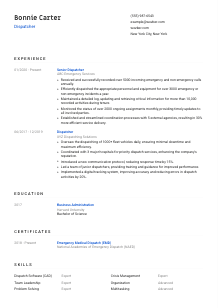
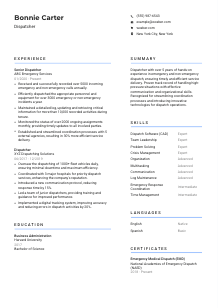
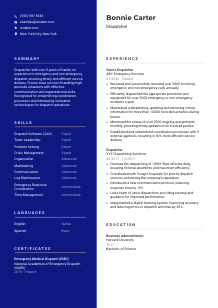
Juggling routes, but your resume feels off-course? Sync it up with this Dispatcher resume example, created with Wozber free resume builder. Learn how to show your logistics know-how in line with job dispatch criteria, ensuring your career narrative flows as smoothly as the paths you chart!
Dispatch work runs on accuracy under pressure. Whether the calls are emergency, non-emergency, fleet-related, or service-based, employers need to see that you can take in information quickly, assign the right response, keep records straight, and stay calm while priorities shift in real time. Your resume should make that operational discipline visible from the first section.
Hiring teams often skim dispatcher resumes first for role-specific proof: call volume, dispatch coordination, CAD or dispatch software use, log maintenance, and communication in active situations. Wozber's free resume builder helps shape that experience into an ATS-compliant resume, so the core question is easier to answer fast: can you handle the pace, accuracy, and coordination this dispatcher job requires?
For dispatcher roles, the header should be clean, practical, and easy to verify. This is not the place for extra design or personal flair. It should immediately confirm who you are, how to reach you, and whether you meet any location requirement named in the posting.
Use your full name in the largest text on the page so it is easy to spot in a quick review. Keep the formatting simple and professional. In dispatcher hiring, clarity matters, and that starts with the first line.
Place "Dispatcher" directly under your name if that is the role you are applying for. If your recent title was more specific, such as "Senior Dispatcher," you can still use the target title when it accurately reflects your background. This helps align your resume with the posting and with ATS keyword matching.
Your phone number and email should be current, professional, and free of errors. Dispatch roles depend on fast, reliable communication, so even your contact section should reflect attention to detail.
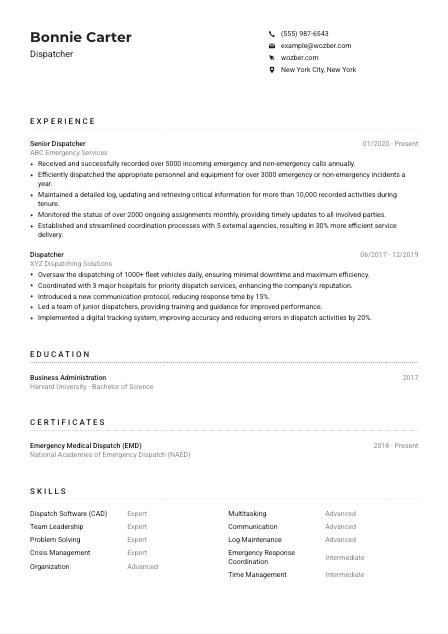
If the employer requires candidates to be based in a specific city, show that clearly in your header. In the example here, listing "New York City, New York" immediately addresses the stated location requirement and removes a common screening question early.
A LinkedIn profile or professional website is optional, but include it if it supports your candidacy and matches your resume. For dispatchers, that usually means a polished LinkedIn page with consistent job titles, certifications, and experience dates rather than a portfolio.
This section should give a hiring manager or recruiter exactly what they need without friction. Clean contact details and any required location information help move attention to your dispatch experience instead of basic follow-up questions.




The experience section carries the most weight for dispatcher hiring. Employers look for proof that you have handled live calls, coordinated personnel or equipment, maintained accurate records, and kept operations moving when conditions changed quickly. Your bullets should show volume, pace, tools, and outcomes.
Start by marking the responsibilities that appear in the job ad, then match your experience to them using the same language where it fits. For this dispatcher opening, the clear priorities are receiving calls, dispatching personnel and equipment, updating logs, monitoring assignments, and coordinating with other agencies. Those are the themes your bullets should reflect first.
List roles in reverse-chronological order so employers see your current operating environment first. Include job title, employer, and dates. If you have worked in emergency response, transportation, healthcare coordination, security, or field service dispatching, make the scope of that environment clear in the bullet points.
Each bullet should show what you handled, how much of it you managed, and what changed because of your work. The sample resume does this well with details like handling more than 5000 incoming calls annually and monitoring over 2000 ongoing assignments monthly. That kind of wording gives real shape to your workload and reliability.
Quantify call volume, incident volume, response time improvement, assignment load, fleet size, documentation accuracy, or coordination gains. Metrics are especially useful in dispatch because they show how you performed under pressure. A line such as "reduced response time by 15%" or "improved dispatch accuracy by 20%" says much more than "worked efficiently."
Save space for the experience that supports dispatch work directly. Communication protocols, CAD use, logging accuracy, escalation handling, cross-agency coordination, and team support matter here. Unrelated achievements can stay out unless they strengthen the same skills the job depends on.
A well-built experience section makes the hiring team picture you in the chair already, taking calls, routing resources, updating systems, and keeping everyone informed. That is the standard your bullets should meet.
Dispatcher roles often set a straightforward education threshold, and this section should meet it without taking attention away from your experience. Keep it concise, accurate, and easy to scan, especially when the posting asks for a high school diploma or equivalent as the minimum.
Read the posting carefully and make sure your education section clearly satisfies the stated baseline. Here, the employer asks for a high school diploma or equivalent, so any higher qualification also covers that requirement as long as it is listed clearly.
List your degree or diploma, school name, and graduation year or date. Clean formatting helps ATS parsing and keeps the section easy to review. If you completed additional training related to emergency response, public safety, logistics, or communications, place that where it fits naturally.
A dispatcher does not need a specific academic major in many cases, so do not worry if your degree is in another field. What matters is whether your background supports organized decision-making, communication, or operational coordination. The example's Business Administration degree works because it still supports those workplace skills.
If you are earlier in your career, coursework in emergency management, communications, criminal justice, transportation, or logistics can strengthen this section. If you already have several years of dispatch experience, those details usually matter less than your work history.
Honors, leadership roles, or extracurricular activities are worth listing only if they add something useful, such as responsibility, communication, or coordination experience. For experienced dispatchers, keep this section lean so your operational record remains the focus.
Once the education requirement is covered, let the resume return quickly to the parts of your background that show live coordination, software use, and response handling. That is usually where dispatcher interviews are won.
Certifications can carry real weight in dispatcher hiring, especially when the role touches emergency response, medical dispatch, public safety, or regulated procedures. If the posting names a credential directly, make it easy to find and easy to understand.
Start with the credentials the employer specifically asks for. In this case, Emergency Medical Dispatch or a comparable certification is a stated requirement, so it should appear prominently rather than being buried behind unrelated training.
Dispatchers may complete many types of training, but your resume should prioritize certifications tied to call handling, emergency protocols, communication systems, compliance, or coordination. The example's EMD certification is a strong match because it directly supports the responsibilities in the posting.
Include the certificate name, issuing organization, and date earned. If the credential must be renewed, show that it is current. That matters for roles where protocol accuracy and up-to-date emergency procedures affect performance from day one.
Review this section before every application. If you are in the process of obtaining a required certification, say so honestly, for example "EMD certification in progress" when that reflects your status. Current training signals that you take the operational side of dispatch seriously.
When a dispatcher posting names a credential, a clear certification section can answer that requirement in seconds. That gives the employer one less reason to hesitate and one more reason to keep reading.
The skills section should reflect how dispatch work is actually done. That means technical tools, communication under pressure, multitasking, documentation accuracy, and coordination, not a long list of generic strengths. Keep the focus on skills that support live operations.
Start with the posting, then pull out the tools and working abilities it names. Here that includes dispatch software, CAD systems, communication, organization, and multitasking in a high-pressure setting. Those belong near the top because they map directly to day-to-day dispatcher work.
Do not make this section only about soft skills or only about systems. Dispatch hiring usually looks for both. Pair technical skills such as CAD or digital tracking platforms with role-specific strengths like crisis management, call prioritization, log maintenance, and incident coordination.
Lead with the capabilities most likely to be screened first. In the sample resume, "Dispatch Software (CAD)," crisis management, communication, and organization all support the employer's stated requirements. Put the most central dispatch skills first so the section reads like a response to the posting, not a generic inventory.
Every item here should connect to something you can back up in your experience, certification, or summary. If a skill helps you take calls, route resources, document activity, or maintain control during busy shifts, it belongs.
For dispatchers, language ability is operational, not decorative. Clear communication affects call intake, instruction accuracy, and coordination with responders or partner agencies. If the posting names a required language, your resume should make that easy to spot.
When a job posting states that English proficiency is vital, list English prominently and label your level accurately. In dispatcher roles, this matters because calls, logs, status updates, and escalation procedures all depend on precise communication.
Order your languages based on what the job needs, not personal preference. For this opening, English should appear first because it is explicitly required and central to the role's daily communication demands.
Extra languages can add value, especially in cities or service areas with diverse populations. They are not always required, but they can help with caller rapport, information gathering, and coordination. The example's Spanish entry adds useful context without distracting from the required English proficiency.
Use honest labels such as Native, Fluent, Advanced, Intermediate, or Basic. Dispatch work leaves little room for overstating language ability, particularly if you may need to gather incident details or relay instructions quickly.
If another language has helped you manage calls, coordinate with communities, or support multilingual environments, that is worth showing. In dispatcher hiring, language skills can be practical service assets, especially in public-facing or emergency settings.
For this kind of role, language proficiency matters most when communication is fast, clear, and dependable. Present it that way, and the section becomes more than a formality.
Your summary should quickly establish your level, operating environment, and the kind of dispatch work you handle well. Keep it short, but make it specific enough that a recruiter or dispatch manager can immediately place your experience in context.
Before writing the summary, identify the two or three realities at the center of the job. For dispatchers, that often means call intake, rapid coordination, record accuracy, and calm communication during active situations. Those ideas should shape the wording.
Lead with a direct line that states your profession and years of relevant experience. The sample summary does this effectively by establishing more than 5 years in emergency and non-emergency dispatch. That immediately gives the reader a frame for the rest of the resume.
Use the next sentence or two to mention the tools, environment, or results that define your work. This might include dispatching personnel and equipment, managing high call volume, improving response time, or coordinating across agencies and departments. Keep the claims grounded in experience you prove later in the resume.
Aim for 3 to 5 lines. That is enough space to establish your dispatch background, communication style, and one or two meaningful accomplishments without repeating your experience section. Short, specific summaries tend to work best in fast-moving hiring reviews.
A clear summary tells the employer right away whether your background is in the kind of dispatch environment they need. When it is specific about workload, coordination, and communication, the rest of the resume lands more effectively.
A well-tailored dispatcher resume makes the essentials easy to find: relevant experience, call and coordination volume, software proficiency, certification status, and communication strength in demanding situations. That is what hiring teams need to see before they trust someone with live operations.
Use Wozber's free resume builder to organize your experience in an ATS-friendly resume format, then refine the language with its ATS resume scanner and AI resume builder features so the wording matches the job's requirements naturally. The final result should make one point clear at a glance: you can manage the pace, precision, and responsibility the dispatcher role demands.




