



Use Wozber and land your dream job
Create Resume
No registration required
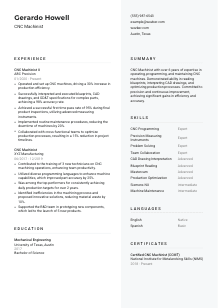
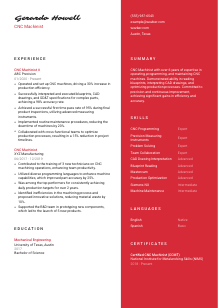
Crafting precision parts, but your resume feels rough around the edges? Carve through this CNC Machinist resume example, created with Wozber free resume builder. Learn how to highlight your technical skills and blueprint expertise to match job specifications, shaping a career profile that's as accurate as your machine output!
CNC machinists are trusted with parts that have little room for error. A hiring team wants to see more than machine operation. They want proof that you can read prints accurately, hold tight tolerances, catch quality issues before parts move downstream, and keep production running without wasting time or material. Your resume should make that shop-floor reliability visible fast.
When the resume reflects the language of the job, the review gets sharper. Wozber's free resume builder helps you line up your experience with the posting, keep an ATS-friendly resume format, and surface terms like GD&T, CAM software, setup, inspection, and machine maintenance in the right sections. That makes it easier for an employer to see whether you can step into their machines, drawings, and quality standards with minimal ramp-up.
This section is simple, but it still affects how smoothly your application moves forward. For CNC machinist roles, clean contact details and the right location signal can remove basic friction before anyone gets to your setup work, programming knowledge, or inspection results.
Use your full name in a clear, readable font at the top of the page. Keep it larger than the rest of the text so the document feels organized from the first glance. In manufacturing hiring, a straightforward layout reads better than decorative styling.
Place your target title directly under your name and match it to the job you are pursuing. "CNC Machinist" works well when that is the posting title. If your background is closer to "CNC Machinist II" or "CNC Setup Machinist," you can still align the headline to the opening while keeping the more specific job title in your experience section.
List a working phone number and a professional email address. One typo here can cost you an interview, especially in fast-moving production hiring. If you include a website or LinkedIn profile, make sure it supports your application with relevant shop, manufacturing, or technical information rather than generic social content.
If an employer requires local availability or relocation, reflect that clearly in your personal details. In this example, Austin, Texas appears in the resume because the posting calls for candidates who are already there or willing to move. Treat location this way when it is a hiring filter, not as a detail to repeat throughout the resume.
A professional profile can add value when it shows manufacturing experience, certifications, technical coursework, or project work with CAD, CAM, or machining. If the profile is sparse or outdated, leave it off. Every line in this section should support the role you want on the shop floor.
Keep the top of the resume clean, accurate, and aligned with the posting. Once these basics are in place, the reader can focus on the part that matters most for a CNC machinist: your record of setup, machining, inspection, and process improvement.




For CNC machinists, experience carries the most weight because it shows how you handle real production conditions. Hiring managers look for signs that you can set up machines correctly, interpret drawings, hold tolerance, inspect parts, troubleshoot issues, and contribute to throughput without sacrificing quality.
Start by marking the requirements that define day-to-day performance. In this posting, that includes blueprint and CAD interpretation, GD&T, CNC programming, CAM software, work across mills and lathes, inspection with precision instruments, and routine machine maintenance. Use those priorities to decide which accomplishments deserve space and which can be cut.
Put your most recent position first and include employer, title, and dates. Under each role, show the type of environment you worked in through your bullets: production machining, prototype support, high-mix work, tight-tolerance parts, or process optimization. That context helps a hiring manager understand the scale and pace of the work you already know.
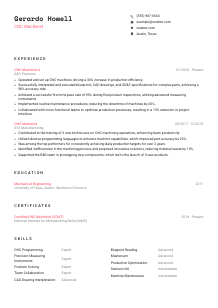
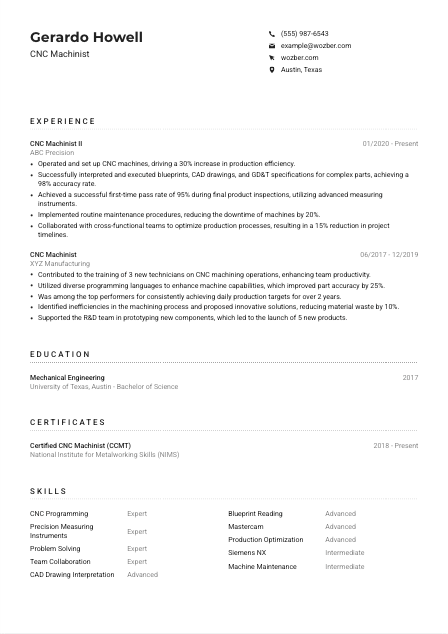
Each bullet should show what you did and what changed because of it. Strong CNC bullets mention setup, operation, programming, inspection, troubleshooting, maintenance, or process improvement. The example does this well with lines about increasing production efficiency by 30 percent, achieving 98 percent accuracy on parts built from blueprints and GD&T specs, and improving first-time pass rate during final inspection.
Use numbers that make sense in machining and manufacturing. Efficiency gains, scrap reduction, downtime reduction, first-pass yield, on-time output, part accuracy, or timeline improvements all tell a stronger story than broad claims about doing quality work. The sample resume uses this well with metrics like 20 percent less downtime and 15 percent faster project timelines.
Prioritize achievements that support the target role directly. A bullet about training new technicians, supporting R&D prototypes, or improving machine capability belongs if it still connects to machining performance, tooling, production flow, or part quality. Leave out accomplishments that do not help prove you can contribute in a CNC environment.
Your experience section should show that you are productive, accurate, and dependable in a machining environment. By the end of it, the reader should understand what machines you have worked on, how you improved output or quality, and how confidently you can handle day-to-day shop demands.
Most CNC machinist openings place heavier emphasis on hands-on experience, but education still helps frame your technical foundation. It can support your understanding of drawings, tolerances, materials, CAD or CAM workflows, and the mechanical principles behind setup and machining decisions.
Include the degree, diploma, or training program most relevant to machining, manufacturing, or engineering. A Mechanical Engineering degree, like the one in the example, strengthens a resume because it supports technical reading, design interpretation, and manufacturing problem-solving. If your background comes from a trade school or machining program instead, that can be just as relevant.
List the school name, credential, field of study, and graduation year or date range. This section should be quick to scan. A hiring manager does not need a long academic narrative here. They need to see the credential and move back to your machining record.
If your education included coursework or training in CAD, CAM, blueprint reading, metrology, manufacturing processes, or materials, mention it when that strengthens the match. This is especially helpful if the posting emphasizes software such as Mastercam or Siemens NX, or technical standards such as GD&T.
If you do not yet have much shop experience, academic projects can help fill the gap. Include projects involving CNC programming, fixture design, prototype machining, tolerance analysis, or drawing interpretation. Once you have several years of production experience, these details usually matter less unless they are unusually relevant.
Honors, awards, or academic distinctions can stay if they support the story of technical discipline and follow-through. If you already have more than 5 years of machining experience, keep this section lean and let your production results do most of the work.
Education should reinforce your technical base without competing with your shop experience. Keep it concise, relevant, and connected to the knowledge areas that matter in CNC machining.
Certifications matter in machining because they show validated skill, current training, and commitment to shop standards. When a posting names a certification directly, include it prominently so the reader does not have to search for it.
Start with credentials that match the posting. Here, Certified CNC Machinist and NIMS-related certification are directly relevant, so they should appear clearly in the resume. When a required or preferred certification is listed in the job ad, mirror the wording accurately if it reflects your actual credential.
Order your certifications by job relevance, not by prestige alone. For a CNC machinist role, machining, inspection, programming, or manufacturing credentials belong above general workplace training. The reader should be able to spot your shop-specific qualifications immediately.
Add the year earned and, if relevant, the active date range. This matters when the certification needs renewal or signals recent training. In the example, showing the certification as active since 2018 helps reinforce current professional standing.
If you have completed additional coursework in CAM software, GD&T, metrology, machine maintenance, or advanced machining methods, include it when it strengthens your fit. Ongoing training matters in shops that expect machinists to keep up with new controls, software, tooling practices, and inspection standards.
Your certifications should make your technical background easier to trust at a glance. For CNC roles, they are especially useful when they confirm machining competence, current standards knowledge, or employer-requested credentials.
A CNC machinist skills section works best when it reflects how the job is actually performed. That means balancing machine-side capability, programming knowledge, inspection skill, and the practical shop habits that keep production moving safely and accurately.
Read the job description and separate the technical skills from the supporting ones. Here, the technical side includes CNC programming, CAM software, blueprint reading, CAD interpretation, GD&T, and experience with mills, lathes, and multitasking machines. Supporting skills include troubleshooting, maintenance, collaboration with production and quality teams, and communication in English.
List the skills you can back up with experience. For this role, that might include CNC programming, precision measuring instruments, blueprint reading, CAD drawing interpretation, machine setup, Mastercam, Siemens NX, process optimization, or machine maintenance. The sample resume handles this well by mixing core machining skills with software and shop-floor support skills.
Lead with the capabilities most likely to affect day-one performance. In most CNC machinist searches, that means setup and operation, drawing interpretation, inspection tools, programming, CAM software, and machine-specific experience. Soft skills such as collaboration and problem solving still matter, but they should support the technical story rather than overshadow it.
This section should read like the toolset behind your results. When the right technical terms appear in a clear order, employers can quickly connect your background to their machines, drawings, software, and quality process.
Language skills may look secondary on a machining resume, but they matter whenever the role calls for clear communication on the floor. Setup instructions, inspection notes, safety procedures, maintenance updates, and production handoffs all depend on being understood accurately.
If the posting specifies English, list it first and state your proficiency honestly. In this case, English competency is required, so it should be visible and unambiguous. That tells the employer you can follow work instructions, discuss part issues, and communicate with supervisors, production staff, and quality teams.
Use straightforward labels such as Native, Fluent, Intermediate, or Basic. Avoid vague descriptions. Clear ratings help employers understand how comfortably you can handle training, shift communication, documentation, and day-to-day coordination in the shop.
Extra languages can be helpful in manufacturing environments with diverse teams, suppliers, or cross-border operations. They are not usually a deciding factor for CNC machinist roles, but they can still add practical value. The example includes Spanish at a basic level, which is worth listing because it expands communication range without overstating fluency.
Do not inflate your level. If you can manage simple conversation but not technical discussions about tolerances, setup changes, or inspection results, label that honestly. Accuracy here matters for the same reason it matters on the shop floor: it prevents problems later.
If the employer serves international customers, runs multilingual teams, or has training materials in more than one language, this section gains importance. If not, keep it short and let your machining experience carry the application. The key is to treat language as support for operational communication, not as filler.
List languages clearly, rate them honestly, and connect them to real workplace communication. For a CNC machinist, this section should support safe, accurate coordination rather than distract from technical qualifications.
The summary sits at the top of the resume, so it needs to establish your level quickly. For CNC machinists, the best summaries combine years of experience with a few core strengths that matter immediately, such as setup, programming, blueprint reading, inspection, process improvement, or machine maintenance.
Start with the parts of the job you actually perform well and that the employer clearly values. For many CNC machinist positions, that means operating and setting up machines, reading blueprints and CAD drawings, interpreting GD&T, programming parts, and maintaining quality on finished components. Keep the opening anchored in real machining work.
A direct opening such as "CNC Machinist with over 6 years of experience" works because it answers a screening question immediately. In this posting, the employer asks for at least 5 years, so leading with 6 years helps clear that threshold in the first line.
Choose strengths you can support in your experience section. The sample summary mentions operating, programming, and maintaining CNC machines, along with blueprint and CAD interpretation and production optimization. That works because the experience bullets below reinforce those claims with metrics on efficiency, accuracy, downtime, and inspection performance.
Aim for a compact paragraph that can be read in seconds. Avoid broad claims about passion or hard work unless they are tied to something concrete like tolerance control, first-pass quality, machine uptime, or process improvement. A tight summary gives the employer a fast technical snapshot and encourages them to keep reading.
By the time someone finishes this section, they should already know your experience level, your strongest machining capabilities, and the kind of production results you tend to deliver. That is enough to frame the rest of the resume well.
A CNC machinist resume works best when it shows the realities of the job clearly: machine setup, drawing interpretation, programming, inspection, maintenance, and measurable production results. Keep each section tied to work the employer actually needs done, and use the language of the posting where it matches your real background.
Wozber's free resume builder can help you organize that experience into an ATS-compliant resume, strengthen wording with job-relevant terminology, and check alignment with an ATS resume scanner before you apply. The finished resume should make one thing easy to judge: whether you can produce accurate parts, work efficiently, and contribute on the floor from day one.