



Use Wozber and land your dream job
Create Resume
No registration required
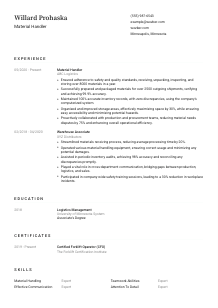
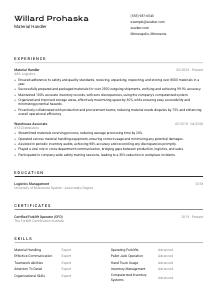
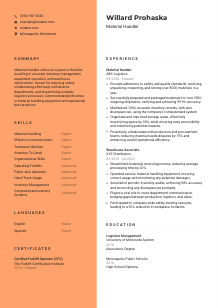
Shuffling stock, but your resume feels out of place? Unpack this Material Handler resume example, created with Wozber free resume builder. Learn how to line up your logistics skills with job demands, ensuring your career is always in the right warehouse!
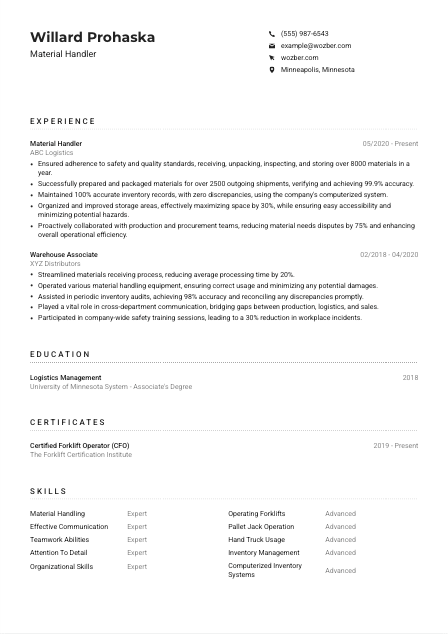
Material handling work gets measured in accuracy, safety, and flow. Hiring teams want to see whether you can keep incoming and outgoing materials moving without creating inventory errors, damaged goods, or safety risks on the warehouse floor. Your resume should make that operational reliability visible, from equipment use to stock control to how you support production or shipping deadlines.
When a resume is tailored well, the reader can quickly separate general warehouse experience from hands-on material handling work that matches the opening. Wozber's free resume builder helps you organize that experience in an ATS-friendly resume format, so equipment operation, inventory accuracy, and shipment handling are easy to recognize in both human review and ATS screening. That clarity matters when the job calls for precise receiving, storage, and dispatch work.
This section is simple, but it still does important work. For a Material Handler, it should confirm that you are easy to contact, professionally presented, and available for the location tied to the operation or warehouse site. Keep it clean and practical.
Use your full name as the clearest visual anchor at the top of the page. In warehouse hiring, nobody needs a stylized header. They need a resume that is easy to scan quickly when reviewing candidates for equipment handling, receiving, and inventory work.
Place "Material Handler" directly under your name when that is the role you are applying for. Matching the posted title helps the resume line up with the opening and avoids confusion with adjacent roles like Warehouse Associate, Shipping Clerk, or Forklift Operator.
Keep this information current and professional so a supervisor, recruiter, or operations coordinator can reach you without delay.
If the job asks candidates to be in a specific area, list your city and state clearly. In the example, "Minneapolis, Minnesota" immediately answers the employer's location requirement. If you are relocating, make that clear in a way that removes doubt about your availability.
A LinkedIn profile can be useful if it mirrors your resume and includes relevant warehouse or logistics experience. For most Material Handler applications, a polished resume matters more than a long online profile, so only include links that reinforce your work history, certifications, or logistics background.
Treat this section like a clean shipping label. It should identify you clearly, confirm how to reach you, and remove any basic doubts about location or professionalism before the employer reaches your experience.




This is where your resume either sounds generic or clearly shows material handling capability. Employers want to see what you handled, how accurately you worked, what equipment you used, and whether your work supported inventory control, shipping timelines, and safe warehouse operations.
Read the job description closely and mark the tasks that define day-to-day success. For this opening, that includes receiving materials, inspecting and storing stock, preparing outgoing shipments, maintaining accurate inventory records, and coordinating with other departments. Those are the points your bullets should speak to directly.
List your jobs in reverse chronological order with title, employer, and dates. Clear structure matters when a hiring manager is tracing whether you have the required 2+ years in material handling or closely related warehouse work.
Do not stop at saying you "handled materials" or "worked in a warehouse." Show what changed because of your work. The example does this well with bullets like reducing receiving time by 20% and cutting material disputes through better coordination with production and procurement. Those details show execution, not just participation.
Material handling resumes benefit from metrics that reflect actual warehouse performance. Good examples include shipment accuracy, inventory accuracy, processing volume, space utilization, damaged-item reduction, and turnaround time. Saying you stored over 8000 materials in a year or achieved 99.9% shipping accuracy gives hiring teams a much better sense of your scale and precision.
Prioritize experience that shows equipment use, stock movement, inventory discipline, and cross-functional support. If you have broader warehouse experience, keep the bullets that connect most directly to the target job. For example, pallet jack operation, audit support, storage organization, and discrepancy resolution all carry more weight here than unrelated general labor tasks.
By the end of your experience section, the reader should understand your pace, accuracy, safety habits, and contribution to warehouse flow. That is what moves a Material Handler resume forward.
Education is rarely the main deciding factor for a Material Handler, but it still needs to be handled correctly. It should confirm that you meet the baseline requirement and, where relevant, show training that supports warehouse, logistics, or inventory work.
If the posting asks for a high school diploma or equivalent, include it clearly. This role does. Do not bury a required credential below less relevant details.
List school, degree or diploma, field if applicable, and graduation year. Clean formatting helps the employer confirm qualifications quickly without digging through extra wording.
Additional education can strengthen your profile when it connects to warehouse operations, supply chain flow, or inventory systems. In the example, an Associate's Degree in Logistics Management adds useful context because it supports the practical experience rather than distracting from it.
Relevant coursework can help if you are earlier in your career or if the classes directly support material control, warehouse safety, inventory systems, or logistics processes. If your work history is already strong, keep this brief.
Awards, activities, or leadership can be worth mentioning if they reflect organization, reliability, teamwork, or process discipline. Only include them when they add something useful to a warehouse or operations hiring conversation.
This section should confirm that you meet the posted requirement and, if applicable, add logistics context that supports your hands-on experience. Clear and concise is the right standard here.
For a Material Handler, certifications matter most when they connect directly to safe equipment use, compliance, or warehouse operations. They can help employers trust that you can step into the floor environment with less ramp-up time.
Prioritize credentials that support the actual job, especially equipment operation and safety. A forklift certification is highly relevant here because the posting specifically mentions forklifts, pallet jacks, and hand trucks.
Order your certificates by hiring value, not by formality. A current forklift-related credential will usually matter more for a Material Handler opening than a less relevant general training certificate.
Show when the certification was earned and whether it is still active. In warehouse roles, recency matters because it helps the employer understand whether your equipment training is current.
If you renew certifications, complete safety training, or add warehouse-related credentials over time, include that progression. It signals that you take compliance, safe handling, and operational standards seriously.
Well-chosen certifications can reinforce your readiness for equipment-based material handling and show that safety is part of how you work, not an afterthought.
A Material Handler skills section should sound like the floor, not like a generic list of strengths. Focus on the tools, work habits, and coordination skills that support receiving, storage, inventory accuracy, and outbound shipping.
Start with the skills stated in the posting and match them to your actual background. For this role, that means material handling equipment, attention to detail, organization, communication, teamwork, and inventory management. Using the employer's wording improves alignment without forcing unnatural phrasing.
Once the core requirements are covered, include adjacent skills that support performance in the warehouse. Inventory systems, storage optimization, discrepancy resolution, cycle counts, receiving inspection, and shipment verification are all useful examples when they reflect work you have really done.
Do not overload the section with every soft skill you can name. A shorter list built around equipment operation, stock accuracy, safe handling, and cross-department coordination will be more convincing. The example's mix of forklift operation, computerized inventory systems, and organizational skills is a solid model because it balances technical and operational capability.
Your skills section should quickly tell the employer that you can move materials safely, keep records accurate, and work smoothly with the rest of the operation. That is the combination they are hiring for.
Language ability matters in material handling because instructions, safety procedures, shipment details, and discrepancy reporting all depend on clear communication. Keep this section practical and tied to the actual communication demands of the job.
If the posting specifies English speaking and listening skills, list English clearly with an accurate proficiency level. This opening does, so that requirement should be easy to find on your resume.
Use labels such as Native, Fluent, Advanced, or Conversational. Clear levels help the employer judge whether you can follow verbal instructions, complete documentation, and coordinate with production, procurement, or shipping teams.
Additional languages can be valuable in busy warehouse environments, especially when teams are diverse or communication across shifts matters. In the example, Spanish adds range, but it should stay secondary to the required English proficiency.
Do not overstate fluency. In warehouse and logistics settings, misrepresenting language ability can create real problems with safety communication, receiving instructions, or shipment documentation.
If the role involves frequent coordination across departments, vendor communication, or multilingual teams, language skills can add practical value. If they are less central to the work, keep this section brief and factual.
For this role, language skills should confirm that you can understand instructions, communicate clearly, and support safe, accurate warehouse operations.
Your summary should sound like someone who understands warehouse flow and can be trusted with materials, records, and equipment. In a few lines, it should connect your experience to the type of handling, inventory, and shipping work the employer needs covered.
Use the posting to decide what belongs in the first few lines. Here, the core themes are material handling experience, equipment operation, inventory accuracy, safety standards, and teamwork across departments. Those should shape your opening statement.
Start with a direct description such as your title and years of experience. The sample summary does this effectively by establishing more than 4 years in material handling, which immediately addresses the employer's 2-year minimum.
Choose two or three strengths that also appear in your experience section. Accuracy in shipments, organized storage, inventory control, and equipment proficiency are all stronger when they connect to actual outcomes like 99.9% accuracy or zero discrepancies.
Aim for 3 to 5 lines with no filler. A hiring manager should be able to read it quickly and understand your core value in warehouse operations before moving into the detailed bullets below.
A well-written summary gives the employer a fast read on your handling experience, operational strengths, and relevance to the opening. It should make them expect solid warehouse performance before they even reach your work history.
A Material Handler resume works best when it shows dependable warehouse execution in concrete terms: safe equipment use, accurate receiving and shipping, organized storage, and clean inventory records. If those points are easy to see, your resume is already doing the right job.
Use Wozber's free resume builder to tighten the wording, strengthen ATS optimization, and present your background in an ATS-compliant resume that matches the role's language naturally. The final version should make one thing clear right away: you can keep materials moving accurately and safely.




