



Use Wozber and land your dream job
Create Resume
No registration required
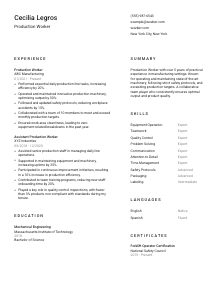
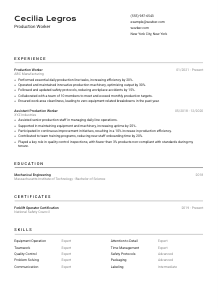
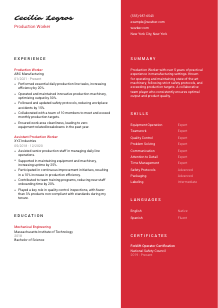
Keeping assembly lines humming, but your resume seems stuck in idle? Rev it up with this Production Worker resume example, built with Wozber free resume builder. Learn how to match your manufacturing mastery to job specifics, driving your career trajectory as efficiently as the products you assemble!
Production work is measured in output, consistency, and control. Hiring teams want to see that you can keep a line moving, handle equipment safely, catch quality issues before they spread, and stay reliable through repetitive, deadline-driven shifts. Your resume should make those shop-floor habits visible, not bury them under vague claims about being hardworking or dependable.
The first screening pass often separates candidates who have real line experience from those with only general labor background. Using Wozber's free resume builder to tailor your wording into an ATS-friendly resume format helps surface the terms that matter here, such as production machinery, packaging, labeling, safety protocols, and quality control, so your resume reads like someone who can step into the line and contribute quickly.
For a Production Worker role, the top of the resume should confirm the basics fast. Hiring managers are checking practical details first, including role alignment, contact access, and whether you meet location or language-related requirements called out in the posting.
Use your full name as the most visible line on the page. Keep the formatting clean and readable so supervisors, recruiters, and HR staff can spot it quickly when reviewing a stack of production resumes.
Place "Production Worker" directly beneath your name when that is the role you are applying for. This immediately aligns your resume with the opening and avoids confusion with nearby roles such as warehouse associate, machine operator, or general laborer.
List a working phone number and a professional email address you check regularly. Production hiring often moves quickly, especially for shift-based roles, so missed calls and unprofessional contact details can slow down an otherwise qualified application.
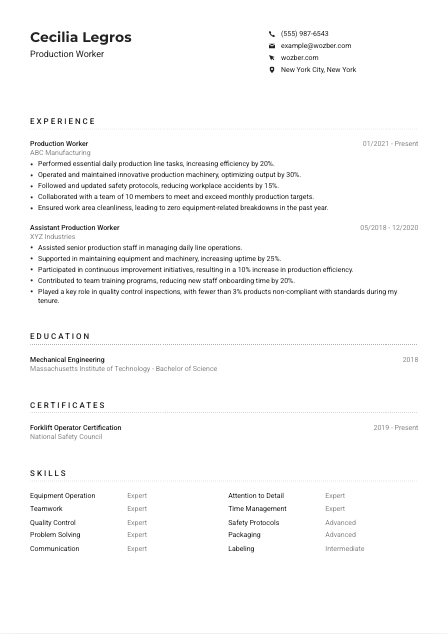
If the employer asks for candidates based in a specific area, show that clearly in your contact section. In the example, listing New York City, New York directly supports the posting's location requirement and removes an easy reason for screening delay.
A LinkedIn profile or personal site is optional for this kind of role, but include it if it supports your application with consistent work history, safety credentials, or manufacturing experience. If the link adds nothing beyond what is already on the resume, leave it out.
This section does not need personality flourishes. It needs to confirm who you are, what role you want, and whether you meet the practical conditions of the job before the reader moves into your production experience.




This section carries the most weight for most Production Worker openings. Employers want to know what kind of line work you handled, what equipment you used, how closely you worked to safety and quality standards, and whether your presence improved throughput, uptime, or accuracy.
Read the posting line by line and mark the operational tasks it repeats. For this role, that includes sorting, packaging, labeling, equipment operation, maintenance, safety compliance, and teamwork around production targets. Those duties should appear naturally in your experience bullets where they reflect work you have actually done.
Start with your most recent position and include your title, employer, and dates. For production hiring, this gives a quick read on how recently you have worked in a manufacturing setting and whether your experience has progressed from support tasks into full line responsibility or equipment ownership.
Each bullet should show what you handled and what changed because of your work. Strong examples mention machinery, packaging flow, cleaning routines, downtime reduction, defect control, or team coordination. The sample resume does this well with bullets such as optimizing output by 30% and keeping equipment-related breakdowns at zero over a year.
Metrics make your contribution easier to understand when they reflect real plant or line performance. Use figures tied to efficiency, output, uptime, safety incidents, scrap reduction, defect rates, target attainment, or training time. Even a simple number, such as team size or shift volume, gives your work more operating context.
Keep unrelated duties brief or remove them entirely if they do not support production hiring. Space is better spent on machine operation, preventive cleaning, quality checks, SOP adherence, and collaboration with leads or supervisors to resolve line issues.
A Production Worker resume gets stronger when the reader can picture you on the line. Show the equipment, the process, the standards, and the measurable effect of your work, and your experience section will carry real weight.
Education is usually a supporting section for Production Worker roles, not the main story. Most employers want to confirm that you meet the stated baseline and then move back to your manufacturing experience, equipment handling, and safety discipline.
If the posting asks for a high school diploma or equivalent, make sure that appears clearly. If you also have further study, include it, but do not let higher education overshadow more relevant production experience unless it directly supports the role.
Use a simple format with school, degree or diploma, field of study if relevant, and graduation year. Production resumes usually benefit from concise education entries so the page stays focused on line work, process discipline, and measurable performance.
If your education connects to machinery, mechanics, manufacturing systems, or industrial processes, that link is worth making clear. In the example, a Mechanical Engineering degree is above the stated requirement, but it still supports the candidate's credibility around equipment and production operations.
Relevant coursework, labs, or technical projects can help if you are early in your career or moving into production from school. Include them only when they support practical shop-floor work, such as machine systems, maintenance basics, process improvement, or quality control.
Clubs, leadership roles, or technical competitions are optional. Include them only if they show something useful for the job, such as safety awareness, mechanical aptitude, team coordination, or process discipline. If you already have solid manufacturing experience, these details can usually stay out.
For most Production Worker applications, education should confirm the baseline and support your technical credibility without taking over the page. Keep it tidy, accurate, and secondary to the work that proves you can perform on the line.
Certifications matter when they connect to equipment use, safety compliance, or production efficiency. Even when a posting does not require one, the right credential can strengthen your case for handling machinery responsibly and working within regulated procedures.
Prioritize credentials tied to production floors, material handling, machine operation, safety training, or quality standards. A forklift certification, lockout-tagout training, OSHA-related coursework, or equipment-specific credential can all reinforce hands-on readiness depending on the job setting.
Choose certifications that map to the role's real demands. For this posting, anything connected to machinery, safety protocols, or maintaining organized production areas will land better than unrelated professional courses.
Show the issue date and, if relevant, the active period or expiration date. This helps the employer understand whether the certification is current enough for immediate use on the floor. The example's forklift certification with an active date range is a useful model.
Production environments change with new equipment, revised SOPs, and tighter quality standards. Recent or renewed certifications show that you keep your operating knowledge current and take safe work practices seriously.
The right certification tells an employer you can be trusted around equipment, materials, and safety procedures. Keep this section selective and tied to the actual demands of production work.
A Production Worker skills section should sound like the real work. The best lists combine equipment-related ability, process discipline, and the people skills needed to keep a shift running smoothly under supervision and production targets.
Start with the capabilities named in the job description. For this opening, that includes operating and maintaining production equipment, following safety and quality control measures, communicating clearly, and working well with a team. Matching that language helps both ATS screening and human review.
Do not fill this section with generic traits that could belong to any job. Prioritize production-relevant skills such as equipment operation, packaging, labeling, quality inspection, safety protocols, line support, basic troubleshooting, and time management during shift work.
Place the strongest operational skills first, then support them with workplace skills such as teamwork and communication. The sample resume gets this balance right by leading with equipment operation, quality control, and teamwork before listing more specific tasks like packaging and labeling.
This section should read like someone ready for production targets, machine routines, and quality checks. If every listed skill points back to daily line performance, the section is doing its job.
Language ability matters in production when workers need to follow instructions, read labels, understand safety notices, and communicate clearly during handoffs or problem reporting. If the posting names a required language, treat that as a core qualification, not a side detail.
When the job states that English proficiency is essential, list English at the top with an accurate proficiency level. That makes it easy for the employer to confirm you can follow written procedures, safety instructions, and supervisor communication.
Additional languages can be useful in multilingual teams, especially in large manufacturing or distribution environments. They are secondary to the job's required language, but they can still strengthen your value in training, coordination, and day-to-day communication.
Describe each language with direct levels such as Native, Fluent, Intermediate, or Basic. Avoid vague wording. The employer should be able to tell quickly whether you can handle technical instructions, routine conversation, or only limited communication.
Some production settings are highly diverse, and extra language ability can help with team coordination, onboarding support, or clearer issue reporting across shifts. Treat that as a bonus, not a substitute for the required production skills and English proficiency.
List only languages you can genuinely use at work. In a production environment, overstatement creates risk because communication affects safety, labeling accuracy, and response to machine or line issues.
For a Production Worker, language skills matter most when they support safe operations and clear communication. Lead with the required language, then add others that can improve collaboration on the floor.
The summary should give a fast, credible snapshot of your line experience. For this role, it should establish how long you have worked in production, what kind of operational responsibility you handle, and what results or standards define your work.
Start with your title and experience level in direct terms. A line like "Production Worker with 5+ years of experience in manufacturing settings" works because it tells the reader immediately that you are not coming from a general labor background alone.
Use the next sentence or two to cover the work this employer needs, such as machinery operation, packaging flow, quality control, safety compliance, and teamwork around production targets. The example summary does this effectively by combining equipment handling, strict safety practices, and output performance in a small space.
Aim for 3 to 5 lines. That is enough space to present your experience, your core production strengths, and one clear value point without repeating bullets from the experience section.
A good summary helps the employer place you quickly. Keep it focused on manufacturing experience, line responsibility, safety habits, and production results so the rest of the resume starts from solid ground.
A Production Worker resume should show that you can contribute to output, protect quality, and work safely around equipment from day one. When each section is tailored to the posting, the employer can quickly connect your experience to the line tasks, machinery, and shift expectations behind the role.
Use Wozber's free resume builder to shape that experience into an ATS-compliant resume with clear production terminology, focused section structure, and stronger ATS optimization. The final result should make one thing easy to judge: you can step into the operation and perform reliably.




