



Use Wozber and land your dream job
Create Resume
No registration required
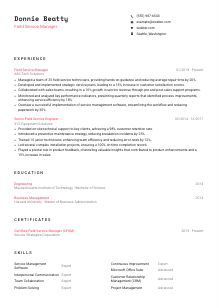
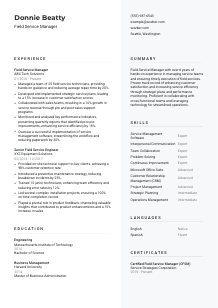
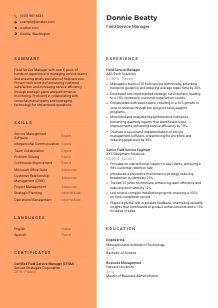
Overseeing on-site operations, but feeling off-site on your resume? Tune into this Field Service Manager resume example, created with Wozber free resume builder. Learn how to align your leadership experience with job requirements, making sure your career trajectory is as strong and connected as your service network!
Field Service Managers sit at the point where service execution, customer expectations, and technician performance meet. A resume for this role needs to show more than time in the field. It should show how you lead technicians, keep installations and repairs moving on schedule, improve service delivery, and turn field data into better operational decisions.
When that story is tailored well, hiring teams can quickly distinguish a candidate who has simply supported service operations from one who has run them. Wozber's free resume builder helps you shape that experience into an ATS-compliant resume that uses the same service language employers search for, from technician leadership to KPI reporting, so your management scope is immediately clear.
This section is brief, but it still carries hiring value. For a Field Service Manager, your header should immediately confirm who you are, what role you are targeting, and whether basic logistics such as location and contact details line up with the opening.
Use your full name as the most visible text in the header. Keep it clean and professional so the resume reads like an operations leader's document, not a decorative profile. A simple layout also helps preserve ATS readability.
Place "Field Service Manager" directly under your name if that is the role you are pursuing. Matching the target title helps frame the rest of the resume around service leadership, technician oversight, customer support, and process improvement from the first line.
List a reliable phone number and a professional email address that you check regularly. If you include a website or LinkedIn profile, make sure it supports your field service background with leadership scope, industry experience, or major service projects.
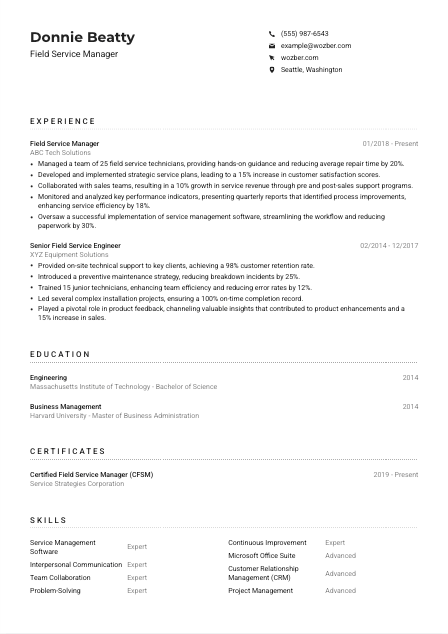
If the employer specifies a location requirement, reflect it plainly in this section. In the example, listing Seattle, Washington answers a stated requirement right away. If you are relocating, note that clearly so location does not become an avoidable screening issue.
A LinkedIn profile, portfolio, or company bio page can strengthen your application when it shows relevant work such as large technician teams, equipment support environments, regional service coverage, or customer-facing leadership. Skip links that do not add anything beyond the resume.
A clear header tells the employer they can reach you, place you, and understand your target role without extra effort. That keeps attention where it belongs, on your service leadership record.




This is the section most hiring teams will study first. For a Field Service Manager, experience needs to show operational control, people leadership, customer outcomes, and measurable service performance, not just a list of duties performed in the field.
Read the job description for the priorities behind the title. Here, the employer wants someone who can manage technicians, oversee installations and repairs, coordinate with sales, improve service strategy, and report on KPIs. Use those priorities to decide which achievements deserve space and which older bullets can be cut.
List your jobs in reverse chronological order with company name, title, and dates. For service leadership roles, that progression matters. It shows whether you moved from hands-on field support into team supervision, regional ownership, or broader service operations management.
Each bullet should show what you led, improved, resolved, or implemented. Strong Field Service Manager bullets often cover technician productivity, response times, customer satisfaction, service revenue, preventive maintenance programs, or software-driven workflow changes. The example works because it points to concrete outcomes such as leading 25 technicians and improving repair time, instead of repeating standard responsibilities.
Quantify your work wherever the role naturally produces metrics. Good examples include first-time fix rate, average repair time, SLA compliance, uptime, customer satisfaction scores, retention, service revenue, on-time completion, or efficiency gains. Numbers like a 20% reduction in repair time or an 18% increase in service efficiency tell a hiring manager how you run an operation.
Prioritize roles and bullets that connect directly to field service, maintenance, installations, technical support, dispatch coordination, or team management. If earlier experience sits closer to engineering or senior field work, frame it around customer site support, technician training, preventive maintenance, and project delivery so the path into management is obvious.
Your experience section should make it easy to see the size of the teams you led, the service work you oversaw, and the outcomes you improved. That is what turns past experience into a credible management profile.
Education usually plays a supporting role for Field Service Manager hiring, but it still matters when the employer asks for a degree in engineering, business management, or a related field. Present it clearly so the requirement is easy to confirm.
Lead with the degree that best fits the posting. If the employer asks for Engineering, Business Management, or a related field, make that alignment obvious. In the example, a Bachelor of Science in Engineering directly supports the requirement, while the MBA adds leadership and business context.
List the institution, degree, field of study, and graduation year. Keep the layout simple so both recruiters and ATS tools can read it quickly without hunting for the credential details.
If you hold more than one degree, think about what best supports your candidacy. Technical degrees often reinforce credibility with equipment, installations, and service operations, while business-focused study can strengthen your case for planning, reporting, and team leadership.
Early-career candidates can include coursework, capstone projects, or lab work tied to maintenance systems, operations, engineering processes, or business analysis. Once you have substantial field leadership experience, those details usually matter less than your service results.
Honors, leadership roles, or industry-relevant extracurricular work can be worth adding if they reinforce problem-solving, technical depth, or management potential. Keep them brief and only include them when they strengthen your case for service leadership.
Your education section does not need extra polish or detail. It needs to show the right degree background quickly and support the broader story of technical credibility and operational leadership.
Certifications matter most when they reinforce how you manage service operations, technician performance, and customer support standards. If a posting names a credential, include it prominently and present it in a way that shows it is current and relevant.
Check whether the employer calls out a specific credential or an equivalent. In this job description, CFSM is listed, so a candidate who holds it should make sure it appears clearly in the certifications section rather than burying it elsewhere.
List certifications that support service management, maintenance operations, customer support environments, technical equipment service, safety, or process improvement. The closer the certification is to day-to-day field service leadership, the more useful it is on the resume.
Add earned or active dates when the certification is current, renewable, or recent enough to show continued development. In the example, showing the CFSM date helps confirm that the credential is active and not outdated.
Field service operations change with new tools, reporting practices, service software, and customer expectations. Ongoing certification work can reinforce your ability to lead modern service teams, especially if your target roles involve more strategic oversight or larger regional operations.
A focused certifications section can strengthen your management profile quickly, especially when it confirms a requirement the employer already listed. Keep it targeted and tied to the kind of service operation you want to lead.
A Field Service Manager skills section should read like the toolkit behind a functioning service operation. The right mix usually combines technician leadership, service software, reporting, customer communication, and continuous improvement.
Use the wording in the posting to identify what should appear here. In this case, service management software, Microsoft Office, communication, cross-functional collaboration, and managerial ability are all direct clues. Mirror those terms when they genuinely match your background so the resume aligns naturally with ATS screening.
Lead with skills that affect daily service performance and team management. That often includes service management platforms, dispatch or workflow systems, KPI reporting, customer relationship management, technician coaching, preventive maintenance planning, and operational problem-solving. Keep lower-priority or generic skills further down.
If your format allows it, organize skills so the employer can scan technical tools and leadership capabilities separately. The example blends software, communication, project management, and continuous improvement, which works because those areas map directly to the responsibilities of running field service teams and improving service efficiency.
Every skill listed should connect to service execution, team oversight, customer support, or operational reporting. If a skill would not matter in the day-to-day work of a Field Service Manager, it does not need space here.
Language skills are especially relevant in field service when the role involves customer sites, technician coaching, and coordination across teams. Present them clearly, but keep them proportional to the job's actual communication needs.
If the job description names a required language, place it first and state your level clearly. Here, English is essential, so it should appear prominently with an accurate proficiency level.
Start with the languages most useful for the role's customer base, technician teams, or regional coverage. This helps employers quickly understand how you will handle field communication, issue resolution, and stakeholder updates.
Additional languages can be useful when you manage multilingual technicians, support diverse customer sites, or work across broader territories. In the example, Spanish adds practical communication value without distracting from English as the core requirement.
Choose labels such as Native, Fluent, Intermediate, or Basic and use them consistently. Accurate proficiency matters in service environments, where communication affects customer trust, technician instruction, and escalation handling.
Not every Field Service Manager role needs multiple languages, but they can add value in national accounts, regional service networks, or customer-facing environments with varied teams. Include them when they strengthen how you can lead and communicate, not just to lengthen the resume.
The best language section shows how you communicate in the environments the role actually covers, whether that means clear English reporting, customer conversations, or smoother coordination across field teams.
Your summary should quickly establish the level of field service operation you can handle. In a few lines, it needs to connect your experience, leadership range, and service results so the reader immediately understands your value.
Start with the parts of the role that matter most. For Field Service Manager positions, that usually means leading technicians, overseeing installations and repairs, improving service efficiency, supporting customers, and reporting operational performance. Use those themes to shape the opening lines.
Mention your years of experience and the leadership level you bring. Phrases such as "Field Service Manager with 6+ years of experience" or "field service leader with 8 years across maintenance and technical support operations" give immediate context and help position you for the scope of the role.
Add two or three specifics that show what you improve. Good summary material includes raising customer satisfaction, reducing repair time, improving technician productivity, growing service revenue, or implementing service systems that streamline operations. The sample summary works because it stays focused on service teams, efficiency, and customer outcomes.
Aim for 3 to 5 lines with direct language. Avoid vague claims about being dynamic or results-driven. Use the space to show operational control, leadership credibility, and the business impact of your service management work.
A sharp summary gives the reader an immediate sense of your service environment, leadership scope, and performance record. By the time they reach your experience section, they should already know what kind of field operation you are ready to lead.
You now have a resume structure that speaks to how Field Service Managers are actually hired, through technician leadership, service delivery results, customer impact, and operational reporting. When each section reflects the language and priorities of the job description, the resume becomes easier to read as a management profile rather than a collection of unrelated experience.
Wozber's free resume builder helps turn that strategy into a polished, ATS-friendly resume template, and its ATS resume scanner can help you check whether key requirements, service terminology, and measurable outcomes are showing up in the right sections. The finished resume should make one thing clear right away: you can lead field service teams and improve the operation they support.




