



Use Wozber and land your dream job
Create Resume
No registration required
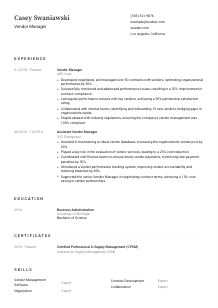
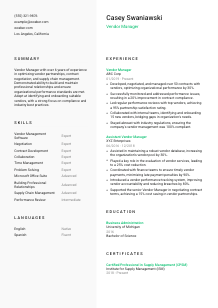
Negotiating deals and deadlines, but your resume isn't getting top bids? Check out this Vendor Manager resume example, created with Wozber free resume builder. Learn how to present your relationship-building skills and strategic sourcing expertise to match job requirements, securing your career as a top pick in the vendor marketplace!
Vendor management sits at the intersection of cost control, contract discipline, and supplier relationships. Hiring teams want to see whether you can negotiate terms that protect the business, track performance against service expectations, and step in quickly when a vendor misses the mark. Your resume should make that operating range visible, from contract ownership to compliance follow-through.
A tailored resume changes how quickly your background reads against the role's priorities, especially when procurement terms, contract language, and vendor performance metrics are screened through ATS filters. Wozber's free resume builder helps organize that language into an ATS-compliant resume, so your experience with negotiations, reviews, and vendor selection comes through clearly from the first scan.
This section should confirm the basics fast and remove friction. For a Vendor Manager, that means presenting a professional identity that matches the role, clear contact details, and any location information that answers an explicit requirement before a recruiter has to look for it.
Use your full name in a larger, clean font so it anchors the page immediately. This is simple formatting, but it matters when your resume is being reviewed alongside many others for a role tied to contracts, supplier oversight, and cross-functional coordination.
Place "Vendor Manager" directly below your name when that is the role you are pursuing. It creates immediate alignment with the posting and helps frame the rest of your experience around vendor negotiations, performance management, and relationship ownership instead of leaving your profile open to broader procurement interpretations.
Make it easy for hiring teams to reach you without distractions or inconsistencies.
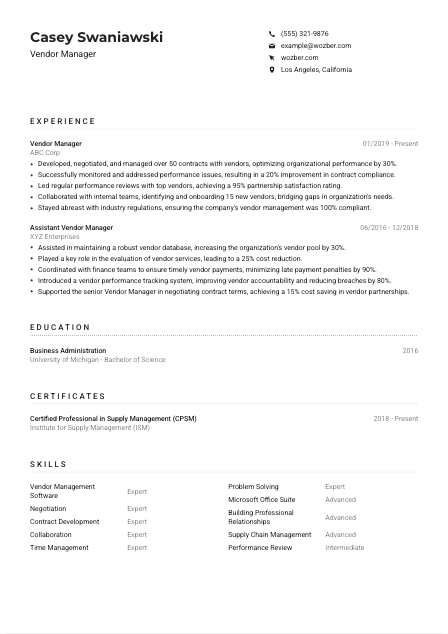
If the employer asks for someone based in Los Angeles or willing to relocate, include that clearly in your personal details. In the example resume, listing Los Angeles, California immediately removes a potential screening question. Use this approach whenever geography is part of the hiring criteria, but do not treat it as a universal requirement for every Vendor Manager opening.
Include LinkedIn or a professional website if it strengthens your application. For Vendor Managers, this can reinforce career progression, procurement credentials, or scope of responsibility across supplier portfolios and contract work. Only include links that are current and consistent with the resume.
Your personal details should answer the practical questions first: who you are, what role you do, how to contact you, and whether you meet any stated location requirement. Clean presentation here keeps the focus on your vendor management track record.




This is where Vendor Manager resumes are won or lost. Employers are looking for proof that you have managed supplier relationships in a measurable way, whether through negotiated savings, stronger compliance, better service levels, faster issue resolution, or smarter vendor selection.
Read the posting closely and identify the work the employer needs handled day to day. In this case, that includes contract negotiation, vendor performance monitoring, issue resolution, regular reviews, collaboration with internal teams, and staying current on regulations. Those themes should shape which achievements you feature and the language you use in your bullets.
List your most recent role first and make each entry easy to scan with job title, company, and dates. For Vendor Managers, career progression often shows growing ownership, from supporting vendor databases or payment coordination to leading contracts, onboarding vendors, and running performance reviews. The example resume shows that progression clearly from Assistant Vendor Manager to Vendor Manager.
Your bullets should show what you negotiated, monitored, improved, or fixed. Strong Vendor Manager achievements often reference contract volume, supplier performance, compliance outcomes, service quality, cost reduction, onboarding results, or stakeholder coordination. For example, "managed over 50 contracts" and "led regular performance reviews" work because they describe actual vendor management activity, not vague responsibility statements.
Metrics make vendor management work easier to evaluate. Use figures tied to savings, compliance, vendor satisfaction, breach reduction, onboarding volume, cycle time, or operational performance. The sample resume does this well with outcomes like a 20% improvement in contract compliance and a 25% cost reduction. Choose metrics that reflect how your work affected supplier performance or business operations, not just activity counts.
Prioritize accomplishments that speak directly to vendor oversight, negotiation, contracts, compliance, supplier relationships, and cross-functional coordination. If a bullet does not help a reader understand how you manage vendors, it is taking space away from stronger material. Relevance matters more than completeness in this section.
By the end of your experience section, a hiring manager should understand the scale of vendors you handled, the contract and performance work you owned, and the outcomes you produced. That is the clearest way to position yourself for a Vendor Manager role.
Education is usually a supporting section for an experienced Vendor Manager, but it still matters because many postings set a clear degree baseline. Present it cleanly and make the connection to business, procurement, or supply chain work obvious when that alignment exists.
If the role asks for a bachelor's degree in Business Administration, Supply Chain Management, or a related field, make sure that information is easy to find. When your degree matches directly, as it does in the example with a Bachelor of Science in Business Administration, it answers a stated requirement with no extra interpretation needed.
List the degree, field of study, school, and graduation year in a simple structure. Recruiters do not need a long academic narrative here. They need to confirm that you meet the educational baseline and move back to your contract, vendor, and performance experience.
If your studies relate directly to procurement, business operations, supply chain, logistics, or commercial management, make that visible through the field of study. This is especially useful if your work history spans adjacent areas like sourcing, purchasing, or supplier operations and you want to keep the connection to vendor management clear.
Relevant coursework can help early-career candidates or career changers, particularly if they studied contract management, supply chain strategy, operations, or business law. If you already have 5+ years of direct vendor management experience, coursework is usually less important than measurable professional results.
Honors, scholarships, or relevant student leadership can add value if they support your professional narrative and do not crowd out more important experience. Use them when they reinforce commercial judgment, analytical ability, or industry interest, and leave them out if they are no longer the strongest proof on the page.
This section should confirm that you meet the degree expectation and, where relevant, reinforce your grounding in business or supply chain work. Once that is clear, let your experience carry the weight.
Certifications can strengthen a Vendor Manager resume because they show formal training in procurement standards, sourcing practices, and supplier management. They are especially helpful when a posting mentions a credential such as CPSM as a preferred qualification rather than a requirement.
When a job posting mentions procurement certification, lead with the credential that matches most closely. Here, Certified Professional in Supply Management, or CPSM, is the obvious choice. That kind of certification supports your credibility in contract work, supplier evaluation, and procurement process discipline.
Do not turn this into a long inventory of unrelated learning. Focus on credentials tied to procurement, contract management, supply chain, compliance, supplier risk, or commercial negotiation. Each item should strengthen your case for handling vendor relationships and governance effectively.
Certification dates matter when they show an active credential or recent professional development. In the example resume, showing CPSM as current helps communicate that the candidate stays engaged with procurement standards and ongoing industry expectations.
Vendor management changes with market conditions, supplier risk, compliance demands, and procurement technology. Keeping certifications current or adding new training in areas like sourcing analytics or contract management shows that your knowledge is moving with the field, not standing still.
Relevant certifications add another layer of trust to your resume, particularly when they connect directly to supplier management, contract oversight, and procurement best practices.
A Vendor Manager skills section should read like a focused operating toolkit. Hiring teams want to see the capabilities that support real work with suppliers, contracts, performance reviews, and internal stakeholders, not a broad list of generic strengths.
Pull out the core skills the employer actually named. In this job description, that includes vendor management software, Microsoft Office Suite, negotiation, and relationship building. Add closely related skills only when they reflect work you have already done, such as contract development, vendor evaluation, compliance tracking, or supplier onboarding.
Lead with the skills most central to the role's daily work. For Vendor Managers, that often means negotiation, contract management, vendor performance monitoring, supplier relationship management, and cross-functional collaboration. The sample resume works well because it leads with skills that map directly to the responsibilities before adding broader capabilities like problem solving and time management.
A shorter, better-targeted list is easier to scan and usually stronger for ATS optimization. Avoid padding the section with basic workplace traits if they are not supported elsewhere in your resume. Prioritize skills that connect to deliverables and workflows a Vendor Manager is expected to handle.
Your skills list should confirm that you can manage the mechanics and relationships of vendor oversight, from negotiation and software use to contract administration and review cycles. If those priorities are clear, the section is doing its job.
Language skills matter in vendor management when the role requires clear business communication, contract discussions, cross-border supplier coordination, or work across diverse stakeholder groups. Present them in a way that supports the commercial side of the role rather than treating them as background detail.
If the employer specifies high proficiency in English, include English prominently and describe your level clearly. That is especially important in roles involving negotiations, performance reviews, compliance discussions, and written contract communication.
List the language required for the role at the top of the section. This removes doubt early and helps recruiters confirm that you can handle the communication demands of vendor meetings, issue escalation, and internal coordination.
Additional languages can be valuable when a company works with international vendors or multilingual partner networks. In the example resume, Spanish adds useful range, but it works best because English proficiency is already clear and the extra language is presented as an added business asset.
Choose clear labels such as Native, Fluent, Advanced, or Intermediate and be prepared to work at that level. In vendor management, overstating language ability can create real problems during negotiations, contract reviews, or supplier issue handling.
If the company has a global supply base or operates across multiple regions, language skills can support smoother relationship management and fewer communication gaps. Mention them when they are relevant to the employer's supplier environment, not simply because you happen to know them.
For Vendor Managers, language skills matter most when they support clearer communication with suppliers and internal teams. Show the required language first, then use additional languages to strengthen the picture of your working range.
Your summary should quickly establish the level and type of vendor management work you have handled. Focus on scope, strengths, and outcomes that matter in this field, so a recruiter can tell within a few lines whether your background fits the role's contract, supplier, and compliance demands.
Before writing, identify the few themes that define the role: contract negotiation, vendor performance, supplier selection, relationship management, and compliance awareness. Use those to shape the summary instead of writing a broad business statement that could fit procurement, operations, or account management equally well.
Start with your title or area of expertise plus years of experience. A line such as "Vendor Manager with 6+ years of experience in contract negotiation and supplier performance management" tells the reader much more than a general statement about being results-driven. The example summary gets this right by establishing both tenure and focus early.
Use the next sentence to highlight capabilities that map directly to the posting, such as optimizing vendor partnerships, maintaining quality standards, improving compliance, or onboarding suitable vendors. If you can mention an area of business impact, such as cost control or performance improvement, even better.
Aim for a short paragraph of three to five lines. Every phrase should earn its place by clarifying what kind of vendor environment you have managed and what results you tend to produce. Skip generic adjectives unless they are backed by the experience section.
Your summary should make it easy to place you in the role before the reader reaches the first job entry. For a Vendor Manager, that means clear experience level, visible supplier and contract strengths, and a brief sense of the outcomes you deliver.
A Vendor Manager resume should leave little ambiguity about what you can own: vendor selection, contract negotiation, performance reviews, compliance follow-through, and supplier relationship management. When each section supports that story with concrete results and the right terminology, your application reads like someone ready to step into the work.
Use Wozber's free resume builder to shape your content into an ATS-friendly resume template, refine role-specific wording with its AI resume builder features, and check alignment with an ATS resume scanner. The result should make one thing easy to judge: your ability to manage vendors with commercial discipline and operational credibility.