



Use Wozber and land your dream job
Create Resume
No registration required
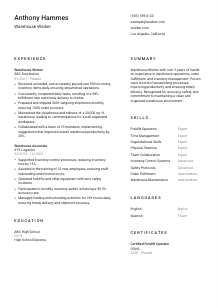
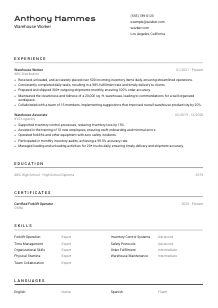
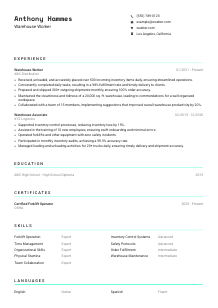
Juggling boxes, but your resume feels out of order? Check out this Warehouse Worker resume example, made with Wozber free resume builder. Learn how to stack your logistics skills to match job specifics, ensuring your career trajectory is never stuck in a loading dock traffic jam!
Warehouse work gets judged in motion. Hiring teams want to see whether you can keep freight moving, handle inventory accurately, work safely around equipment, and stay productive through a full shift. Your resume should make those day-to-day operating standards visible, especially around receiving, order fulfillment, shipping, and warehouse upkeep.
Small wording changes can quickly separate general labor experience from true warehouse experience. When your resume mirrors the language used for tasks like unloading, packing, labeling, inventory control, and forklift operation, it reads more clearly in an ATS and to supervisors scanning for floor-ready candidates. Wozber's free resume builder helps organize that alignment into an ATS-compliant resume, so your background is easier to recognize for what matters first in warehouse hiring: dependable execution.
For warehouse hiring, the top of the resume needs to answer practical questions fast: who you are, what role you do, how to reach you, and whether you meet any location requirement in the posting. Keep this section clean and direct so nothing slows down that first review.
Use your full name as the most visible text on the page. Warehouse resumes are usually reviewed quickly, often alongside many similar applications, so readability matters more than styling tricks.
Place "Warehouse Worker" directly under your name if that matches the role you're targeting. If your recent title was "Warehouse Associate" or something similar, you can still align with the posting by using the target title in the header and keeping your official titles in the experience section.
Include a working phone number and a professional email address. Skip anything distracting. If a supervisor or recruiter needs to schedule an interview around shift coverage, your contact details should be easy to find and easy to trust.
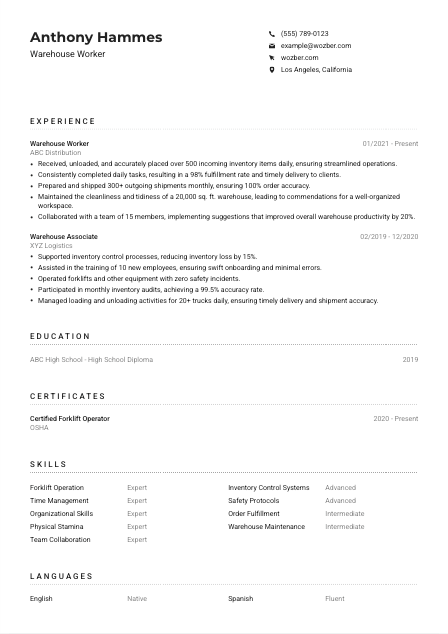
If the employer wants someone based in a specific area, include your city and state. Here, listing "Los Angeles, California" immediately answers a stated requirement and removes doubt about availability or commute.
A LinkedIn profile or personal website is optional for most warehouse roles. Include one only if it supports your application with consistent work history, certifications, or logistics-related experience. If you add it, make sure the information matches your resume exactly.
Your personal details should confirm the basics without friction. For warehouse work, that means clear identification, direct contact information, and any required location detail handled right away.




This is where warehouse candidates separate themselves. Employers are looking for proof that you can receive stock accurately, fulfill orders on time, operate equipment safely, and keep pace during busy shifts. Your bullets should describe the work in operational terms, then back it up with volume, accuracy, or productivity results.
Read the posting closely and lift the phrases that describe real warehouse activity, such as "receive," "unload," "order fulfillment," "pack and label," and "inventory control systems." Use those terms where they match your experience so your resume reflects warehouse workflow, not generic labor language.
Start with your most recent warehouse or logistics job and work backward. That lets the reader see your current operating level first, whether that involves shipping volume, equipment use, inventory handling, or team coordination across a shift.
Focus each bullet on work performed and the result. Instead of writing "responsible for unloading trucks," show scale and consistency. The example resume does this well with details like receiving and placing more than 500 inventory items daily and preparing 300+ outgoing shipments monthly with full order accuracy.
Quantify the pace and accuracy of your work where possible. Useful measures include items received per day, trucks loaded, fulfillment rate, inventory accuracy, shipment volume, safety record, or productivity gains. Metrics like a 98% fulfillment rate or 99.5% audit accuracy tell a hiring manager far more than broad claims about being efficient.
Prioritize experience that shows relevant floor skills, such as stock handling, scanning, packing, shipping, cycle counts, sanitation, and equipment operation. If you include work from another field, draw out the parts that transfer directly, like meeting quotas, following safety procedures, or handling physically demanding shifts.
Your experience section should show that you can keep warehouse operations accurate, safe, and on schedule. Lead with recent work, use warehouse language, and make the scale of your contribution easy to picture.
Education usually plays a supporting role for warehouse positions, so keep it straightforward. Most employers want to confirm your baseline education and then move back to your hands-on experience, equipment use, and reliability on the job.
List your highest completed education clearly. For many warehouse roles, a high school diploma or equivalent is enough unless the posting asks for something more specialized.
Include the school name, diploma or degree, and graduation year or completion date. A short, clean entry works best here because this section is rarely where warehouse hiring decisions are made.
Add coursework or training only when it directly supports the job, such as logistics, supply chain basics, OSHA-related instruction, or inventory systems training. If not, keep the section lean.
Awards, honors, or school activities are optional. Include them if they strengthen your case through reliability, leadership, or technical training, but do not crowd out stronger warehouse experience.
Short courses in safety, equipment handling, warehouse systems, or process improvement can reinforce your application, especially if you are building on limited formal education. In this field, practical training often carries more weight than academic detail.
For a warehouse resume, education should confirm your foundation and then get out of the way. Let it support the application without pulling focus from your operational experience.
Certifications matter most when they connect directly to safety, equipment use, or warehouse compliance. If the posting mentions forklifts or similar equipment, this section can become a clear advantage rather than a formality.
Check the posting for equipment, safety, or compliance requirements. In this case, forklift proficiency is specifically requested, so a current forklift certification directly supports the application even though the employer did not list a mandatory license by name.
Prioritize certifications tied to forklift operation, OSHA safety practices, pallet jack use, hazardous materials handling where relevant, or inventory systems training. One strong, role-related certificate is more useful than a long list of unrelated completions.
Show the issue date and, if applicable, the expiration or renewal period. For equipment and safety credentials, current status matters because employers are trying to reduce risk and keep operations compliant.
Warehouse work often rewards workers who can take on more responsibility safely. Adding updated forklift training or warehouse safety credentials can help you compete for better shifts, broader duties, or higher-volume operations.
When a warehouse posting calls for equipment handling or safe operations, certifications give you concrete credibility. Keep this section focused on credentials that translate directly to the floor.
A warehouse skills section works best when it mirrors how the job is done. That means equipment operation, order accuracy, inventory handling, pace, safety, and teamwork. Keep the list specific enough for ATS matching and practical enough for a warehouse lead to trust.
Look for repeated requirements and convert them into skill entries using the employer's wording where accurate. Here, that includes forklift operation, organizational skills, time management, inventory control systems, and English fluency, along with physical stamina for lifting and long periods on your feet.
Lead with the abilities most connected to daily warehouse output. Skills like order fulfillment, shipping and receiving, safety protocols, pallet handling, scanning, and team collaboration should appear before generic traits. The sample resume handles this well by placing forklift operation, time management, and inventory control near the top.
Group or order skills by relevance so the most important ones are visible immediately. An ATS-friendly resume format helps, but the content still needs to be disciplined. Keep the section focused on practical warehouse capability rather than broad personality terms.
Your skills section should sound like someone who can step onto the warehouse floor and contribute on day one. Prioritize the capabilities tied to safety, accuracy, equipment use, and steady output.
Language ability matters in warehouse work when it affects instructions, safety communication, labeling, team coordination, or customer shipment accuracy. If the posting names a required language, make that easy to find.
If English fluency is listed in the job description, include English clearly in this section. Do not assume it is obvious from the rest of the resume. State it directly.
Start with the language the employer requires, then add others that may help on the floor. In a multilingual warehouse environment, additional languages can support smoother handoffs, clearer instructions, and fewer misunderstandings during busy shifts.
Use clear labels such as native, fluent, intermediate, or basic. That makes your communication range easier to understand, especially for roles where safety instructions and shipment details need to be handled accurately.
Extra language skills are especially useful when they support teamwork, supervisor communication, or coordination across a diverse crew. In some markets, bilingual ability can be a real plus, but it should complement, not replace, core warehouse qualifications.
Only list languages you can actually use on the job. If you can help with verbal instructions, training support, or day-to-day coordination, say so through your proficiency level rather than stretching your claims.
For warehouse roles, language skills matter when they improve safety, teamwork, and execution. State required fluency clearly and treat additional languages as practical support for daily operations.
The summary needs to establish your value quickly. In a few lines, show your level of experience, the kind of warehouse work you handle, and the results you are known for, whether that is order accuracy, shipping volume, safe equipment use, or dependable shift performance.
Start with the parts of your experience that match the target role most closely. For warehouse applications, that often means years of experience, receiving and shipping work, order fulfillment, inventory handling, and equipment operation.
A direct first line works best, such as "Warehouse Worker with over 3 years of hands-on experience." That immediately places you in the right lane and gives the hiring manager useful context before they reach the experience section.
Mention two or three specifics that match the posting, such as maintaining high fulfillment accuracy, operating forklifts safely, supporting inventory control, or improving warehouse productivity. The sample summary works because it stays close to real warehouse outcomes instead of generic work ethic claims.
Aim for three to five lines. This section should read like a quick briefing on your warehouse value, not a life story. Focus on what you handle well and what results follow from your work.
Your summary should tell the reader, within seconds, what kind of warehouse worker you are and where you add value. Keep it concise, specific, and closely aligned with the actual work in the posting.
A warehouse resume works when it makes your pace, accuracy, safety habits, and equipment experience easy to spot. Every section should support that picture, from a clear location line to measurable experience in receiving, shipping, inventory, and daily floor operations.
Use Wozber's AI resume builder to tighten the wording, align your content with the job description, and present it in an ATS-friendly resume format. Wozber's ATS resume scanner can also help you check for missing requirements and improve ATS optimization before you apply. The finished resume should make one thing clear right away: you can keep warehouse operations moving reliably.




