



Use Wozber and land your dream job
Create Resume
No registration required
Guiding teams, but your resume feels lost? Navigate this People Manager resume example, created with Wozber free resume builder. Learn how to showcase your leadership drive and connect it to the job compass, so your career journey always moves toward the right destination!
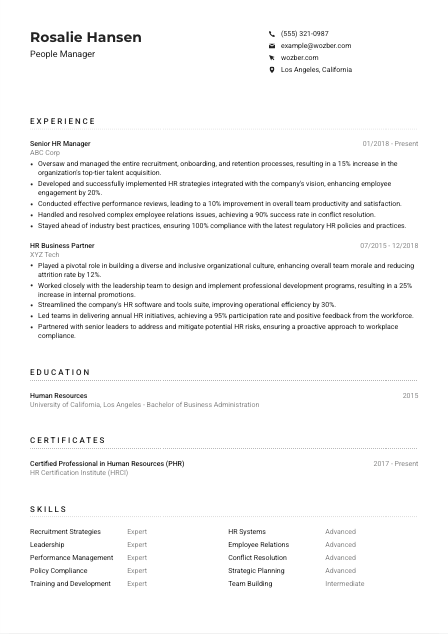
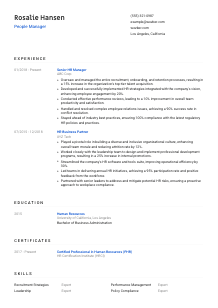
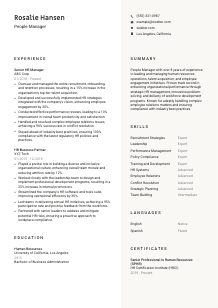
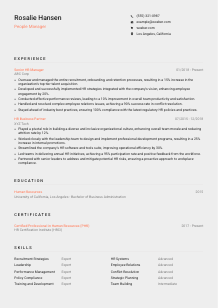
People Manager resumes are strongest when they show how you run the people side of the business with judgment, consistency, and clear outcomes. Hiring teams want to see more than generic HR support. They look for someone who can improve hiring, guide managers through performance conversations, handle employee relations carefully, and keep policies aligned with changing regulations.
A tailored resume makes that scope easier to recognize quickly, especially when ATS filters are screening for HR leadership, compliance, and talent management language. Wozber's free resume builder helps you match your wording to the role and keep an ATS-friendly resume format, so your background reads clearly as people leadership rather than general administration.
For a People Manager, the header should communicate professionalism and remove basic friction. This section will not win the job on its own, but it can quickly confirm that you are aligned on title, location, and contact details before the reader gets into hiring results, employee relations work, or leadership scope.
Place your full name at the top in a clean, readable format, then follow it with the exact title you are pursuing when it accurately reflects your background. Using "People Manager" immediately frames your experience around HR leadership, team oversight, and workforce strategy instead of leaving the reader to interpret a broader HR label.
If your recent title was something adjacent such as HR Manager or Senior HR Manager, you can still position yourself for a People Manager opening by using the target title in the header and supporting it throughout the resume. The sample resume does this well because the title aligns with the role while the experience section supplies the management-level HR context behind it.
Use a current phone number and a professional email address that looks business-ready. For HR leadership roles, small presentation choices matter because the job involves policy communication, documentation, and day-to-day credibility with employees and managers. Add a website or LinkedIn profile only if it supports the same story as the resume.
When a posting specifies a city or state, include it clearly in your personal details. In this example, listing Los Angeles, California directly addresses a stated requirement and removes uncertainty about local availability. If location is not a factor in another application, city and state are usually enough.
A LinkedIn profile can help if it reflects the same strengths shown in your resume, such as employee engagement work, HR systems experience, compliance leadership, or retention results. Before adding any link, check that job titles, dates, certifications, and major accomplishments match. Consistency matters in a role where trust and accuracy are part of the work.
Your personal details should confirm the basics quickly and support the hiring context around the role. When the header is clean, accurate, and aligned with the opening, the rest of the resume can focus on the real question: how effectively you lead people operations.




This is the section that usually decides whether a People Manager candidate moves forward. Employers want to see how you handled hiring pipelines, onboarding, retention, manager coaching, investigations, performance reviews, and compliance in actual business settings, not just that you were exposed to HR work.
Start by identifying the work that defines the opening. For a People Manager, that often includes recruiting oversight, onboarding, retention strategy, employee relations, performance management, and policy compliance. Use those themes to choose which past work to emphasize, especially if your background spans generalist, business partner, and management roles.
For every relevant position, include title, company, and dates, then write accomplishment bullets that show what you owned and what changed because of your work. In HR leadership roles, that usually means improvements in hiring quality, attrition, engagement, compliance, promotion rates, process efficiency, or manager effectiveness. Wozber's ATS-friendly resume template helps keep that structure easy to scan for both recruiters and ATS systems.
Your bullets should sound like decisions and outcomes, not a task list. Compare "conducted onboarding" with "redesigned onboarding that improved early retention" or "led performance review cycles across multiple teams." The sample resume is effective here because it connects responsibility to results, including stronger engagement, better productivity, and successful conflict resolution.
People management work is measurable, even when the outcomes are operational or cultural. Add numbers where they are natural, such as reduced attrition, increased internal promotions, improved participation in HR initiatives, faster recruiting cycles, stronger employee engagement scores, or compliance rates. Metrics like the sample's 15% talent acquisition improvement or 20% engagement gain help hiring teams picture your level of influence.
Keep the experience section focused on work that speaks directly to the opening you want now. If a bullet does not support hiring, employee relations, leadership, performance management, HR systems, or compliance, remove it or rewrite it. Wozber's ATS resume scanner can help you compare your language against the posting and see whether your strongest HR management themes are coming through clearly.
A People Manager experience section should show that you can lead core HR processes, guide difficult personnel decisions, and improve workforce outcomes with structure and judgment. When your bullets connect responsibility to measurable business and employee results, your level becomes much easier to recognize.
For People Manager roles, education is usually a qualification check before the reader returns to your experience. That means the section should be clear, accurate, and aligned with the field, especially when the posting asks for a bachelor's degree in Human Resources, Business, or a related discipline.
List the degree that best matches the requirement first. If you hold a bachelor's in Human Resources, Business Administration, Organizational Development, or a related field, make that connection obvious. In the example, a Bachelor of Business Administration in Human Resources directly supports the role's stated academic requirement.
Keep the entry easy to read by listing degree, field of study, school, and graduation year. This is one section where simple structure works best because recruiters and ATS software are often checking for qualification match rather than narrative depth. An ATS-friendly resume format helps that information pass cleanly without clutter.
If your degree title is broad, use the field of study to bring it closer to the role. For example, a business degree with a concentration in human resources, labor relations, or organizational behavior should be written in a way that makes the HR connection visible. That matters when the role sits between strategy, compliance, and team leadership.
Additional coursework, executive education, or HR-focused training can be useful if it supports your target role. Include items such as employment law training, leadership development programs, compensation coursework, or DEI-related education when they add context that your degree title alone does not provide.
Honors, scholarships, or major HR-related projects can help if you are earlier in your career or if the achievement is especially relevant to the role. For more experienced People Managers, this information is optional and usually secondary to business results, team leadership, and policy expertise.
Education should confirm that you meet the baseline and support your HR foundation without distracting from your management experience. Once the degree requirement is clear, the resume should move the reader back to how you lead people operations in practice.
Certifications matter in People Manager hiring because they can reinforce your command of employment practices, compliance expectations, and current HR standards. They are rarely a substitute for real management experience, but they can strengthen your profile, especially when the posting names a credential such as PHR or SPHR as a plus.
When a job description mentions specific certifications, list those prominently if you hold them. For this opening, PHR and SPHR are directly relevant because they support the employer's interest in HR knowledge, regulatory awareness, and professional standards. Put the most relevant certification first.
Choose certifications that support your work as a People Manager rather than filling the section with every course completion. Credentials in human resources, employee relations, compliance, coaching, compensation, or workplace investigations are usually more valuable here than general business badges with little connection to day-to-day people operations.
Many HR certifications require renewal or continuing education, so dates can help show that your credential is current. The example resume includes active date ranges for both PHR and SPHR, which gives the reader confidence that the certifications are maintained rather than outdated.
People Managers work in an environment shaped by changing labor regulations, documentation standards, and employee expectations. If you are pursuing or maintaining relevant certifications, that supports your credibility in compliance, policy interpretation, and responsible people leadership. Keep the section updated as your credentials evolve.
Well-chosen certifications tell employers that your HR judgment is backed by current professional standards. In a People Manager resume, they work best when they support the leadership, compliance, and employee relations experience already shown elsewhere.
The skills section should echo the actual work of a People Manager. That means a balanced mix of HR process knowledge, people leadership capability, and systems fluency, written in terms that match the posting and make sense for ATS screening.
Look beyond the obvious keywords and identify the actual capabilities behind the role. A posting that mentions recruitment, onboarding, retention, performance reviews, complaints, and compliance is pointing to skills such as talent acquisition, employee relations, performance management, conflict resolution, policy administration, and leadership communication.
Prioritize skills that appear in the posting when they reflect your real background, then support them in the experience section. Wozber's ATS optimization tools can help you align language around HR systems, leadership, communication, and compliance so the resume reads naturally while still matching the employer's terminology.
Avoid turning the section into a long inventory of every HR capability you have touched. Focus on the skills most associated with people management at your level, such as employee relations, recruiting strategy, HR systems, training and development, policy compliance, leadership, and strategic planning. The sample resume handles this well by mixing operational HR skills with management strengths.
A focused skills section helps recruiters and ATS tools quickly place you in the right lane. For a People Manager, that lane should point clearly toward HR leadership, workforce strategy, and sound handling of employee issues.
People Managers spend a large part of their workday in conversations that carry real consequences, from interviews and onboarding to performance feedback and employee relations meetings. If language proficiency matters in the posting, list it clearly and truthfully so employers can judge communication readiness without guessing.
If the job requires English fluency, include it clearly with an accurate proficiency level. In this case, English is specifically mentioned, so it should be visible rather than implied. For a People Manager, language ability affects interviews, policy communication, documentation, and difficult conversations with employees and leaders.
Additional languages can strengthen your profile when you work with diverse employee populations, multi-site teams, or communities where bilingual communication helps build trust. The sample resume includes Spanish, which can be a practical advantage in many workplaces, even when it is not formally required.
Choose straightforward levels such as native, fluent, intermediate, or basic. That gives hiring teams a usable sense of your communication range and avoids overstatement. Accuracy matters in HR, where miscommunication can affect onboarding, investigations, and policy interpretation.
Language skills become more valuable when they connect to the workforce you serve. In some organizations, multilingual ability helps with interviews, training sessions, employee questions, or conflict resolution across different groups. Include extra languages when they genuinely improve your ability to support employees and managers.
Do not add languages just to make the resume look broader. Include them when they are relevant to communication, inclusion, or employee support in your target environment. For HR and people leadership roles, that practical connection is what makes language skills persuasive.
On a People Manager resume, language skills should support the real communication demands of the role. When listed accurately, they add useful context about how you work with employees, managers, and broader teams.
The summary sets the frame for everything that follows. For a People Manager, it should quickly establish your HR leadership level, the areas you manage well, and the workforce outcomes you have influenced, without slipping into broad claims that could describe almost anyone in human resources.
Start with the main themes in the job description and shape your opening around them. For a People Manager, that usually means HR leadership, recruiting and retention oversight, employee engagement, performance management, employee relations, and compliance. This gives the reader the right lens before they reach your detailed experience.
Open with your years of relevant HR experience and your management scope if it is solid enough to claim. Phrasing like "People Manager with 8+ years in HR, including leadership across talent acquisition, employee relations, and performance management" tells the reader where you sit immediately and aligns well with a posting asking for more than 5 years in HR and management experience.
Use selected results to show what your work changes. Good summary details for this profession include stronger retention, improved engagement, better promotion pathways, more efficient HR systems, or reliable policy compliance. The sample summary works because it combines operational HR leadership with workforce development and employee relations impact rather than relying on vague leadership language.
Aim for a short paragraph that reads with focus. Four to five lines is usually enough to establish your level, specialties, and a few outcomes. Save the deeper detail for the experience section, where you can back up each claim with metrics, programs led, and examples of manager and employee support.
A well-written summary should make your resume read like it belongs to a People Manager from the start. When the opening names your HR leadership scope and the outcomes you drive, the rest of the document lands with much more force.
A People Manager resume needs to show that you can lead core HR processes, guide managers through sensitive issues, improve employee experience, and keep the organization compliant while supporting business goals. When each section is tailored to that level of responsibility, your resume reads as management-ready rather than broadly HR-adjacent.
Use Wozber's free resume builder, ATS-friendly resume templates, and ATS resume scanner to sharpen your wording, align with the posting, and strengthen ATS optimization across the full document. The finished resume should make one thing easy to judge: you can lead people operations with credibility, structure, and results.




