



Use Wozber and land your dream job
Create Resume
No registration required
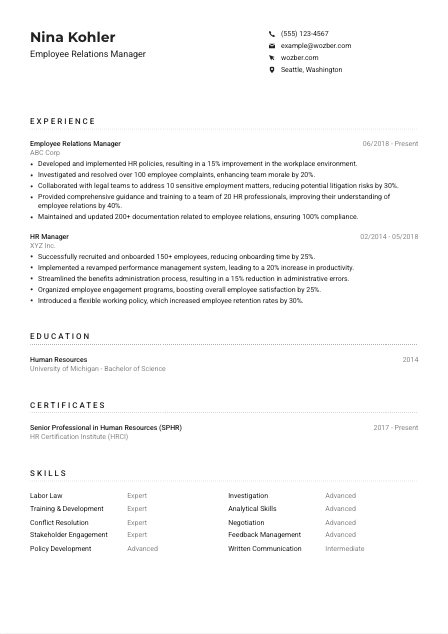
Handling workplace dynamics, but your resume feels like an awkward conversation? Smooth it out with this Employee Relations Manager resume example, created with Wozber free resume builder. Learn how to clearly show your relationship-building strengths to meet job expectations, charting a professional journey that's as harmonious as an office karaoke session!
Employee relations work sits where workplace trust, policy consistency, and legal risk meet. Hiring teams look for people who can handle complaints, investigations, manager coaching, and sensitive decisions without losing sight of culture or compliance. Your resume needs to show that you have done that work in real settings, with clear outcomes such as resolved cases, policy improvements, stronger manager capability, or reduced exposure to employment claims.
A tailored resume changes how quickly a reader can place you in that mix of case management, policy work, and risk control. Wozber's free resume builder helps you shape an ATS-compliant resume around the language of the posting, so terms like employee relations, labor law, investigations, documentation, and manager guidance are easy to parse and easy to connect to your actual experience. That makes it much easier for a hiring team to see whether you can step into complex workplace issues with sound judgment from day one.
For an Employee Relations Manager, the top of the resume should read as credible, local when required, and easy to contact. This section is brief, but it still carries practical hiring information that can affect whether your application moves forward.
Use your full name in a larger font than the rest of the header so it is easy to spot in a stack of HR and employee relations applications. Keep it simple and professional. This role deals with formal documentation, investigations, and policy communication, so your presentation should already reflect that standard.
Place "Employee Relations Manager" directly under your name if that matches your background and target role. It immediately positions you in the right lane, especially when employers are sorting candidates across broader HR, business partner, and generalist profiles.
Make it easy for employers to reach you for interviews or follow-up questions about case handling, policy work, or labor law experience.
If the employer requires local presence or a specific market, state your city and state clearly. In the example posting, Seattle, Washington is a stated requirement, so listing Seattle, Washington near the top removes a basic screening question right away. Treat this as tailoring to the posting, not a rule for every Employee Relations Manager resume.
A LinkedIn profile or professional website can help if it supports your resume with consistent titles, dates, and HR credentials. Before adding it, make sure the profile reflects the same story as your resume, including your employee relations scope, certifications, and career progression.
Your header should tell an employer who you are, what role you do, how to reach you, and, when relevant, whether you meet a location requirement. Keep it clean and credible so the rest of the resume can focus on investigations, policy work, and employee relations results.




This is the section most likely to decide whether you move forward. For Employee Relations Manager roles, employers want more than generic HR experience. They want to see the kind of issues you handled, how you worked with managers or legal teams, and what changed because of your actions.
Read the job description closely and mark the repeated themes. In this example, the priorities are policy development, complaint and grievance resolution, legal and HR collaboration, manager guidance, and documentation accuracy. Use those themes to decide which accomplishments deserve space and which can be cut or reframed.
List positions in reverse chronological order and include your title, employer, and dates. For employee relations hiring, clean structure matters because reviewers are often tracing progression from HR generalist or HR manager work into deeper investigations, conflict resolution, and compliance responsibility.
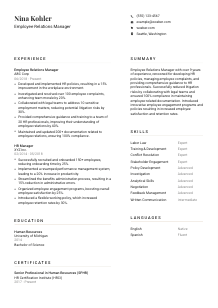
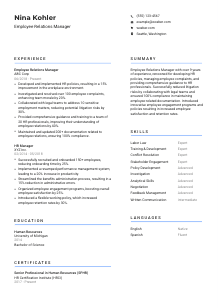
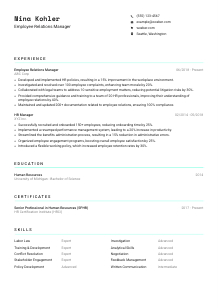
Your bullets should show the work itself and the result. Good Employee Relations Manager bullets often cover complaint resolution, grievance handling, policy implementation, training for line managers, disciplinary guidance, or documentation controls. The example resume does this well with points such as developing HR policies that improved the workplace environment and collaborating with legal teams to reduce litigation risk. Those are the kinds of outcomes that show mature employee relations practice.
Quantify where it adds real meaning. Useful numbers in this field include volume of cases handled, reduction in escalation or litigation risk, employee satisfaction movement, compliance rates, training reach, or documentation volume. Resolving 100+ complaints, training 20 HR professionals, or maintaining 200+ employee relations records tells a hiring team about scale and consistency, not just effort.
You do not need to remove broader HR experience, but you should trim or downplay work that does not strengthen your employee relations profile. If a past HR Manager role included recruiting, onboarding, and engagement programs, keep the parts that connect to retention, policy rollout, performance management, or employee concerns. Shape older experience so it supports your move toward employee relations leadership rather than distracting from it.
Your experience section should make it easy to picture you handling investigations, advising managers, refining policy, and protecting the organization through sound employee relations decisions. Lead with the work that shows judgment, confidentiality, and measurable HR impact.
For an Employee Relations Manager, education usually functions as a qualification check before the deeper review of your experience begins. Present it clearly, and make sure the degree information supports the field expectations named in the posting.
If the role asks for a bachelor's degree in Human Resources, Business Administration, or a related field, make that match easy to find. In the example, a Bachelor of Science in Human Resources aligns directly with the requirement, which removes doubt at the initial screening stage.
Include degree, field of study, school, and graduation year or date. Wozber's ATS-friendly resume template helps keep this section easy to parse so your qualifications are not buried in unnecessary formatting.
If your degree is closely tied to HR, labor relations, organizational behavior, or business administration, show that clearly. For employee relations roles, that academic alignment reinforces your grounding in workplace policy, people management, and organizational structure.
Most experienced candidates can keep this section brief. If you are early in your career or transitioning from another HR path, relevant coursework in employment law, conflict resolution, labor relations, or organizational behavior can help explain your direction.
Add honors, leadership roles, or notable projects only if they reinforce skills used in employee relations, such as mediation, communication, policy analysis, or team leadership. Keep the focus on details that support the role rather than turning the section into a full academic profile.
Education should confirm that you meet the stated baseline and that your academic background supports the people, policy, and compliance side of employee relations work. Once that is clear, your experience can do the heavier lifting.
Certifications are not always mandatory for Employee Relations Manager roles, but they can add weight when they show deeper command of HR practice, employment law awareness, or ongoing professional development. In a field shaped by changing regulations and workplace standards, current credentials carry real value.
Start with the job description. If no specific certification is required, choose credentials that still support the role's demands, especially around employee relations, compliance, investigations, and HR leadership.
List credentials that hiring teams will immediately understand. For this profession, examples can include SPHR, PHR, SHRM-SCP, or other established HR certifications. The example resume's SPHR is a strong fit because it signals senior-level HR knowledge that supports policy and employee relations work.
Include the year earned and, if relevant, the active date range. That helps employers understand whether the certification is current, which matters in areas tied to labor law, policy interpretation, and evolving workplace regulations.
If you hold a certification, maintain it and update the resume accordingly. Employee relations managers are often asked to guide difficult conversations, disciplinary issues, and compliance-sensitive documentation, so current credentials can reinforce that you stay engaged with changing standards and best practices.
Well-chosen certifications can reinforce your authority in employee relations and HR leadership. Use this section to show continued investment in the legal, policy, and people side of the profession.
The skills section should reflect how employee relations is actually practiced. That means a mix of compliance knowledge, investigation ability, judgment in conflict situations, and communication strong enough to work across employees, managers, HR partners, and legal counsel.
Pull out the exact capabilities the employer names, then compare them with your own experience. In this example, labor law knowledge, analytical problem-solving, interpersonal communication, negotiation, and documentation are all central. Those should guide what appears in your skills list.
Employee relations hiring usually looks for both. Include hard-skill areas such as labor law, policy development, investigations, documentation management, compliance, and training, alongside role-critical strengths like conflict resolution, stakeholder management, negotiation, and written communication. The example skills list handles that balance well.
Do not overload this section with every HR skill you have. Choose the skills most relevant to employee relations and present them in a clean, ATS-friendly resume format so the connection between the posting and your background is obvious. A shorter, well-targeted list is more useful than a long catalog of generic HR terms.
This section should quickly show that you understand both the compliance side and the human side of employee relations. If a hiring team can immediately see labor law fluency, investigation capability, and manager-facing communication strength, the section is doing its job.
Language skills matter differently depending on the organization, workforce mix, and geography. For Employee Relations Manager roles, the first priority is clear communication in the language required for investigations, coaching, documentation, and policy interpretation.
If the posting specifies English proficiency, list English prominently with an honest proficiency level. This example explicitly requires proficient English speaking skills, so placing English first directly addresses a stated qualification.
Additional languages can be valuable in employee relations, especially in diverse workplaces where manager coaching, complaint intake, or policy explanation may happen across language groups. Spanish, for example, can be a practical asset if it reflects the employee population you have supported.
List languages in a sequence that makes immediate sense to the employer. Put the required language first, then any additional language that could help with employee communication, training, or workplace inclusion. The example's English followed by Spanish is a clear model.
Use realistic labels such as Native, Fluent, Professional, or Conversational. In employee relations work, overstating language ability can create problems quickly if you are expected to handle sensitive discussions, investigations, or documentation in that language.
Only include languages you can use meaningfully. If you can support employee communication across cultures or help reduce misunderstandings in a multilingual environment, that is relevant. If not, leave the section concise and focused on the required language.
List the languages you can actually use in professional employee relations settings and be precise about your level. Clear, credible communication matters in every complaint review, manager conversation, and policy discussion.
Your summary should give a fast, concrete read on your employee relations background. In a few lines, show your level, your core strengths, and the kind of outcomes you deliver in policy, investigations, manager support, and workplace risk management.
Build the summary around the responsibilities that define the role. For this profession, that usually means employee complaint resolution, policy development, legal and HR collaboration, manager coaching, compliance-minded documentation, and a positive workplace environment. Keep the language specific to employee relations, not broad HR generalities.
Start with a direct professional identity, such as "Employee Relations Manager with 9+ years of experience." That quickly gives context for your seniority and tells the reader you are not approaching the role from a vague HR background.
Choose achievements that speak to the employer's priorities. In the example, reducing litigation risk through legal collaboration and maintaining full compliance in employee relations documentation are strong choices because they connect directly to the role's responsibilities. Use results that show the scale and consequences of your work.
Aim for three to five lines with no filler. A hiring manager should finish the summary knowing your level of employee relations experience, the issues you handle well, and the value you bring to policy, investigations, and workplace culture.
Your summary should frame you as someone who can manage sensitive employee relations issues with judgment, consistency, and a clear understanding of compliance. If it quickly connects your background to the employer's priorities, it is working.
A well-tailored Employee Relations Manager resume should show more than HR tenure. It should show how you handle complaints, shape policy, coach managers, document sensitive matters accurately, and work with legal or leadership when the stakes are high.
Use Wozber's free resume builder to organize that experience into an ATS-friendly resume format, then refine it with the ATS resume scanner so the language of the posting is reflected naturally across your summary, skills, and experience. The finished resume should make one thing easy to judge: whether you can manage employee relations issues with sound judgment, compliance awareness, and steady leadership.




