



Use Wozber and land your dream job
Create Resume
No registration required
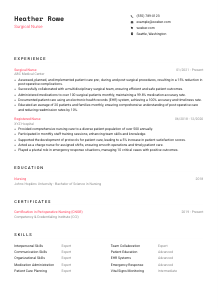
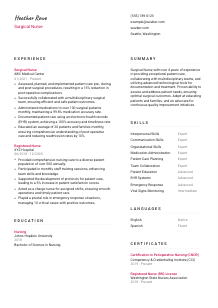
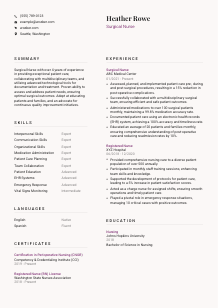
Juggling gowns and instruments, but your resume feels pre-op? Scrub into this Surgical Nurse resume example, created with Wozber free resume builder. It shows how to align your OR expertise and patient care with precise job needs, ensuring your career trajectory stays scalpel-sharp!
Surgical nursing leaves very little room for vague claims. Hiring teams want to see how you support patient safety before incision, stay composed during procedures, and document accurately when the pace of the OR is high. Your resume should make that clinical judgment visible through perioperative experience, medication administration, team coordination, and post-op patient education.
Small wording choices change how quickly your background reads as operating-room ready. When your resume uses the same perioperative language the employer uses, an ATS-compliant resume built with Wozber's free resume builder is easier to route correctly and easier for reviewers to connect to OR workflow, EHR documentation, and surgical team collaboration. That is the level of alignment this guide will help you build.
In hospital hiring, the header section is basic but important. It should confirm who you are, how to reach you, and, when relevant, whether you meet practical requirements such as local availability for shift-based surgical care.
Use your full name in a clean, readable format at the top of the page. Keep it slightly larger than the body text so the resume is easy to scan, especially when a hiring coordinator is moving quickly through multiple perioperative candidates.
Place your target title directly under your name and match the posting when it fits your background. If you are applying for a Surgical Nurse position, label yourself "Surgical Nurse" rather than a broader title like "Registered Nurse" when your OR experience supports it. This helps both recruiters and ATS systems connect your profile to perioperative work faster.
List a reliable phone number and a professional email address. Double-check every character. In hospital recruiting, missed calls about interviews, credential checks, or shift discussions often come down to simple contact errors you can avoid.
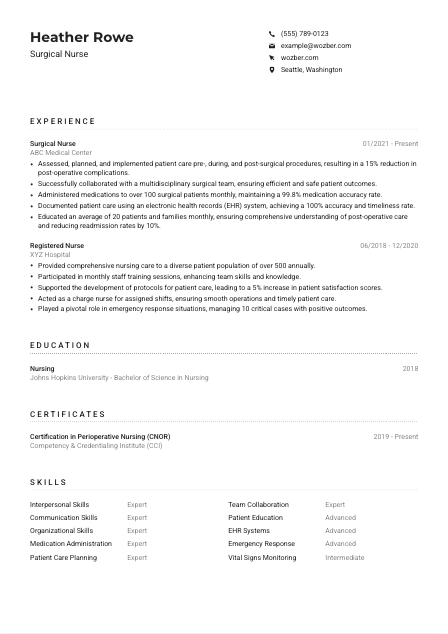
If the employer specifies a city or state, show that detail clearly in your header. In the example, listing "Seattle, Washington" directly supports a stated location requirement and removes an early question about relocation or local eligibility.
Include LinkedIn or another professional profile only if it reinforces your nursing background with consistent dates, credentials, and clinical scope. If it mentions perioperative work, certifications, unit responsibilities, or continuing education, it can strengthen the overall picture. If not, leave it off.
This section does not need personality lines or extra detail. It should confirm your identity, role target, and availability cleanly so the reader can move straight into your OR experience and clinical qualifications.




For a Surgical Nurse, the experience section carries most of the hiring weight. It should show how you contribute to safe procedures, steady perioperative care, accurate charting, and coordinated work with surgeons, anesthesiologists, and surgical assistants.
Start by marking the responsibilities and requirements that define the job. In this case, that includes at least 2 years of OR experience, perioperative patient care across pre-, intra-, and post-op stages, medication administration, vital signs monitoring, EHR documentation, and patient and family education. Those are the themes your bullets should answer directly.
Lead with your current or most recent position and include employer name, job title, and dates. That structure lets reviewers quickly confirm recent surgical or acute-care exposure. If you progressed from a general RN role into a Surgical Nurse position, that progression is worth making easy to follow.
Bullet points should show what changed because of your work. The example does this well by tying perioperative care to a 15% reduction in post-operative complications and patient education to a 10% reduction in readmissions. Metrics like complication rates, medication accuracy, patient volume, documentation timeliness, or satisfaction scores give your experience real clinical weight.
Operating-room hiring often depends on trust in execution. Numbers help establish that trust. Use figures that reflect surgical nursing work, such as patients supported per month, medication accuracy, response time, case volume, chart completion rates, or quality-improvement results. The sample's "99.8% medication accuracy rate" and "100% accuracy and timeliness" in EHR documentation are strong models because they match how nursing performance is actually judged.
Prioritize achievements that relate to perioperative care, sterile workflow support, patient monitoring, cross-functional coordination, and discharge teaching. Earlier nursing experience can still stay on the resume, but frame it around transferable strengths such as emergency response, charge responsibilities, protocol development, or high patient-volume care. The point is to keep the reader focused on your readiness for the surgical environment.
A hiring manager should be able to picture you in the OR from this section alone. When your bullets connect patient care decisions to measurable outcomes, your experience reads as current, capable, and relevant to surgical practice.
Education is a straightforward section in nursing resumes, but it still matters. It confirms that you meet the baseline training requirement and helps employers quickly separate qualified applicants from those without accredited nursing education.
If the posting calls for a bachelor's or associate degree in Nursing, make that visible without forcing the reader to interpret abbreviations or infer the field. The example's Bachelor of Science in Nursing aligns directly with the requirement, which is exactly what this section should do.
List the degree, school, field of study, and graduation year or date. Nursing recruiters are usually checking for accredited education first, not elaborate formatting. A clean structure keeps the focus on the qualification itself.
Write the full degree title when possible, such as "Bachelor of Science in Nursing" or "Associate Degree in Nursing." That language maps neatly to both ATS screening and human review, especially when the employer has listed degree requirements explicitly.
Most experienced Surgical Nurses do not need a long education section. If you are earlier in your career, you can include senior practicum work, perioperative coursework, simulation labs, or honors that support surgical or acute-care preparation. Otherwise, let your clinical experience do the heavier lifting.
Academic honors, nursing society memberships, or leadership roles can be useful if they add context to your training and professionalism. Keep them brief. They should support your nursing profile, not distract from your OR experience and licensure.
This section should answer one question quickly: do you meet the nursing education requirement for the role? Once that is clear, the reader can move on to the clinical experience and certifications that matter most for surgical hiring.
Certifications carry extra weight in surgical nursing because they point to validated knowledge in a high-stakes clinical setting. They also help distinguish candidates who have moved beyond general bedside care into perioperative specialization.
Review the posting and surface the credentials that matter most. Here, an active RN license is essential and CNOR is preferred. Lead with anything that is required to practice, then follow with specialty credentials that strengthen your perioperative profile.
List certifications that directly support the work of the role. For Surgical Nurses, that usually means your RN license first, followed by CNOR or other clinically relevant credentials. The example does this effectively by featuring both the RN license and perioperative certification without adding unrelated items.
For licenses and certifications, dates are not decorative. They show whether the credential is current and usable. Use date ranges or active-status wording so the employer can quickly confirm you are up to date, especially for state licensure and time-sensitive clinical certifications.
Perioperative standards, infection-control practices, and documentation expectations evolve. If you are pursuing or renewing a credential such as CNOR, that effort is worth showing because it signals continued engagement with surgical practice and patient safety standards.
This section should reassure the reader that your credentials are current and relevant to surgical care. For perioperative roles, that extra layer of validated training can meaningfully strengthen your application.
A skills section should reinforce the competencies your experience already demonstrates. For Surgical Nurse roles, that means balancing clinical tasks, perioperative workflow knowledge, and the interpersonal skills needed to communicate with patients, families, and the surgical team under pressure.
Start with the language in the posting. Here, interpersonal, communication, and organizational skills appear alongside patient care, medication administration, monitoring, documentation, and collaboration. Those should shape your list because they reflect how the employer defines effective practice in the OR environment.
Do not separate yourself into either a "clinical" or "people" candidate. Surgical nursing requires both. A well-built list might include patient care planning, medication administration, EHR systems, vital signs monitoring, team collaboration, and patient education. The sample handles this balance well by pairing hard nursing skills with communication and organizational strengths.
Avoid padding the section with every nursing skill you have used across your career. Choose the abilities most relevant to perioperative care and hospital workflow. A shorter list with clear connection to the role is more persuasive than a long inventory with little surgical relevance.
When this section is tailored well, it supports the rest of your resume instead of repeating it. The reader should come away with a clear sense of your clinical range, your teamwork style, and your comfort with perioperative responsibilities.
Language ability can be a practical advantage in healthcare, especially when patient education and discharge instructions need to be clearly understood. In surgical nursing, that matters most when it improves informed communication before and after procedures.
If the posting specifies a language requirement, list it clearly. For this role, English proficiency is mandatory, so English should appear first with an accurate proficiency level. This is a simple but important compliance detail.
Place the required or primary workplace language first, then add any others that could support patient care. In many hospital settings, additional languages can help with patient trust, discharge teaching, and family communication when care instructions are time-sensitive.
Extra languages are especially useful when your patient population is diverse. The example includes Spanish, which can be a meaningful advantage in patient-facing care, though it should be framed as a bonus rather than a universal requirement for all Surgical Nurse jobs.
Choose clear labels such as "Native," "Fluent," "Intermediate," or "Basic." In a clinical setting, overstating language ability can create real communication risk, so accuracy matters more than ambition here.
This section has the most value when it relates back to care delivery. If you speak another language well enough to support patient education, explain procedures, or answer family questions, that can strengthen your profile in settings that serve multilingual communities.
List languages that you can use confidently in real conversations about care, instructions, and recovery. That kind of communication support can be especially valuable in perioperative and post-op settings.
Your summary sits at the top of the resume, so it should quickly establish your nursing background, perioperative relevance, and the kind of outcomes you support. For Surgical Nurse roles, a clear summary can immediately separate OR-focused candidates from broader RN profiles.
Use the posting to decide what belongs in these opening lines. For a Surgical Nurse, that usually means years of nursing experience, OR or perioperative exposure, patient care across the surgical timeline, collaboration with the surgical team, and strong documentation or education skills.
Start with who you are and how much relevant experience you bring. The example opens with "Surgical Nurse with over 4 years of experience," which works because it immediately establishes role alignment and a credible level of clinical practice.
After the opening line, mention two or three strengths that matter for surgical hiring, such as multidisciplinary coordination, post-op care, EHR documentation, or patient education. If you can point to outcomes like reduced complications, strong medication accuracy, or quality-improvement work, the summary becomes much more convincing.
Aim for three to five lines. Skip broad personality statements and focus on what would matter to an OR leader or nurse manager scanning quickly. Every sentence should reinforce your readiness to support safe procedures, efficient team workflow, and informed patient recovery.
A focused summary gives the reader an immediate reason to take the rest of the resume seriously. By the time they reach your experience section, they should already understand your perioperative background and the kind of patient care results you bring.
Your resume should now show the essentials clearly: nursing education, active licensure, perioperative experience, surgical team collaboration, accurate documentation, and patient education that supports recovery. Those are the details that make a Surgical Nurse application credible.
Use Wozber's free resume builder to organize that experience into an ATS-friendly resume format, and use its ATS resume scanner and AI-powered tailoring tools to align your wording with the posting's requirements. The result should make it easy for a hiring team to recognize you as a nurse who can step into the OR and contribute safely from day one.




