



Use Wozber and land your dream job
Create Resume
No registration required
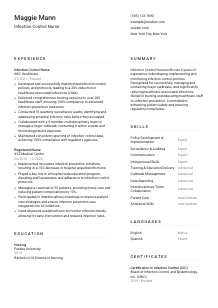
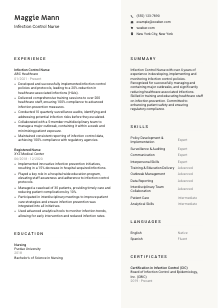
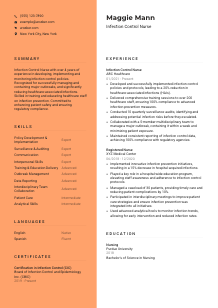
Deft in defending against germs, but your resume lacks immunity? Check out this Infection Control Nurse resume example, created with Wozber free resume builder. Learn how to present your pathogen-fighting expertise to match job criteria, creating a career record as healthy as the environments you safeguard!
Infection control nursing sits where clinical judgment, prevention strategy, and regulatory discipline meet. Hiring teams look for nurses who can reduce healthcare-associated infections, respond calmly during outbreaks, and turn guidelines into daily practice across units, staff groups, and patient settings. Your resume needs to make that operational impact visible fast, not bury it under broad bedside nursing language.
When the resume is tailored well, the first scan quickly shows whether you work confidently with surveillance, audits, staff education, and infection reporting. Wozber's free resume builder helps you shape that experience into an ATS-compliant resume that uses the right infection prevention terminology, so both the system and the reader can quickly see your ability to protect patients, support compliance, and manage risk.
For an Infection Control Nurse, the top of the resume should read like a clean clinical handoff. Keep it accurate, professional, and aligned with the role so there is no confusion about your credentials, contact information, or availability.
Your name should be the most visible text on the page, set apart from the rest of the header so it is easy to find in both digital review and printed copies. In a field where documentation accuracy matters, even small formatting choices can reinforce professionalism.
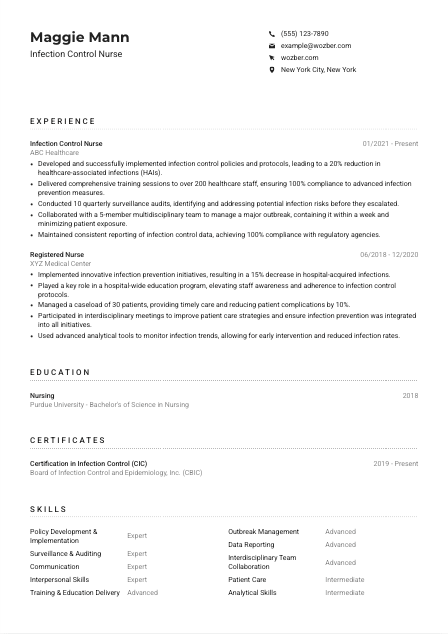
Place "Infection Control Nurse" directly under your name when that is the role you are applying for. Matching the posted title helps ATS screening and immediately frames your background around infection prevention, surveillance, outbreak response, and staff education rather than general nursing alone.
List a working phone number and a professional email address with zero errors. This section should be simple and dependable. Wozber's free resume builder helps keep the header structured and ATS-friendly, which matters when a hospital or healthcare system is processing a high volume of applications.
If the employer requires candidates to be based in a certain city or willing to relocate, include that clearly. In the example here, New York City is relevant because the job specifically asks for it. That kind of detail belongs in the header so it is resolved immediately rather than left as a question.
A LinkedIn profile or professional website can support your application if it is current and consistent with your resume. For this role, that means matching job titles, dates, certifications, and infection prevention experience. If the profile is outdated or thin, leave it off.
Your personal details should confirm that you are reachable, professionally presented, and aligned with any practical requirements the employer named upfront.




This section carries the most weight for an Infection Control Nurse. Hospitals and healthcare employers want to see how you handled surveillance, policy rollout, training, audits, outbreak management, and reporting, along with the results those actions produced.
Pull the main duties from the job description and map them to your own background. If the posting emphasizes infection control policies, staff training, audits, outbreak investigations, and regulatory reporting, your bullets should echo those areas with real examples from your units, facility, or health system. This is where tailoring moves from generic nursing experience to infection prevention expertise.
Lead with your most recent role and make the position titles easy to scan. If you moved from a broader RN role into infection prevention, that progression is worth showing clearly. The example resume does this well by placing Infection Control Nurse experience first, then showing earlier nursing work that still contributed to prevention outcomes and interdisciplinary care.
Hiring teams already know an Infection Control Nurse develops protocols and monitors compliance. What matters more is what changed because of your work. A bullet like "reduced HAIs by 20% after implementing updated infection control policies" is far more useful than "responsible for infection control protocols." The sample resume's HAI reduction, outbreak containment, and full compliance reporting are strong models for this approach.
Numbers make your scope easier to understand when they reflect real performance indicators for the field. Good examples include HAI reduction rates, audit cadence, percentage compliance, number of staff trained, response time during outbreaks, or reporting accuracy to regulatory bodies. Those measures show how your work affected patient safety, operational risk, and compliance.
Trim experiences that do not support your case for this role. General bedside nursing experience can stay if it shows patient safety, interdisciplinary coordination, education, or trend monitoring, but the emphasis should remain on infection prevention work. The goal is a focused record of surveillance, investigation, policy enforcement, and measurable improvement.
By the end of your experience section, a reader should be able to see the infection risks you managed, the systems you improved, and the outcomes you delivered.
Infection Control Nurses are usually hired from a solid clinical base, so your education should confirm that foundation quickly and clearly. Keep the section straightforward, then add detail only when it strengthens your relevance for infection prevention work.
If the posting asks for a Bachelor's degree in Nursing, make sure your degree is listed in plain language. A Bachelor of Science in Nursing should appear exactly as your credential, since that immediately confirms a core qualification for the role.
List degree, school, and graduation year in a consistent order. This section does not need extra design or long explanations. In healthcare hiring, clarity matters more than decoration, especially when reviewers are checking credentials quickly.
Spell out your nursing degree rather than shortening it too aggressively. The example resume's "Bachelor's of Science in Nursing" works because it mirrors the educational requirement directly and removes guesswork for both ATS screening and human review.
Most experienced candidates do not need to list classes, but it can help early-career applicants if they completed coursework in epidemiology, microbiology, public health, infectious disease management, or quality improvement. Include it only if it sharpens your infection prevention profile.
If you led a capstone, research project, or practicum tied to infection prevention, patient safety, or population health, that can strengthen this section. Keep it brief and relevant. Once you have several years of direct infection control experience, those details become optional rather than essential.
Your education section should confirm that you meet the nursing foundation for the job and, where relevant, show early academic focus on infection prevention or public health.
Certifications carry real weight in infection prevention hiring because they show specialized knowledge, current practice standards, and commitment to the field. This section should make those credentials easy to find and easy to verify.
If the employer highlights a credential such as CIC, place it prominently. For Infection Control Nurse roles, Certification in Infection Control is often a meaningful differentiator because it directly supports work in surveillance, outbreak response, and prevention program oversight.
List certifications that support infection prevention practice first, then include required licensure such as your RN license. Avoid filling this section with unrelated courses or general attendance certificates. Relevance matters more than volume here.
Certification names alone are not enough. Add the issuing body and the validity period so employers can quickly understand whether your credentials are current. The example resume does this well with both the CIC and the New York RN license.
Infection prevention standards shift with new guidance, pathogens, and reporting expectations. If you have newer training in outbreak management, sterilization, isolation precautions, or healthcare epidemiology, include it when it supports the role you are targeting.
A focused certification section tells employers that your infection control knowledge is formal, current, and backed by recognized credentials.
The skills section should read like a compact map of how you operate in infection prevention. Focus on capabilities tied to surveillance, policy enforcement, education, reporting, and cross-functional collaboration rather than broad nursing traits alone.
Read the posting closely and extract both technical and interpersonal requirements. For this role, that includes infection control guidelines, outbreak investigations, surveillance, audits, education, communication, and data reporting. Those are the terms that should shape your skills section if they reflect your actual experience.
Lead with the skills that matter most in this specialty, such as policy development, surveillance and auditing, outbreak management, training delivery, and multidisciplinary collaboration. The example resume gets this right by emphasizing infection-prevention capabilities before more general patient care skills.
Use short, specific skill labels instead of paragraphs or vague descriptors. Wozber helps structure this content in an ATS-friendly resume format, making it easier to present role-specific terms naturally. The result should be a skill list that a hiring manager can scan in seconds and immediately connect to infection prevention work.
Your skills section should quickly confirm that you can monitor infection risk, educate teams, support compliance, and work across departments when prevention issues escalate.
In infection control, communication affects compliance, education, and patient safety. Language skills matter most when they help you train staff clearly, explain precautions to patients, and work effectively in the population your facility serves.
If the role requires English fluency, list English clearly with the appropriate proficiency level. For an Infection Control Nurse, this supports policy communication, audit follow-up, education sessions, and regulatory reporting, all of which depend on precise language.
Extra languages can strengthen your application when they are useful in patient education or staff communication. In a diverse care environment, Spanish or another commonly spoken language may help with explaining isolation procedures, PPE use, or discharge precautions more effectively.
Use honest levels such as native, fluent, intermediate, or basic. Overstating language ability can create risk in clinical communication, especially when discussing infection prevention instructions that need to be understood without ambiguity.
Some Infection Control Nurse roles include staff in-service training, patient-facing education, or coordination across varied clinical units. In those settings, multilingual ability can support better adherence to prevention protocols and clearer communication during high-pressure situations.
If you know the facility serves a multilingual patient population, highlight languages that genuinely help in that setting. Keep the section practical. The point is not to look impressive, but to show communication range that supports safer care and clearer infection prevention guidance.
Language skills are most useful when they strengthen education, compliance, and patient understanding in real care settings.
Your summary should quickly establish your specialty, years of experience, and the kind of infection prevention results you are known for. Keep it brief, but make sure it reflects the actual scope of your work rather than generic nursing strengths.
Build the summary around the work that defines infection control nursing: reducing infection risk, leading prevention programs, supporting compliance, educating staff, and managing outbreaks. The job description gives you a clear guide for what to foreground, especially if the employer is emphasizing surveillance, audits, and reporting.
Start with a direct line such as "Infection Control Nurse with 4+ years of experience" or a similar phrasing that reflects your background accurately. That opening immediately tells the reader whether you bring the specialized experience the role requires.
Choose achievements that show concrete infection prevention value, such as reducing HAIs, containing an outbreak, improving compliance, or training large staff groups. The sample summary works because it points to outbreak management, policy implementation, and HAI reduction instead of relying on broad claims about being dedicated or hardworking.
Aim for a short paragraph that can be read in a few seconds. Avoid stuffing in every skill you have. A better summary gives a precise snapshot of your infection control scope and results, then lets the experience section carry the detail.
It should make your infection prevention background clear immediately and set up the rest of the resume as proof of that claim.
An effective Infection Control Nurse resume shows how you prevent spread, improve compliance, educate staff, and respond when infection risks escalate. Every section should support that picture, from the RN and CIC credentials to the surveillance metrics and outbreak examples in your experience.
Use Wozber's free resume builder to organize those details into an ATS-friendly resume template, then refine the language with its ATS resume scanner and AI resume builder features so your terminology, phrasing, and section content align closely with the role you want. The finished resume should make it easy to judge your ability to lead infection prevention work with confidence and precision.