




Use Wozber and land your dream job
Create Resume
No registration required
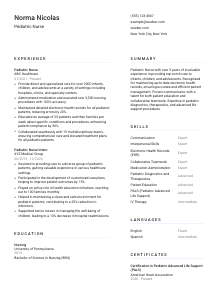
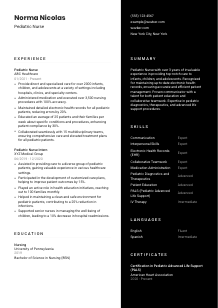
Caring for tiny patients, but your resume feels under the weather? Check out this Pediatric Nurse resume example, created with Wozber free resume builder. It shows how to blend your pediatric expertise with job requirements, making your career as healthy and blooming as the little ones you care for!
Pediatric nursing is reviewed through the lens of safe clinical judgment and calm family-facing care. Hiring teams want to see that you can handle medication administration, pediatric procedures, documentation, and education for parents or caregivers without losing precision in a fast-moving setting. Your resume should make that combination visible early.
A tailored pediatric nurse resume also changes how quickly your background makes sense in screening. When the language reflects the posting's clinical terms and credentials, Wozber's free resume builder helps you shape an ATS-compliant resume that clearly surfaces pediatric experience, licensure, and patient-care scope before your application gets filtered into a general RN pile.
This section does quiet but important work in healthcare hiring. It confirms who you are, how to reach you, and whether you meet straightforward requirements such as location and professional identity without making the reader search for them.
Lead with your full name, then use the exact role title when it matches your target opening. For a pediatric nurse application, placing "Pediatric Nurse" under your name immediately frames the rest of the resume around child-focused care, family communication, and pediatric clinical experience rather than general bedside nursing.
Use one reliable phone number and a professional email address that would look appropriate in a hospital, clinic, or specialty center setting. If you include a LinkedIn profile or professional website, make sure it supports your nursing credentials with consistent job titles, license information, recommendations, or pediatric care involvement.
Some pediatric nursing roles have clear location expectations tied to staffing needs, licensing, or on-site patient care. Here, New York City is explicitly requested, so listing "New York City, New York" helps remove an avoidable question at first review. Treat that as targeted tailoring for this opening, not a rule for every pediatric nurse resume.
A profile link earns its place when it strengthens your application with relevant content. For pediatric nurses, that may include endorsements from colleagues, pediatric care volunteer work, continuing education, or healthcare-focused publications. If the link is sparse or outdated, leave it off and keep the header clean.
Do not include age, marital status, gender, photo, or other personal data unless a local standard specifically requires it. Pediatric nurse hiring decisions center on licensure, clinical experience, documentation quality, communication with families, and ability to work within care teams.
Your personal details should remove friction, not add it. When the top of the resume quickly confirms your title, contact information, and any sample-specific requirement like location, the reader can move straight to your pediatric nursing qualifications.




For pediatric nurses, experience is where employers look for real clinical range. They want to see the age groups you have treated, the care settings you have worked in, the procedures you handled, and how well you supported families while coordinating with physicians and multidisciplinary teams.
Before rewriting bullets, mark the responsibilities and terms that define the opening. In this case, those include direct care for infants, children, and adolescents, medication administration, nursing procedures, EHR documentation, family education, and team-based care. Then bring the same ideas into your bullets using language that matches your actual work.
List your most recent nursing role first, followed by earlier positions. Include job title, employer, and dates for each entry so reviewers can quickly trace your pediatric progression. That structure also helps ATS systems parse your work history and separate staff-level pediatric experience from internships or training roles.
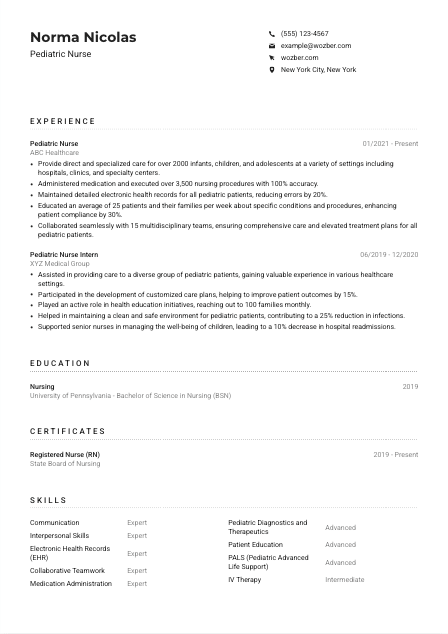
Avoid filling this section with broad duty statements. Show what you handled and what changed because of your work. Good pediatric nurse bullets often include patient volume, procedure count, documentation accuracy, education delivered to families, infection reduction, compliance improvement, or readmission impact. The sample resume does this well by pairing core care tasks with measurable results such as reduced charting errors and stronger patient compliance.
Numbers help translate pediatric nursing experience into hiring value. Useful metrics include number of patients served, procedures performed, families educated per week, multidisciplinary teams supported, or improvements in safety and outcomes. For example, "executed over 3,500 nursing procedures with 100% accuracy" tells a much clearer story than "responsible for procedures."
Choose experience that reinforces your ability to care for children and communicate with families in clinical environments. If you have broader RN experience, highlight the parts that overlap with pediatric medication administration, treatment-plan support, patient education, or specialty-center workflow. Every bullet should help the reader picture you functioning effectively in a pediatric unit, clinic, or similar setting.
The best experience sections let a hiring manager picture your clinical judgment, pace, and reliability. If your bullets show pediatric scope, accurate documentation, family education, and teamwork with pediatricians and other clinicians, the section is doing its job.
In nursing, education is not a background detail. It confirms that you completed the academic preparation behind clinical practice, licensure eligibility, and pediatric patient care standards.
When a posting calls for a Bachelor of Science in Nursing, make that degree easy to find. Write the full degree name, the institution, and graduation year. In this opening, a BSN from an accredited program is a stated requirement, so there is no advantage in making the reader decode abbreviations or hunt for it.
A straightforward education entry works best for healthcare roles. List school, degree, field if needed, and date. That gives recruiters and ATS software exactly what they need to confirm the academic requirement quickly, especially when they are sorting across many RN applicants.
If the job description uses specific degree wording, mirror it naturally. For example, "Bachelor of Science in Nursing (BSN)" directly reflects what the employer asked for and helps avoid mismatch in ATS screening. Accuracy matters more than decorative formatting here.
Most experienced pediatric nurses can keep this section brief. If you are early in your career, relevant pediatric rotations, child health coursework, honors, or clinical projects can add useful context. Keep those details tied to pediatric assessment, family-centered care, or child development rather than listing unrelated coursework.
Additional coursework, hospital training, or continuing education can help if it connects directly to pediatric care, emergency response, documentation systems, or family education. Use these additions selectively so the section stays focused on nursing preparation rather than becoming a full training log.
Your education section should confirm the required nursing degree quickly and cleanly. Once that foundation is clear, the reader can focus on the pediatric experience and credentials that make you competitive.
For pediatric nurses, certifications carry operational weight. They confirm legal ability to practice, emergency preparedness, and specialty readiness in child-focused care settings where timing and protocol matter.
Put the certifications that the role depends on first. In this posting, that means an active RN license and PALS. Listing both clearly tells the employer you meet the core clinical requirements or, if relevant, that you are on track to obtain the pediatric life support credential within the stated timeframe.
Do not crowd this section with every course completion or minor credential. Prioritize licenses and certifications that support pediatric bedside care, emergency response, medication safety, or specialty treatment environments. Relevance reads better than volume.
Include the issuing body and active date range or expiration information where appropriate. In nursing, current status matters. A clear entry such as an RN license issued by the state board and a current PALS certification prevents follow-up questions and supports compliance screening.
If you have additional pediatric-relevant training, add it when it strengthens your application. Good examples include pediatric emergency care, IV therapy, immunization administration, or specialty workshops linked to your target setting. Keep the emphasis on practical bedside value.
When this section is done well, the employer can immediately confirm licensure and pediatric emergency preparedness. That is exactly the kind of clarity healthcare hiring needs.
A pediatric nurse skills section should read like a realistic snapshot of how you work on the floor, in clinic, or in specialty care. Hiring teams look for a mix of clinical execution, documentation ability, and communication skills that hold up with children, caregivers, and multidisciplinary staff.
Use the job description to identify the skills the employer already values. Here, communication, interpersonal ability, EHR use, medication administration, and collaborative care all appear in the posting. If those match your background, include them in the wording the employer uses so the connection is obvious.
Pediatric roles require both clinical and relational skill. Include hard skills such as medication administration, IV therapy, pediatric diagnostics support, EHR charting, or PALS alongside communication, patient education, and teamwork. The sample resume handles this balance well by pairing procedure-based skills with patient and family support capabilities.
Keep the list focused on the work the employer needs done. For a pediatric nurse, that usually means care delivery, documentation, emergency response, care coordination, and family education before broader or less relevant skills. A shorter list with clear alignment is stronger than a long inventory of generic abilities.
Every skill you list should feel consistent with your experience and the unit's needs. If the section reflects pediatric care tasks, charting workflow, and communication with families and care teams, it will reinforce the rest of the resume.
Language ability matters in pediatric care because instructions, reassurance, and follow-up often involve both the patient and the family. Clear communication can affect consent, compliance, comfort, and the quality of health education at discharge or during treatment.
If the job posting specifies fluent English, list it clearly and do not bury it. That requirement matters in patient education, care coordination, charting, and communication with physicians and caregivers. Lead with English, then add any other languages you can use professionally.
Start with your strongest language and continue in descending order of proficiency. This keeps the section easy to read and gives immediate context for how you may support a diverse patient population. In a city-facing pediatric setting, an additional language can be a meaningful advantage when it helps with family communication.
Choose clear levels such as fluent, native, intermediate, or basic. In healthcare, overstating language ability can create patient-safety issues, especially during education, intake, and discharge discussions. Only claim the level you can use confidently in a clinical setting.
Extra languages become more valuable when they connect to the communities a hospital or clinic serves. That does not make them mandatory for every pediatric nurse role, but if you can speak with families in a commonly used language, mention it because it can improve trust and understanding.
Language skills are not just a resume extra. In pediatric care, they can help you explain procedures, answer caregiver questions, and reduce confusion around treatment plans. Present them as part of your patient-support toolkit, not as a side note.
A well-framed language section tells employers you can support clearer conversations with children and families. That matters in pediatric care where understanding often shapes outcomes.
The summary should quickly position you as a pediatric nurse who can deliver safe care, document accurately, and communicate well with families and care teams. In a few lines, it should connect your experience level, clinical strengths, and the kind of pediatric environment you are ready to support.
Start with your title and years of experience so the reader immediately understands your professional level. A line such as "Pediatric Nurse with 3+ years of experience" works because it is direct and easy to scan. If your background includes hospitals, clinics, or specialty centers, mention that scope when it is relevant to the target role.
Use the middle of the summary to name the capabilities that define your fit, such as medication administration, pediatric procedures, EHR documentation, patient education, or multidisciplinary collaboration. The example summary is strongest where it ties documentation quality and pediatric clinical knowledge to day-to-day nursing practice.
Aim for three to five lines with no filler. This is not the place for broad claims about passion or dedication unless they are attached to actual pediatric work. Short, specific phrases about your patient population, care setting, or clinical strengths will carry more weight.
Pediatric nursing is never purely technical, so include one line that reflects how you work with children and caregivers. That might be strong patient education, calm communication, or collaborative care planning with families and clinicians. Keep the wording grounded in practice rather than sentiment.
A good pediatric nurse summary gives the reader a fast, accurate picture of your clinical scope and care style. After those few lines, they should already understand the setting, strengths, and patient-facing work you bring.
A pediatric nurse resume works best when it shows more than compassion alone. It should clearly connect your licensure, pediatric experience, clinical procedures, EHR documentation, and family education work to the needs of the opening.
Wozber's free resume builder gives you a practical way to organize that experience in an ATS-friendly resume template, and its ATS resume scanner helps you align wording, credentials, and pediatric terminology with the job description. The final result should make it easy to judge whether you can step into pediatric care and contribute safely from day one.




