



Use Wozber and land your dream job
Create Resume
No registration required
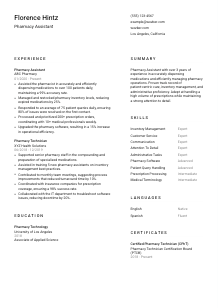
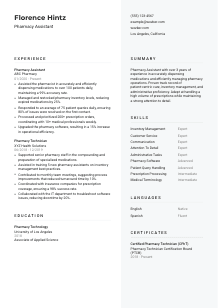
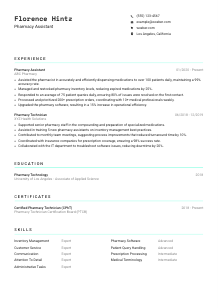
Dispensing medications, but your resume doesn't have the right prescription? Refresh your career profile with this Pharmacy Assistant resume example, created with Wozber free resume builder. It shows how to match your pharmaceutical know-how to job requirements, ensuring your career serves up success in perfectly measured doses!
Pharmacy Assistant work runs on accuracy under pressure. Hiring teams want to see that you can support medication dispensing, keep patient information secure, manage inventory without lapses, and stay calm when the counter is busy and prescriptions are piling up. Your resume should make that day-to-day reliability easy to recognize from the first section.
A tailored resume also helps separate pharmacy experience from general retail or admin backgrounds. With Wozber's free resume builder and ATS optimization tools, you can align your wording with the posting's pharmacy terms, software requirements, and patient-service duties so an ATS-compliant resume shows where you've handled prescription flow, insurance updates, and pharmacist support. That is the distinction the resume needs to surface quickly.
In pharmacy hiring, small details matter because the role itself depends on correct records, clear communication, and dependable follow-through. Your Personal Details section should reflect that same standard and cover the basics an employer needs to contact and place you.
Put your name at the top in a clean, readable format. Keep it simple and easy to scan, much like a patient label or prescription record. For a Pharmacy Assistant role, polished presentation supports the impression that you work carefully and accurately.
Place "Pharmacy Assistant" directly under your name if that is the role you are pursuing. Matching the job title helps recruiters and ATS systems connect your resume to the position right away, especially when employers are sorting between Pharmacy Assistants, Pharmacy Technicians, and broader customer service applicants.
Include a current phone number and a professional email address. Double-check both. If a pharmacy cannot reliably reach you for an interview, the rest of the resume stops mattering.
If the employer requests local candidates, list your city and state clearly. In the example posting, "Los Angeles, California" matters because the company states that candidates must be located there. Add location when it removes friction around availability or commuting, but do not overload this section with a full street address unless asked.
If you maintain LinkedIn or another professional profile, include it only if the information is current and supports your pharmacy background. Make sure your titles, dates, and certifications match your resume so there is no confusion around your experience level or training.
Do not include age, marital status, photo, or other personal details that do not help with pharmacy hiring. Save the space for information tied to the job, such as location, contact access, and professional identity.
This section should read like a well-kept patient record: accurate, current, and easy to use. When the basics are handled cleanly, the hiring team can move straight to your pharmacy experience and qualifications.




For a Pharmacy Assistant, experience is where employers look for proof that you can handle prescription volume, patient interaction, inventory work, and administrative accuracy in a real pharmacy setting. Focus less on generic duties and more on what you handled, how much, and how well you did it.
Start by identifying the operating tasks in the posting. Here, the employer calls for help with medication dispensing, inventory control, patient questions, prescription prioritization, coordination with medical professionals, and insurance processing. Those points should shape which bullets you keep and which ones you rewrite.
List your most recent role first, then work backward. For each position, include the title, employer, and employment dates so the reader can quickly understand your pharmacy progression and how recently you handled relevant systems and patient-facing work.
Choose accomplishments that map directly to pharmacy operations. Strong bullets often show dispensing support, shelf restocking, labeling, patient communication, data entry, insurance claim work, or coordination with pharmacists and prescribers. The sample resume does this well by showing daily medication support, patient query handling, and prescription order processing instead of vague statements about being helpful or hardworking.
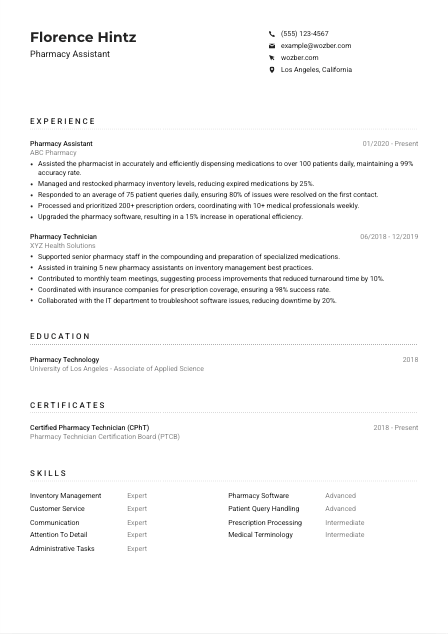
Numbers are especially useful in this field because they show how you perform under routine workload. Metrics such as patients served per day, prescription orders processed, first-contact resolution, claim success rate, inventory loss reduction, or workflow efficiency are all credible. For example, "assisted in dispensing medications to over 100 patients daily with 99% accuracy" tells a hiring manager far more than "helped fill prescriptions."
Keep older or unrelated work brief unless it adds something useful, such as customer service in a healthcare setting, records handling, or regulated inventory work. Every bullet should help the reader understand your pharmacy readiness, whether through technical tasks, patient interaction, or attention to confidential information.
Your experience section should make it clear that you can keep a pharmacy moving without losing accuracy. When the bullets reflect prescription workflow, patient service, inventory control, and measurable results, employers can picture you handling the job's daily demands.
Education for a Pharmacy Assistant is usually straightforward, but it still matters because it establishes your baseline training and, in some cases, shows added preparation in pharmacy technology or healthcare support. Keep the section simple and make any pharmacy-related coursework or credential stand out naturally.
Start with the minimum education the employer asks for. In the posted role, a high school diploma or equivalent is required. If you have additional study beyond that, include it as well, especially when it relates to pharmacy operations, healthcare administration, or medical terminology.
List your degree or diploma, field of study if applicable, school name, and graduation date or attendance date. The format should be easy to scan so the hiring team can quickly confirm your academic background without searching through extra detail.
If you completed an Associate of Applied Science in Pharmacy Technology or a similar program, place it prominently because it reinforces your familiarity with dispensing procedures, terminology, and pharmacy workflow. The example resume uses this well by listing a pharmacy-specific associate degree rather than leaving education too generic.
Relevant coursework can help if you are early in your career or your work history is still growing. Subjects like pharmacology basics, pharmacy law, medication preparation, insurance billing, or medical terminology can add context, but only include them if they support the target job directly.
Honors, projects, student activities, or training programs belong here only when they connect to healthcare service, accuracy, regulated processes, or pharmacy operations. If you already have solid work experience, keep these extras brief so the focus stays on practical performance.
This section does not need to be long. It needs to confirm that you meet the employer's baseline requirements and, where applicable, show pharmacy-specific training that supports faster onboarding.
Certifications can add weight to a Pharmacy Assistant resume because they show formal training, current knowledge, and commitment to regulated healthcare work. Even when a posting does not require one, the right credential can help distinguish you from candidates with only general retail or clerical experience.
Lead with credentials that connect directly to dispensing support, medication handling, or pharmacy operations. A posting may not always require certification, but a relevant credential such as CPhT can still support your credibility, especially if your past title or duties overlap with technician-level responsibilities.
Do not crowd this section with every short course you have taken. Choose certifications that matter for pharmacy work, patient safety, compliance, medication processes, or healthcare administration. A shorter, more relevant list is stronger than a long list with weak connection to the role.
If a certification is current, renewed, or tied to continuing education, include the date range or status. This helps employers understand whether your qualification is active. The example "CPhT, 2018 - Present" is useful because it signals ongoing standing rather than an outdated credential.
Pharmacy systems, insurance processes, and medication handling requirements evolve. Adding updated certifications or structured training can strengthen your resume over time, particularly if you are aiming for positions with higher prescription volume, specialized medications, or more complex patient support tasks.
In pharmacy settings, formal credentials support confidence in your training and discipline. When this section is current and relevant, it adds another clear reason to take your application seriously.
A Pharmacy Assistant skills section should read like a practical inventory of what you can handle on the job. Focus on skills that affect dispensing accuracy, patient communication, pharmacy systems, inventory control, and administrative reliability.
Start with the skills the employer explicitly asks for. In this case, attention to detail, pharmacy software proficiency, confidentiality, customer service, and professional English communication all deserve space because they map directly to prescription handling, patient records, and front-counter interaction.
List skills in a way that reflects how the work is actually done. Technical and workflow skills might include pharmacy software, prescription processing, inventory management, insurance claims, and medication labeling. Support skills can include customer service, communication, and handling sensitive information. The sample resume works because its list reflects daily pharmacy tasks rather than generic soft skills alone.
Avoid filling the section with broad claims that do not help the employer picture you in the role. Choose skills tied to pharmacy execution, such as inventory management, patient query handling, medical terminology, and administrative tasks. If you use ratings, keep them realistic and consistent with your experience bullets.
A hiring manager should be able to scan this section and immediately connect it to pharmacy workflow. When the list matches the posting and reflects real tasks you have handled, it strengthens both ATS alignment and human review.
Language ability matters in pharmacy because instructions, questions, and insurance details all need to be handled clearly. If the role involves direct patient contact, your language section can support your case as someone who communicates accurately and professionally.
Check whether the employer names a required language. Here, professional English communication is mandatory, so English should appear clearly in your language section if it is one of your working languages.
Lead with the language the job requires, especially when the role includes patient questions, phone communication, and coordination with pharmacists or medical offices. That ordering helps the employer confirm an essential qualification quickly.
Extra languages can be a real advantage in community pharmacy settings, where patient populations are often diverse. They are especially valuable when they help with front-desk communication, prescription pickup questions, or basic medication-related conversations, as long as you present them honestly.
Describe your proficiency with standard labels such as "Native," "Fluent," "Intermediate," or "Basic." This gives employers a practical sense of how independently you can communicate with patients, staff, and external providers.
In some markets, language ability can improve patient experience and reduce misunderstandings at pickup, over the phone, or during insurance clarification. The example resume includes Spanish, which can be particularly helpful in many Los Angeles pharmacies, though that is an advantage rather than a universal requirement.
This section works best when it helps the employer picture how you will interact with patients and colleagues in real situations. Clear, honest language levels can add meaningful value to a pharmacy application.
Your summary should quickly explain what kind of Pharmacy Assistant you are, how much relevant experience you bring, and which parts of pharmacy workflow you handle well. Keep it short, but make every line speak to daily performance in a pharmacy environment.
Before writing, identify the responsibilities the employer is likely to care about most. For this job, that includes dispensing support, inventory management, patient communication, prescription processing, and administrative accuracy. Those themes should shape the summary instead of generic statements about being motivated or reliable.
Start with your current or recent pharmacy identity, years of experience, and strongest area of value. A line such as "Pharmacy Assistant with 3+ years of experience supporting high-volume prescription operations" immediately tells the reader what environment you know and what kind of work you can step into.
Mention strengths that are native to pharmacy work, such as dispensing accuracy, patient service, insurance coordination, inventory control, or pharmacy software use. The sample summary is effective because it combines core duties with a clear performance profile: medication dispensing, pharmacy operations, patient-focused care, and attention to detail.
Aim for a short paragraph, usually three to five lines. Every phrase should earn its place by pointing to relevant workflow, scale, or outcomes. A concise summary with pharmacy-specific language gives the hiring team a clear frame for reading the rest of your resume.
A well-written summary should tell the employer, within seconds, whether you can support the pace, accuracy, and patient contact the role requires. Once that is clear, the rest of the resume can back it up with detail.
You now have a clear framework for shaping a Pharmacy Assistant resume around the work that matters most: accurate dispensing support, steady patient communication, inventory control, administrative follow-through, and comfort with pharmacy software. Using Wozber's free resume builder helps you organize those details into an ATS-friendly resume format that stays easy to scan.
From here, refine each section against the target posting, then run it through an ATS resume scanner to catch missing terminology, strengthen alignment, and improve section-level match. The finished resume should make one thing easy to judge: that you can step into the pharmacy workflow and contribute with accuracy from day one.




