



Use Wozber and land your dream job
Create Resume
No registration required
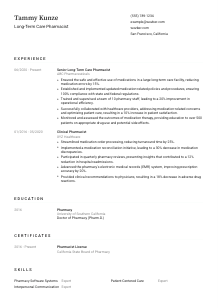
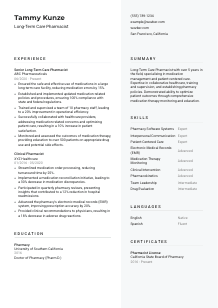
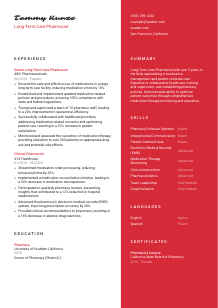
Dispensing medications for others, but feeling a prescription gap in your resume? Browse this Long-Term Care Pharmacist resume example, created with Wozber free resume builder. It shows how to align your clinical expertise with job requirements, scripting a career trajectory as fluid as your formulated remedies.

Long-term care pharmacy work sits where medication safety, chronic disease management, and regulatory compliance meet. Hiring teams want to see whether you can review medication orders with clinical judgment, catch therapy risks in older adult populations, and work smoothly with nurses, prescribers, caregivers, and pharmacy staff. Your resume should make that operational range visible early, not bury it under generic pharmacist language.
A tailored resume changes what stands out first: your relevance to long-term care workflows, including medication review, EMR use, policy compliance, and patient education. Wozber's free resume builder helps you shape that experience into an ATS-compliant resume with language that matches the posting naturally, so the hiring team can quickly see whether you are prepared for the medication oversight and interdisciplinary collaboration the role requires.
Long-term care hiring moves quickly past surface details and into license status, role alignment, and practical availability. Your header should confirm who you are, what role you do, and whether you meet straightforward requirements such as location without adding anything irrelevant.
Place your full name at the top, then use the exact target title beneath it when it reflects your background, such as "Long-Term Care Pharmacist." That immediately frames your experience around medication regimen review, geriatric care, and facility-based pharmacy operations instead of broader retail or general clinical pharmacy work.
List a professional email address and a phone number you answer consistently. In pharmacy, small errors raise concerns about larger ones, so check every character. If a hiring manager wants to discuss your license, availability, or experience with pharmacy systems, they should be able to reach you without friction.
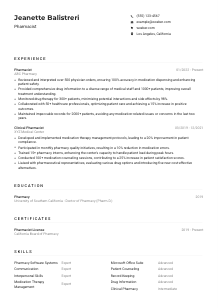
If the employer asks for local availability or relocation, show that clearly in your personal details. In the example, listing San Francisco, California immediately removes doubt about a stated requirement. Use this only when location is relevant to the posting, not as filler in every application.
A LinkedIn profile or professional website can help if it reinforces your pharmacy background, leadership work, or continuing education. Keep titles, dates, and major achievements aligned with the resume. If your online profile is sparse or outdated, leave it off until it reflects the same clinical and operational scope.
Do not include age, marital status, photo, or other personal details unrelated to pharmacy practice. For this role, the important basics are your name, contact information, professional title, and any practical requirement the employer flagged, such as location.
This section should confirm the essentials in seconds: you are a pharmacist, you are targeting long-term care work, and you are reachable for the next step. Keep it lean, accurate, and aligned with the posting.




In long-term care pharmacy, experience is judged by the quality of your medication oversight and the outcomes that followed. Employers look for proof that you can review orders accurately, reduce discrepancies, support care teams, manage compliance expectations, and improve medication use for residents over time.
Read the posting closely and identify the work that defines success in the role. Here, that includes reviewing medication orders and patient profiles, collaborating with other healthcare providers, monitoring therapy outcomes, educating patients and caregivers, maintaining compliant procedures, and supervising staff. Those themes should guide which bullets you keep and how you phrase them.
Start with your most recent pharmacy role and work backward. This helps hiring teams quickly see whether your current practice includes long-term care responsibilities, geriatric medication management, clinical recommendations, or staff oversight. If your latest role is not in long-term care, make the transferable parts easy to spot, such as medication reconciliation, EMR-based review, or interdisciplinary consultation.
Generic duties do not tell enough. Focus each bullet on a pharmacy action and a measurable result. The example does this well with achievements such as reducing medication errors by 15%, improving patient satisfaction by 10%, and lowering medication discrepancies by 30%. Those numbers work because they are tied to core long-term care priorities: safety, coordination, and resident outcomes.
Use metrics that fit pharmacy work naturally. Good examples include medication error reduction, turnaround time, adverse drug reaction decreases, readmission impact, number of patients educated, staff supervised, or compliance rates. In the sample resume, "100% compliance with state and federal regulations" and "trained and supervised a team of 10 pharmacy staff" tell a hiring manager far more than a general claim about leadership.
Choose bullets that match the target position before adding broader accomplishments. For a long-term care opening, medication therapy monitoring, order verification, EMR accuracy, geriatric patient education, consultant-style recommendations, and policy development deserve more space than unrelated dispensing volume or retail customer service. Your experience section should read like someone ready to work inside a facility-based medication management environment.
Your best experience bullets should make a hiring manager picture you catching medication risks, improving therapy outcomes, and supporting compliant pharmacy operations. If that picture is clear, the section is doing its job.
For pharmacists, education is not a decorative section. It confirms that you hold the professional training required to practice and gives employers quick confirmation that you meet a non-negotiable credential before they review the rest of your clinical background.
When the posting requires a Doctor of Pharmacy, list your Pharm.D. clearly and exactly. Include the degree name, school, field, and graduation year. In this case, the example resume handles that cleanly with a Doctor of Pharmacy from the University of Southern California, which immediately satisfies a core requirement.
Use a straightforward structure: degree, field, institution, date. That is usually enough for an experienced pharmacist. Clean formatting matters because education is often checked quickly before attention shifts to your license, long-term care background, and practice outcomes.
If your degree directly supports the role, do not bury it beneath unrelated academic details. A long-term care pharmacist resume should make the Pharm.D. easy to find because it anchors your authority to review medication regimens, assess drug interactions, and contribute to resident care planning.
Most experienced pharmacists do not need to list coursework, but it can help early-career candidates or career changers. If you include it, choose subjects with direct value to the role, such as geriatric pharmacotherapy, pharmacokinetics, medication safety, or pharmacy law. Skip broad course lists that do not sharpen your positioning.
If you are newer to practice, academic honors, research, clinical rotations, or professional memberships can strengthen this section. Prioritize anything that points toward geriatrics, chronic care, medication management, or collaborative clinical training. Once you have substantial experience, these extras should stay secondary to your work history.
For this role, the education section should answer one question immediately: do you have the pharmacy training required to practice? Make that answer obvious, then let your experience section carry the deeper story.
In pharmacy hiring, licensure is a practice requirement, not a bonus line. This section should make your authorization to practice easy to confirm and give room for any additional credentials that strengthen your long-term care or geriatric profile.
If the job requires an active pharmacist license in the state of practice, list it first and spell it out clearly. In the example, the California State Board of Pharmacy license directly addresses the posting's requirement. For other applications, tailor this to the relevant state and keep the wording exact.
After your license, include certifications or training that support the actual work of the role. Useful examples may include geriatric pharmacy, medication therapy management, immunization, consultant pharmacy training, or systems-related credentials if they reflect real practice. Do not add certificates simply to fill space.
A license or certification without dates creates unnecessary questions. Show the issue date and, when relevant, the active period or expiration. The sample's "2016 - Present" format works because it tells the employer the credential is current and maintained.
Long-term care pharmacy changes with regulations, formulary decisions, quality standards, and medication safety expectations. If you complete continuing education in geriatrics, psychotropic stewardship, anticoagulation management, or pharmacy law, include the most relevant items. They show that your knowledge stays current in the areas that affect resident care and compliance.
A hiring manager should not have to search for your license status. Put current licensure first, support it with relevant credentials, and use this section to reinforce that you can step into regulated long-term care practice with confidence.
The best skills sections for pharmacists do more than list generic strengths. They point to the systems, clinical capabilities, and communication demands that shape daily work in long-term care, where medication review, documentation, and coordination with care teams all matter.
Start with the requirements and responsibilities in the job ad. Here, that includes pharmacy software systems, electronic medical records, interpersonal communication, patient-centered care, medication review, therapy monitoring, and staff supervision. Using the employer's language helps your resume stay aligned with both ATS screening and human review.
Long-term care pharmacists need both system fluency and clinical judgment. Combine hard skills such as EMR use, pharmacy software, medication therapy monitoring, drug evaluation, and clinical intervention with people-facing strengths such as patient counseling, provider communication, and caregiver education. The example skills list does this well by pairing EMR and pharmacokinetics with interpersonal communication and patient-centered care.
Do not overload the section with every pharmacy skill you have ever used. Feature the ones that support long-term care workflows first, especially tools and capabilities tied to order review, resident medication profiles, regulatory compliance, and interdisciplinary care. A short, well-chosen list tells a clearer story than a long inventory of marginal skills.
Your skills section should read like the toolkit of someone who can manage medication safety, document accurately, and communicate clearly across a long-term care team. Relevance matters more than volume here.
Communication in long-term care pharmacy often involves more than brief prescription counseling. You may need to explain medication use to residents, speak with caregivers about side effects, and coordinate with nurses and prescribers, so language proficiency matters when it affects safe understanding.
If the posting specifies English communication, list English first and state your level clearly. That directly addresses a stated requirement and reassures the employer that you can handle medication discussions, documentation, and interdisciplinary communication without ambiguity.
Order your languages by importance to the role. For this posting, English belongs first because the employer explicitly requires clear English communication. Use labels such as Native, Fluent, Advanced, or Conversational, and keep them consistent.
Additional languages can strengthen your profile when they help with resident or caregiver communication. In the example, Spanish is a useful extra because it may expand patient education reach in a diverse care setting. Treat additional languages as an asset, not a substitute for the required one.
Only claim the proficiency you can use confidently in real pharmacy conversations. If you may need to explain dosing, side effects, drug interactions, or adherence concerns, accuracy matters. Overstating fluency can become a patient safety issue, not just a resume issue.
In facilities serving varied resident populations, extra language ability can improve education, trust, and follow-through on medication instructions. Include it when it reflects real communication capacity, especially if patient counseling or caregiver interaction is a visible part of your work.
Language skills matter most when they support clear medication guidance and smooth coordination with the care team. Keep the section honest, relevant, and tied to how you actually communicate in practice.
The summary is where you frame your background before the reader reaches the detail. For a long-term care pharmacist, that means quickly establishing your experience level, your clinical focus, and the kinds of outcomes you have influenced in medication safety, care collaboration, or regulatory practice.
Review the posting and pull out the themes that define the job. For this one, medication safety, patient-centered care, collaboration with healthcare providers, therapy monitoring, and policy compliance should shape your summary. Those are the points worth leading with, not broad claims about being hardworking or passionate.
Begin with a direct line that states who you are and how long you have worked in the field. The example summary does this effectively by identifying the candidate as a Long-Term Care Pharmacist with over 5 years of experience. That kind of opening gives immediate context for everything that follows.
Use the next lines to name the capabilities that matter most for the target role. Good options include medication management in long-term care facilities, EMR-based review, staff supervision, policy development, patient education, or proven improvements in medication accuracy and outcomes. Pull these from your actual record rather than writing a generic profile.
Aim for three to five lines with clear pharmacy language. A concise summary is easier to absorb and works better in ATS-friendly resume formats because the key terms are easy to find. If every sentence points to long-term care practice, clinical judgment, or measurable contribution, the section is strong enough.
Your summary should quickly tell the reader that you understand long-term care pharmacy and have delivered results within it. When this section is tailored well, the rest of the resume reads with the right context from the start.
A long-term care pharmacist resume works best when every section supports the same hiring picture: you can manage medication use safely, communicate well with care teams and caregivers, and operate within the regulatory realities of facility pharmacy practice. That means leading with your Pharm.D. and active license, building experience bullets around outcomes such as error reduction or therapy improvement, and keeping skills aligned with EMR use, pharmacy systems, patient education, and clinical collaboration.
Use Wozber to turn that experience into an ATS-friendly resume format that matches the posting with accurate terminology, focused structure, and practical ATS optimization. When your resume is tailored this way, a hiring team can quickly judge whether you are ready to step into long-term care pharmacy and improve medication outcomes from day one.




