



Use Wozber and land your dream job
Create Resume
No registration required
Dispensing prescriptions, but your resume feels like the wrong dosage? Refill your confidence with this CVS Pharmacist resume example, created with Wozber free resume builder. Learn how to match your clinical expertise to the job requirements, keeping your career profile as impactful as the medications you provide!
Pharmacy hiring moves quickly past generic retail experience. For a CVS Pharmacist role, the resume needs to show safe dispensing, sharp prescription verification, clear patient counseling, and steady control of compliance and workflow in a high-volume setting. If those strengths are buried under vague duties, hiring teams cannot tell whether you can handle the pace and clinical responsibility of the bench.
A tailored resume also helps separate pharmacists who simply held the title from those who actively improved outcomes, supported medication therapy management, and kept operations audit-ready. Wozber's free resume builder helps you shape that experience into an ATS-compliant resume that uses the right pharmacy language, so your application surfaces the details that matter first: licensure, patient care scope, and day-to-day judgment.
This section should confirm, within seconds, that you are reachable, professionally presented, and available for the position's basic requirements. For a pharmacist opening, that means clean contact information, the right job title, and any location detail the employer has made relevant.
Place your full name at the top in the version used on your license, applications, and work records. Consistency matters in regulated fields like pharmacy, where employers may compare your resume against licensure and onboarding documents.
Add "CVS Pharmacist" beneath your name if that is the job you are pursuing. Matching the posted title helps frame your background correctly, especially if your recent role used a variation such as Staff Pharmacist, Lead Pharmacist, or Pharmacist Associate.
List a current phone number and a professional email address you check regularly. Pharmacy hiring often moves through recruiter outreach, license verification, and interview scheduling, so small errors here can delay the process more than candidates expect.
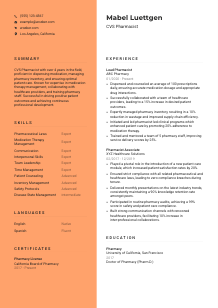
If the posting specifies a city or state requirement, include it clearly. In this example, listing Los Angeles, California directly supports the employer's stated location need and removes early questions about relocation or local availability.
A LinkedIn profile can help if it reflects the same employers, dates, and pharmacy credentials shown on your resume. Skip any link that does not add professional value. For pharmacists, accuracy and consistency matter more than having extra profile links.
Your header should answer the practical basics without distraction: who you are, what role you are targeting, how to reach you, and whether any location requirement is already covered.




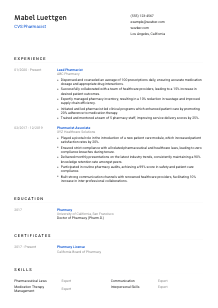
Hiring teams look here for proof that you can manage the clinical, operational, and interpersonal demands of the pharmacy. Strong pharmacist experience bullets show what you verified, improved, led, or prevented, not just that you worked a shift and filled prescriptions.
Start by marking the responsibilities that define the role. For this CVS opening, the core themes are prescription verification, medication counseling, medication therapy management, disease state support, inventory control, audits, compliance, and staff supervision. Those should directly shape the language of your bullets.
Use reverse chronological order so the employer sees your current practice level first. In pharmacy, recent experience carries weight because workflows, safety standards, immunization practices, and patient care programs evolve over time.
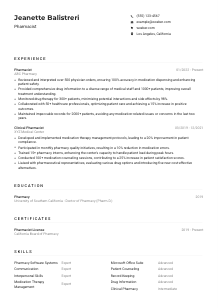
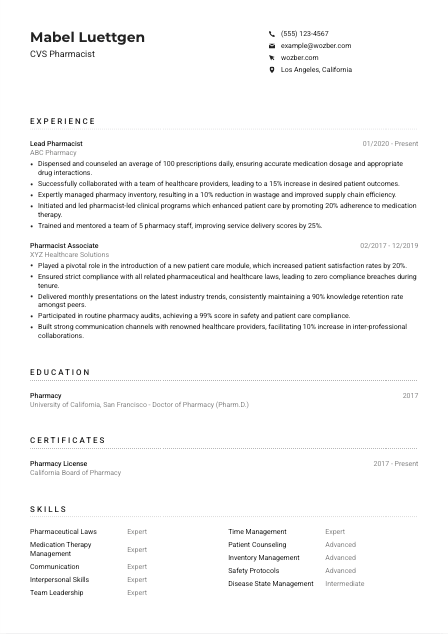
Focus each accomplishment on decisions and outcomes that belong to a pharmacist. Good bullets mention checking drug interactions, resolving therapeutic duplications, collaborating with prescribers, improving adherence, or mentoring technicians and support staff. The sample resume does this well by moving beyond general retail duties into clinical programs, provider collaboration, and team training.
Metrics make your scope easier to understand. Use prescription volume, adherence improvement, compliance scores, patient satisfaction, reduced waste, turnaround improvements, or team results when they are accurate. For example, "counseled an average of 100 prescriptions daily" and "achieved a 99% audit score" tell a hiring manager far more than "responsible for patient care."
Keep the experience section centered on work that matches community or retail pharmacy practice. If an older bullet does not support dispensing accuracy, patient counseling, legal compliance, inventory management, or provider collaboration, trim it or rewrite it so it does. Every line should reinforce your readiness to step into a CVS workflow.
By the end of this section, a hiring manager should be able to picture your pharmacy floor impact: prescription volume handled, patient care contributions, compliance record, and how you support both providers and staff.
For pharmacists, education is a licensing and practice requirement, not a background detail. Present it clearly so the employer can immediately confirm that you meet the degree standard for the role.
List your Doctor of Pharmacy, exactly as awarded, because it is a stated requirement. Do not bury it under unrelated coursework or extra formatting. The employer should be able to confirm this credential at a glance.
Include the school name, degree, field, and graduation year in a simple format. A straightforward education entry works best in pharmacy resumes because the credential itself carries the value.
If the posting calls for a "Doctor of Pharmacy (Pharm.D.) degree from an accredited school of pharmacy," use the same degree wording on your resume when accurate. That helps both human reviewers and ATS screening connect your education to the requirement without extra interpretation.
Recent graduates can include advanced practice rotations, clinical concentrations, research, or honors if those details support retail pharmacy, medication counseling, or patient care. Once you have solid professional experience, keep this section tighter.
Student pharmacy associations, public health outreach, medication safety projects, or research can support your profile if they connect to patient education, disease state management, or pharmacy operations. Use them selectively rather than turning education into a second experience section.
This section should make one point easy to confirm: you hold the pharmacy degree required to practice and to qualify for the role.
In pharmacy, certifications are not decorative. They confirm that you are legally able to practice and, in some cases, that you have kept pace with patient care standards and professional development.
Your pharmacy license belongs at the top of this section because it is essential for eligibility. For this opening, an active license in the state of practice is a direct screening requirement, so make sure the state and current status are easy to identify.
List certifications and credentials that strengthen your work as a pharmacist, such as immunization authority, MTM-related training, or other patient care and compliance credentials relevant to your setting. Leave out items that do not add to your ability to dispense, counsel, supervise, or maintain regulatory standards.
Include issue dates and, when relevant, expiration or current status. A license listed as "2017 - Present," as in the example, immediately tells the employer the credential is active and maintained.
Pharmacy practice changes through updated treatment guidelines, regulations, and clinical service expectations. If you have recent training that supports disease state management, patient counseling, or pharmacy operations, this is the place to show that you have stayed current.
A recruiter should be able to scan this section and confirm that your license is active and that your credentials support the level of patient care and compliance the role requires.
A pharmacist skills section works best when it reflects how the job is actually performed. That means combining clinical knowledge, patient communication, and operational control rather than listing broad traits with no pharmacy context.
Use the job description as a starting point, then add the pharmacy capabilities that sit behind those responsibilities. For this role, that includes pharmaceutical law, medication therapy management, patient counseling, prescription verification, drug interaction review, inventory management, and staff leadership.
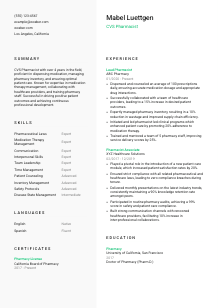
Place the skills most central to the opening near the top. If the employer emphasizes laws and regulations, patient engagement, and provider collaboration, those should appear before more general strengths like time management. The sample resume handles this well by leading with pharmaceutical laws and medication therapy management.
Use a clean, organized format with concise skill names. Hiring teams should be able to find core pharmacy competencies quickly, especially when comparing multiple candidates with similar degrees and licenses.
Your skills section should read like the profile of someone who can verify prescriptions, counsel patients, manage compliance, and keep the pharmacy operating smoothly.
Language ability can materially affect pharmacy care. Clear communication improves counseling, medication adherence, provider coordination, and the patient experience at pickup, especially in diverse communities.
If the job calls for strong English communication, list English prominently with an accurate proficiency level. For a pharmacist, this is not a formality. It affects counseling quality, documentation, provider calls, and patient safety.
Any additional language can strengthen your value if it helps you explain directions, answer patient concerns, or support a broader community. In markets with diverse patient populations, bilingual pharmacists can improve trust and reduce communication gaps.
Use honest labels such as "Native," "Fluent," or another level you can support in real pharmacy interactions. Employers may test this indirectly during interviews, especially if language ability affects patient communication.
When another language is relevant, it helps to think in practical terms. Can you explain dosage schedules, discuss side effects, or answer refill questions comfortably? That is the kind of usefulness that matters more than simply listing a language.
If a language is widely spoken in the area you are targeting, highlighting it can strengthen your application. The example's Spanish proficiency is a good illustration for a Los Angeles-based opening, but the broader rule is to emphasize languages that support the patient population you expect to serve.
This section should make clear whether you can communicate confidently with the patient base and clinical contacts the pharmacy serves.
The summary should quickly establish your level of practice, your strongest areas of contribution, and the kind of pharmacy environment you know how to handle. Keep it specific enough to feel real, but compact enough to read in one pass.
Start with your title and years of experience, then anchor that introduction in pharmacy work that matters to the role. A line such as "Pharmacist with 4+ years in retail and patient-facing care" tells the reader far more than a generic statement about being dedicated or hardworking.
Choose strengths that match the opening, such as dispensing accuracy, medication therapy management, patient counseling, regulatory compliance, or team leadership. The example summary works because it connects years of experience with concrete areas like inventory management and patient care rather than broad personality claims.
A short summary becomes much stronger when it hints at results. Improved adherence, better patient outcomes, audit performance, workflow leadership, or staff development can all work if they are supported elsewhere in the resume.
Close by reinforcing the kind of contribution you can make in a CVS setting: safe dispensing, effective patient counseling, collaboration with healthcare providers, and reliable pharmacy operations. Keep it grounded in what you have already done, not in aspirational language.
After reading the summary, the employer should already understand your experience level, your core pharmacy strengths, and the kind of patient care and operational results you bring to the role.
A CVS Pharmacist resume works best when it makes the essentials easy to confirm: Pharm.D. education, active licensure, safe dispensing experience, patient counseling, compliance discipline, and measurable impact in a pharmacy setting.
Use Wozber to turn that experience into a well-structured, ATS-friendly resume format, strengthen role-specific wording with its AI resume builder, and check alignment with an ATS resume scanner before you apply. The finished resume should make one thing clear right away: you are prepared to handle the clinical and operational demands of the pharmacy from day one.




